Postiz n8n Docker Self-Hosting Guide — 7 Steps From OOM Crashes to a Stable $10/Month SNS Automation Stack
March 29, 2026
Intel Core Ultra 9 290HX Plus vs AMD Ryzen 9 8940HX: The Definitive 2026 Gaming Laptop CPU Showdown
March 31, 2026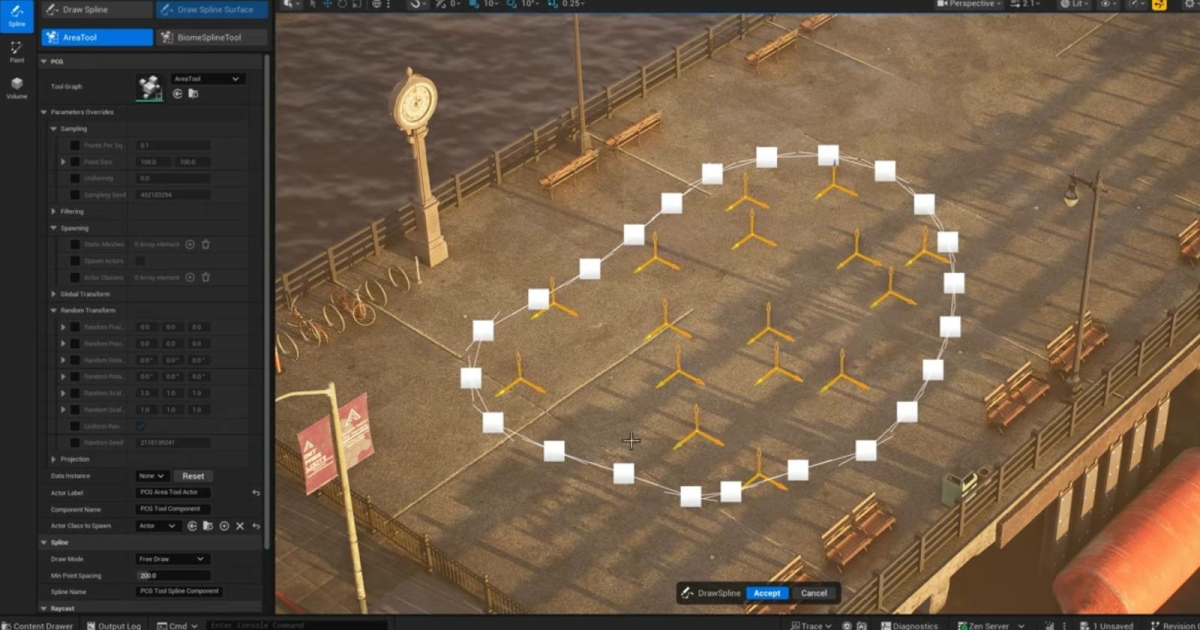
One artist. Zero lines of code. A 4km x 4km procedural jungle. That is what Epic Games demonstrated with their Electric Dreams project, and the Unreal Engine PCG framework GDC 2026 session made it clear this is no longer experimental technology. UE5.7’s PCG framework has officially graduated to production-ready status, and the implications for level design and world building are enormous.
[IMAGE:1]
UE5.7 PCG Framework: What Production-Ready Actually Means
Let us be specific about what changed. The PCG (Procedural Content Generation) framework in Unreal Engine 5.7 is not just an incremental update with a new label. Epic Games delivered a 2x performance improvement over UE5.5, an optimized GPU Compute path, and an entirely new PCG Editor Mode that fundamentally changes how artists interact with procedural systems.
In previous versions, PCG carried an implicit warning: powerful but experimental. API changes could break existing graphs between minor engine versions. Performance bottlenecks made large-scale deployment risky. And the tooling required significant technical knowledge to use effectively. With the production-ready designation in UE5.7, Epic is making a public commitment to API stability, performance guarantees, and artist-friendly workflows.
The 2x performance gain alone is a game-changer for production pipelines. PCG graphs that previously caused editor hitches during generation now run smoothly even at scale. The GPU Compute path offloads heavy operations like point distribution and density calculations to the graphics card, freeing the CPU for other tasks. For open-world games with millions of placed instances, this is the difference between a workflow that works in theory and one that actually ships.
GDC 2026 Session: PCG Biome Core and Large-Scale Procedural Systems
The centerpiece of Epic’s GDC 2026 presence was the session “Developing Large Procedural Systems with Low Friction and Fast Generation”, presented by Adrien Logut (Senior Tools Programmer) and Chris Murphy (Principal Technical Artist). This was not a marketing presentation — it was a deep technical dive into how Epic builds and manages procedural content at production scale.
The session introduced PCG Biome Core, a system for managing procedural content across distinct ecosystem zones in large open worlds. Each biome — forest, desert, wetland, tundra — is defined by its own PCG graph, with sophisticated blending and transition rules where biomes meet. This modular approach solves one of the biggest practical challenges of procedural world generation: how do you maintain visual coherence across an entire world while keeping the system manageable?
- Runtime vs. Static Serialization — Teams can choose whether PCG data is generated at runtime (saving disk space and enabling dynamic worlds) or pre-serialized to disk (faster load times, deterministic results). The GDC session detailed when to use each approach and how to mix them within a single project.
- Source Control Contention — One of the most practical insights from the session addressed a pain point every large team faces: multiple artists working on the same world simultaneously. By structuring PCG data at the biome level, teams can avoid merge conflicts and enable parallel workflows without stepping on each other’s work.
- Performance Optimization Strategies — Logut and Murphy shared concrete techniques including GPU-accelerated instancing, distance-based LOD integration, and smart regeneration caching that prevents unnecessary PCG recalculation when only portions of the world change.
Unreal Engine PCG Framework Editor Mode: Zero-Code Procedural Tools for Artists
The most exciting addition in UE5.7 is arguably the PCG Editor Mode. Previously, working with PCG graphs meant navigating a node editor, connecting data flows, and tweaking parameters through abstract interfaces. The new Editor Mode brings procedural content creation directly into the viewport with three primary tools that change the entire interaction model.
- Spline Drawing — Draw splines directly in the viewport to define paths for rivers, roads, fences, power lines, or any linear feature. The drawn splines automatically feed into PCG graphs as input data, triggering procedural generation along the path in real time.
- Point Painting — Use a brush to paint points onto terrain surfaces. Each point becomes a generation seed, placing objects according to PCG graph rules. Want to scatter boulders across a hillside or plant a grove of trees? Paint them in with a brush, and the PCG system handles distribution, rotation, scale variation, and collision avoidance automatically.
- Volume Creation — Draw 3D volumes to define where PCG rules apply or do not apply. Exclude a village clearing from forest generation, or define a swamp zone where different vegetation rules take over. Volumes provide spatial control without touching a single node in the graph.
- Zero-Code Custom Tools — Perhaps the most significant aspect is that all of these tools can be customized using PCG graphs alone — no C++, no Blueprints required. Artists can create their own specialized placement tools tailored to their project’s specific needs, without writing a single line of code.
[IMAGE:2]
Procedural Vegetation Editor (PVE): Rethinking How Plants Are Made
As Creative Bloq’s detailed analysis highlights, the Procedural Vegetation Editor in UE5.7 goes beyond placement — it reimagines how vegetation assets themselves are created. Instead of modeling trees and plants in external tools like SpeedTree and importing them, PVE allows artists to build vegetation assets procedurally within the engine using graph-based workflows.
The standout feature is PVE’s ability to output directly as Nanite skeletal assemblies. Nanite, Unreal Engine 5’s virtualized micro-polygon geometry system, can render billions of polygons in real time. When PVE generates a tree or shrub, it outputs geometry that is already Nanite-optimized — no manual LOD creation, no polygon budget anxiety, no separate optimization pass. The vegetation simply works at any distance and any density.
New data types, polygon operations, and advanced spline operators give artists granular control over every aspect of plant generation. Want leaves that follow a specific phyllotaxis pattern? Bark texture that varies based on trunk diameter? Branch structures that respond to wind simulation data? PVE’s graph-based approach makes these variations systematic rather than manual, meaning a single graph can produce infinite unique variations of a tree species while maintaining biological plausibility.
Electric Dreams: The 4km x 4km Proof of Concept
Numbers tell the story. Epic’s Electric Dreams sample project generates a 4km x 4km tropical jungle using nothing but PCG graphs. Tens of thousands of trees, shrubs, rocks, ground cover details, and terrain features are placed according to rules — and the result looks hand-crafted rather than algorithmic.
Moss grows on north-facing slopes. Reeds cluster along waterlines. Tree density decreases with altitude. Fallen logs accumulate in valleys. Each of these behaviors is defined by a PCG rule, not by an artist manually placing individual assets. The system understands terrain context and responds to it intelligently, creating environments that feel organic despite being entirely procedural.
From a production standpoint, what Electric Dreams demonstrates is clear: work that would have required a team of dozens of level designers over months can be achieved by a small group of technical artists defining PCG rules. The rules require expertise to design well, but once established, they can generate virtually unlimited content at consistent quality. This is not about replacing artists — it is about freeing them from repetitive placement work to focus on creative direction and rule design.
My Take: Procedural Thinking Goes Far Beyond Game Dev
After 28 years in music production and audio engineering, I have watched procedural and rule-based thinking transform every creative field I have worked in — and UE5.7’s PCG framework is one of the clearest examples of where all creative tools are heading. The blog pipeline I run today is itself a procedural system: research, writing, image sourcing, publishing, and quality review all flow through rule-based agent chains. The architecture mirrors a PCG graph more closely than most people would expect.
In the audio world, procedural generation is already a production standard. Game audio middleware like Wwise and FMOD generates environmental soundscapes procedurally — wind intensity, rain patterns, crowd ambiance, all built from parameterized rules rather than static recordings. Visual programming environments like Max/MSP and Pure Data design sound through node-based graphs that are strikingly similar to PCG’s architecture. The conceptual overlap is not coincidental. These are all expressions of the same fundamental idea: define rules, not individual instances.
What impresses me most about UE5.7’s approach is the zero-code philosophy of PCG Editor Mode. In every automation system I have built, the hardest problem is always the same: how do you make powerful tools accessible to people who are not programmers? Giving artists viewport-level tools — spline drawing, point painting, volume creation — that feed directly into sophisticated procedural systems is exactly the right answer. It is the difference between a tool that only engineers can use and a tool that empowers entire creative teams. Epic’s direction here signals something bigger than a game engine feature. It is a preview of where creative software is going across every industry.
Conclusion: The New Standard for Content Creation at Scale
UE5.7’s PCG framework reaching production-ready status is not just an engine update — it marks a genuine shift in how game worlds are built. The 2x performance improvement, intuitive PCG Editor Mode, PVE’s automated vegetation creation, and the Biome Core management strategies revealed at GDC 2026 collectively prove that procedural content generation has moved from experimental territory into production-critical infrastructure.
Whether you are a level designer, technical artist, or a programmer curious about procedural systems, now is the ideal time to dive into the PCG framework. Start with Epic’s GDC 2026 session materials and the Electric Dreams sample project. The barrier to entry has never been lower, and the production ceiling has never been higher.
Need help building automation pipelines or procedural workflows? 28 years of engineering experience, ready to collaborate.
Get weekly AI, music, and tech trends delivered to your inbox.