NVIDIA GTC 2026 Keynote Recap: Vera Rubin Platform, 336B Transistors, HBM4, and Why the CPU Is Taking Center Stage
March 16, 2026
Samsung Galaxy Buds4 Pro Review: The Best Wireless Earbuds of 2026?
March 16, 2026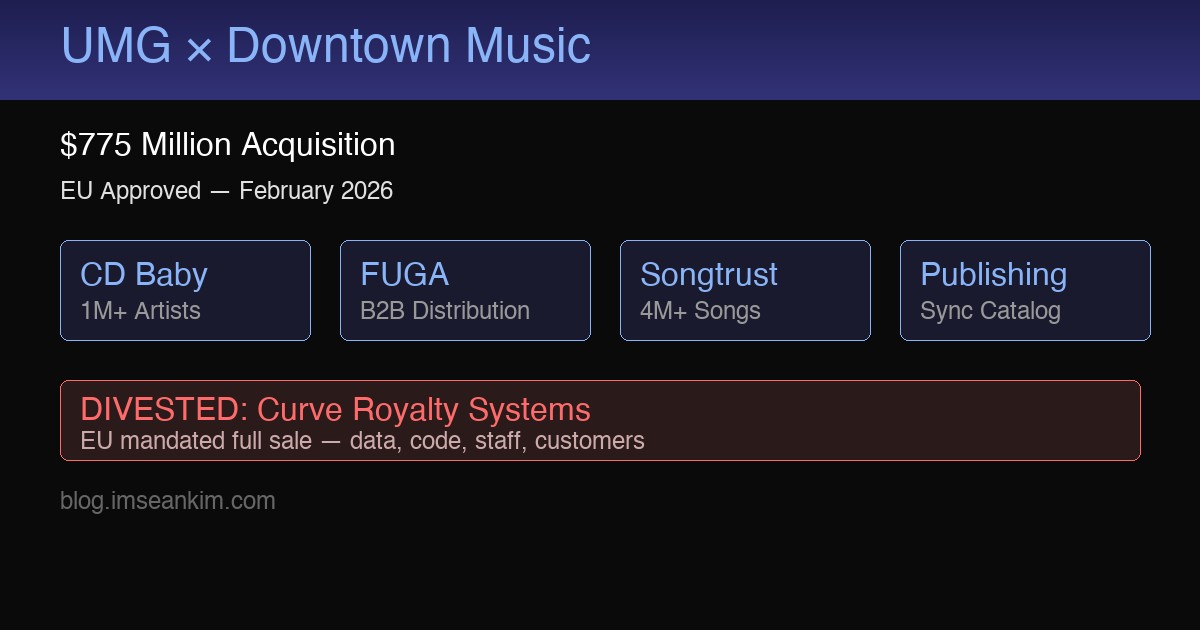
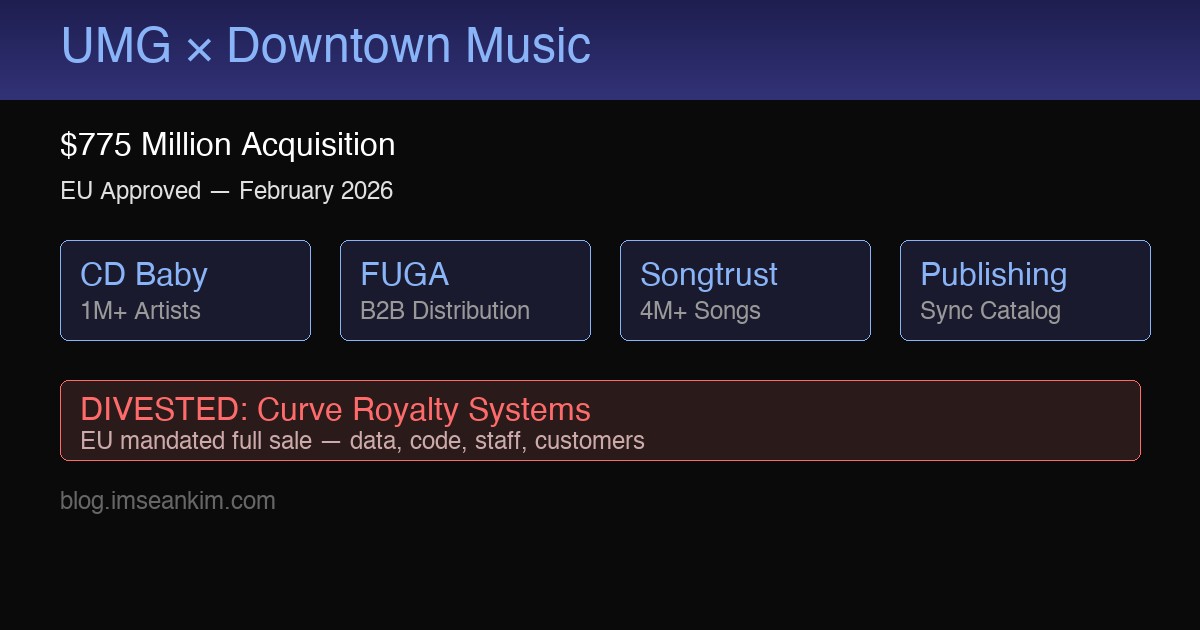
$775 million. That is the price Universal Music Group just paid to absorb Downtown Music Holdings — and the European Commission almost blocked the entire thing. The UMG Downtown acquisition EU approval, finalized on February 13, 2026, came with a critical catch: UMG must fully divest Curve Royalty Systems, the accounting and rights-management platform that processes royalties for hundreds of independent labels. If you distribute through CD Baby or FUGA, this deal reshapes your entire supply chain.
What UMG Actually Bought for $775 Million
The UMG Downtown acquisition EU deal encompasses four major subsidiaries that together form one of the largest independent music infrastructure networks in the world. CD Baby, the distribution platform serving over 1 million independent artists, now falls under UMG’s Virgin Music Group umbrella. FUGA, the B2B distribution and analytics platform used by hundreds of mid-tier labels, joins the portfolio alongside Songtrust, which administers publishing rights for over 4 million songs globally. Downtown Music Publishing itself, with its catalog of sync-friendly compositions, rounds out the package.
To put this in perspective, UMG now controls the distribution pipelines for a massive chunk of the independent music ecosystem. Virgin Music Group — already UMG’s indie-facing division — becomes an even more dominant force in artist services, distribution, and publishing administration. The deal was first announced in December 2024, but the regulatory review dragged on for over a year before landing on the European Commission’s desk for a Phase II deep dive.
Why the EU Forced UMG to Sell Curve Royalty Systems
Here is where it gets interesting. The European Commission identified a specific competition risk: if UMG controlled Curve Royalty Systems, it would gain access to commercially sensitive data from rival record labels. Curve is not just a royalty calculator — it is the accounting backbone for independent distributors and labels, processing financial data that reveals release strategies, revenue streams, and catalog performance across the industry.
EU Commissioner Valdis Dombrovskis stated the decision reflects the Commission’s dedication to “promoting fair competition and supporting a thriving and diverse music landscape in Europe.” The remedy is comprehensive: UMG must sell everything associated with Curve — customers, their data, contracts, staff, the platform itself, source code, algorithms, and even Curve-specific hardware. UMG receives only a limited, data-free transitional license for restricted internal use.
An independent trustee will oversee the entire divestment process, and the European Commission must approve whoever buys Curve. Until the sale closes, Curve must operate as a completely standalone business with no data flowing to UMG. This is one of the most aggressive structural remedies the EU has imposed on a music industry deal in recent memory.
The Indie Label Perspective: Winners and Losers
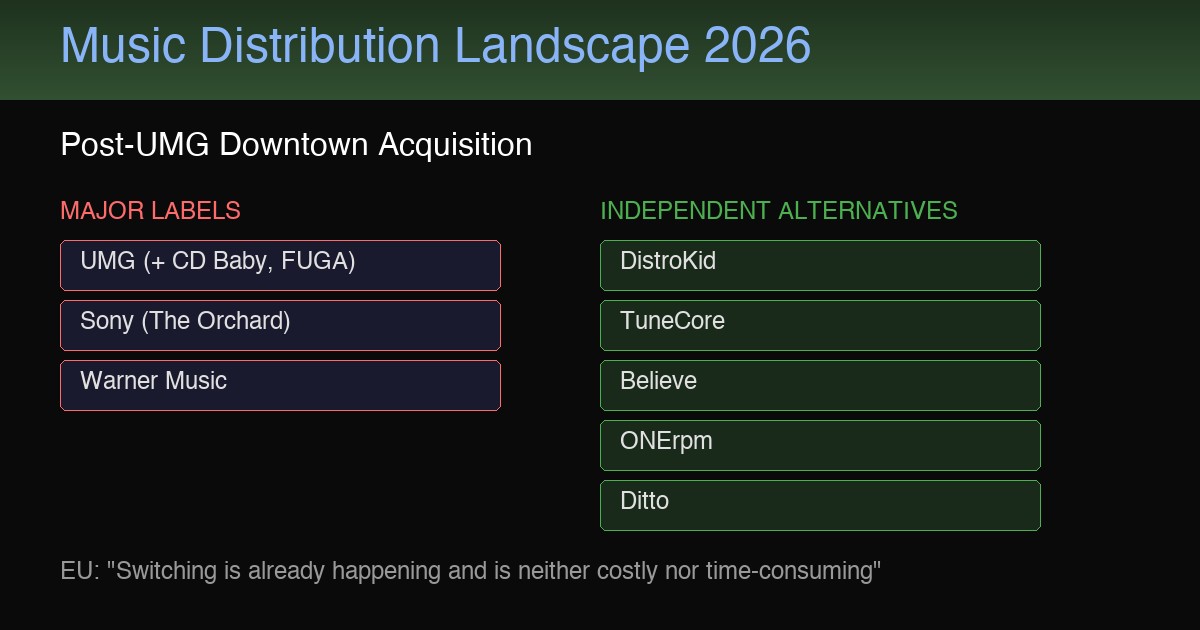
Independent labels and artists are split on what this means. On one hand, the EU’s decision to force a full Curve divestment provides genuine protection against data exploitation. Labels using Curve can continue their operations knowing that UMG will not have a window into their financials. The Commission specifically noted that switching between alternative service providers “is already happening, and is neither costly nor time-consuming,” pointing to competitors like Believe, ONErpm, and DistroKid as viable alternatives.
On the other hand, the concentration of CD Baby and FUGA under one major label’s umbrella raises legitimate concerns. CD Baby alone serves over a million independent artists. FUGA powers distribution for hundreds of labels that specifically chose it for its independence from the majors. These artists and labels did not sign up to have their distribution handled by a Universal Music subsidiary. While UMG has stated that Virgin Music Group will continue operating these services independently, the structural incentives have fundamentally changed.
What Happens Next: Timeline and Market Shifts
The deal officially closed approximately one week after the February 13 approval, with UMG and Virgin Music Group confirming the completion. The Curve divestment process is now underway, with the independent trustee monitoring operations. Several potential buyers have reportedly expressed interest in acquiring Curve, though the Commission must vet and approve any purchaser to ensure they maintain the platform’s independence.
For the broader market, this acquisition accelerates an already visible trend: major labels building vertically integrated ecosystems that span recording, distribution, publishing, and artist services. Warner Music’s investments in distribution technology and Sony’s expansion of The Orchard follow similar logic. The question is whether independent alternatives can keep pace — and whether artists and labels will proactively diversify their distribution strategies before the next wave of consolidation hits.
Practical Takeaways for Artists and Labels
If you are currently distributing through CD Baby or FUGA, do not panic — but do pay attention. Your existing agreements remain in force, and the EU’s conditions ensure that the transition period is supervised. However, this is an excellent moment to audit your distribution strategy. Consider whether having all your eggs in one major-label-adjacent basket aligns with your long-term goals.
- Review your CD Baby or FUGA distribution agreement for any change-of-control clauses
- Evaluate alternative distributors (DistroKid, TuneCore, Believe, ONErpm, Ditto) as backup options
- If you use Curve for royalty accounting, monitor announcements about the new buyer
- Consider splitting catalog across multiple distributors to reduce concentration risk
- Watch for changes to fee structures, payout timelines, or service terms post-acquisition
The UMG Downtown acquisition EU approval marks a turning point in how the music industry’s infrastructure is owned and operated. The European Commission drew a clear line — data access is a competition weapon, and structural separation is the remedy. Whether that line holds depends on enforcement, and whether the industry learns from this precedent before the next mega-deal arrives.
Navigating music industry consolidation and distribution strategy? Sean Kim brings 28+ years of music and audio industry experience to help artists and labels build resilient business frameworks.