FabFilter Pro-C 3 Review: 6 New Compression Algorithms, Character Mode, and Dolby Atmos — Was the 10-Year Wait Worth It?
April 2, 2026
Microsoft Zero Trust for AI: 700 Security Controls Every Enterprise Needs Before Deploying AI Agents
April 2, 2026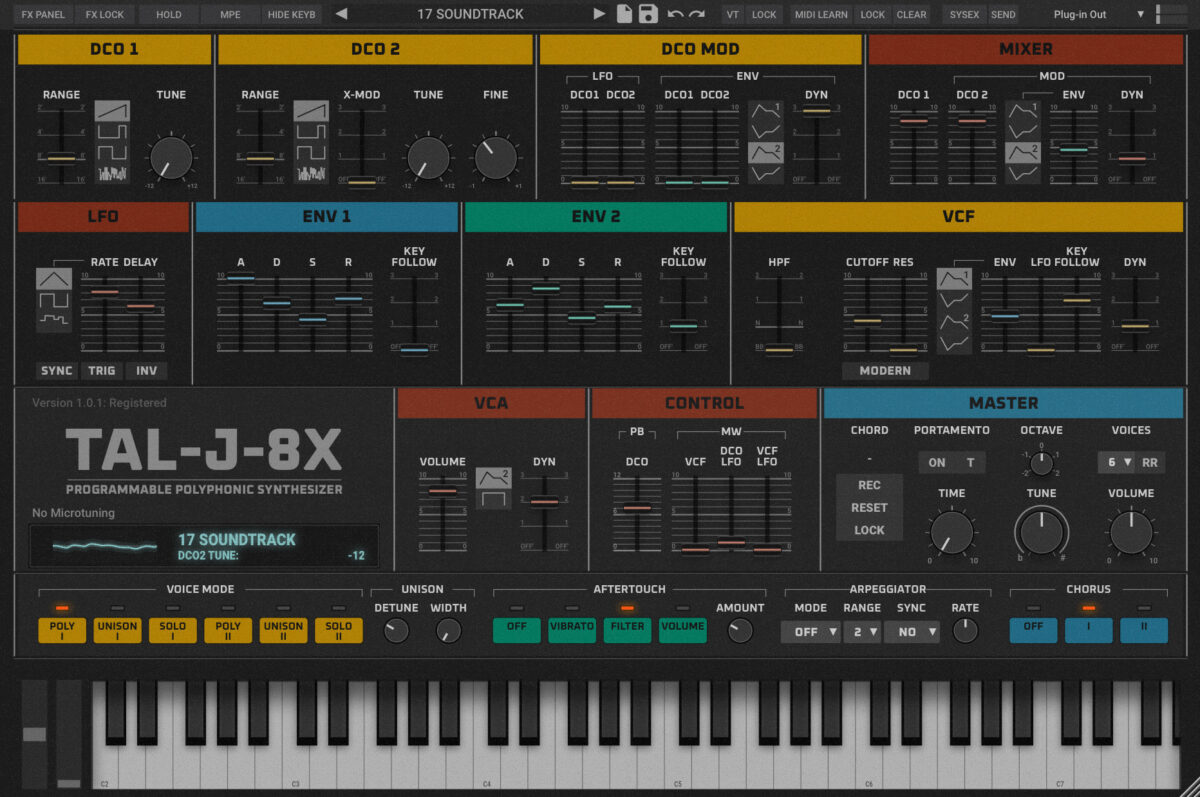
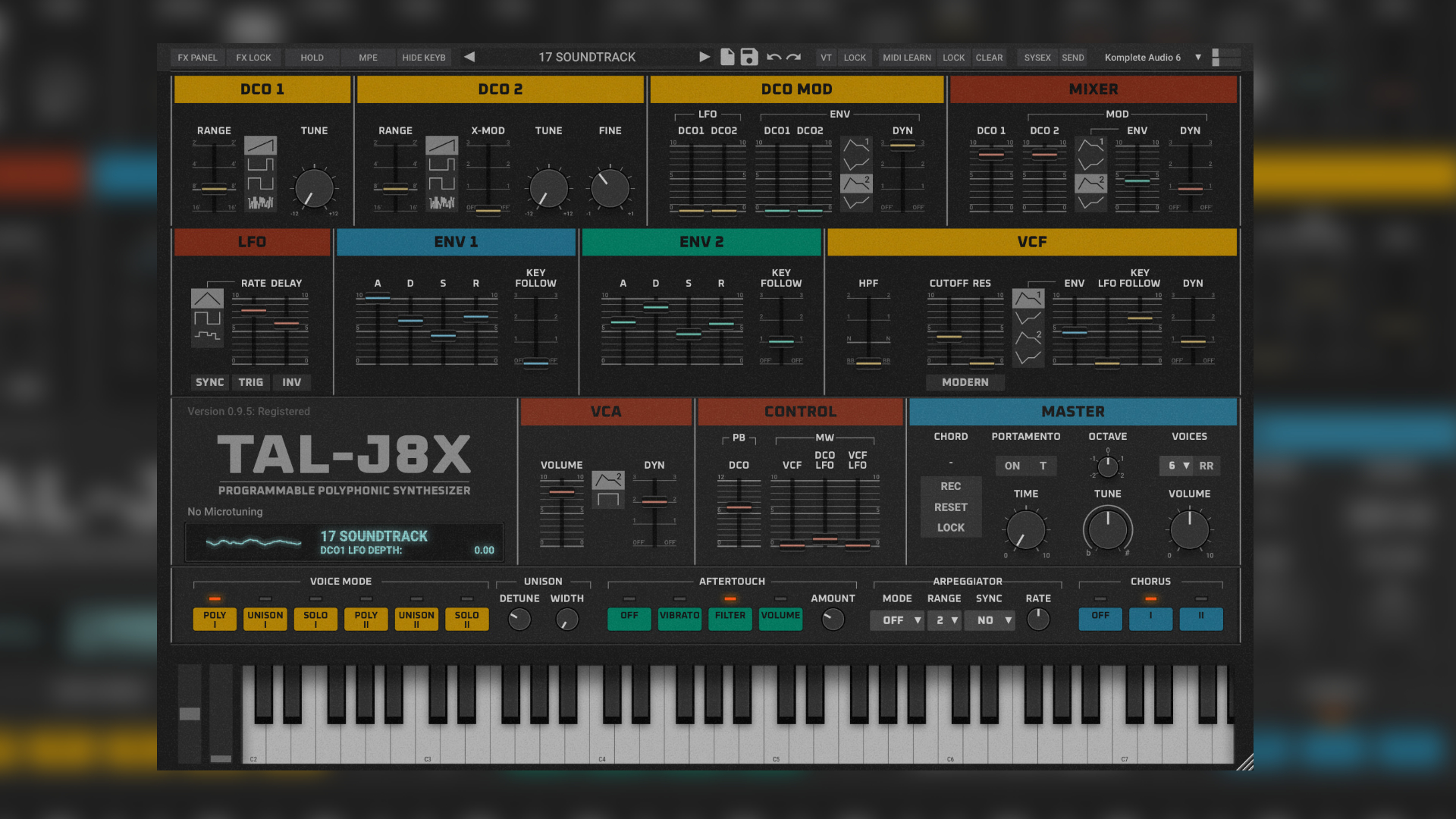
A single synthesizer from 1985 was the secret weapon behind Howard Jones, Depeche Mode, and countless 80s hits that defined an entire generation of pop music. Now, for just €55, you can load that exact sound into your DAW — and push it further than the original hardware ever could. TAL Software dropped TAL-J8X on March 31, 2026, and this isn’t just another Roland JX-8P emulation. It’s a two-way bridge between your computer and actual vintage hardware, complete with features the 1985 engineers couldn’t have imagined.
Why the Roland JX-8P Still Matters in 2026
The Roland JX-8P launched in 1985 as the spiritual successor to the legendary Jupiter-8. It featured dual DCOs (Digitally Controlled Oscillators), the distinctive IR3R05 filter chip that gave it a unique tonal character, and a programmable interface that was genuinely revolutionary for its era. Unlike the purely analog oscillators of its predecessors, the DCO design offered rock-solid tuning stability while retaining much of the warmth that made Roland synths famous.
Yet despite its considerable sonic merits, the JX-8P lived in the long shadow of the Juno-106 and Jupiter-8. While those synths became mainstream legends with their own dedicated fan communities, the JX-8P quietly earned a cult following as the “insider’s synth” — the instrument that working session musicians and studio engineers reached for when they needed a sound that would sit perfectly in a mix without demanding all the attention. On today’s used market, clean units command $1,500–$2,000, a clear testament to the enduring demand for its uniquely warm and glassy pads, thick brass patches, and delicate string textures that no other synth of its era could quite replicate.
TAL Software has already proven their mastery of vintage Roland sound recreation with TAL-U-NO-LX (widely regarded as the definitive Juno-60 emulation) and TAL-J-8 (their acclaimed Jupiter-8 recreation). TAL-J8X is the latest chapter in that lineage, and it may be their most ambitious project yet — modeling every characteristic of the JX-8P at the component level while adding modern capabilities that extend the instrument’s creative potential far beyond its original design specifications.
7 Key Features That Push the TAL-J8X Roland JX-8P Emulation Beyond the Original
1. Component-Level IR3R05 Filter Modeling
The IR3R05 chip is the soul of the JX-8P’s sound, and TAL has modeled it at the component level with painstaking attention to detail. Every subtle nonlinearity, every hint of warm saturation, every quirk of the original circuit behavior is faithfully reproduced. The result is a lowpass filter that responds and sounds like the real thing — not just at static settings, but dynamically as you sweep the cutoff and push the resonance.
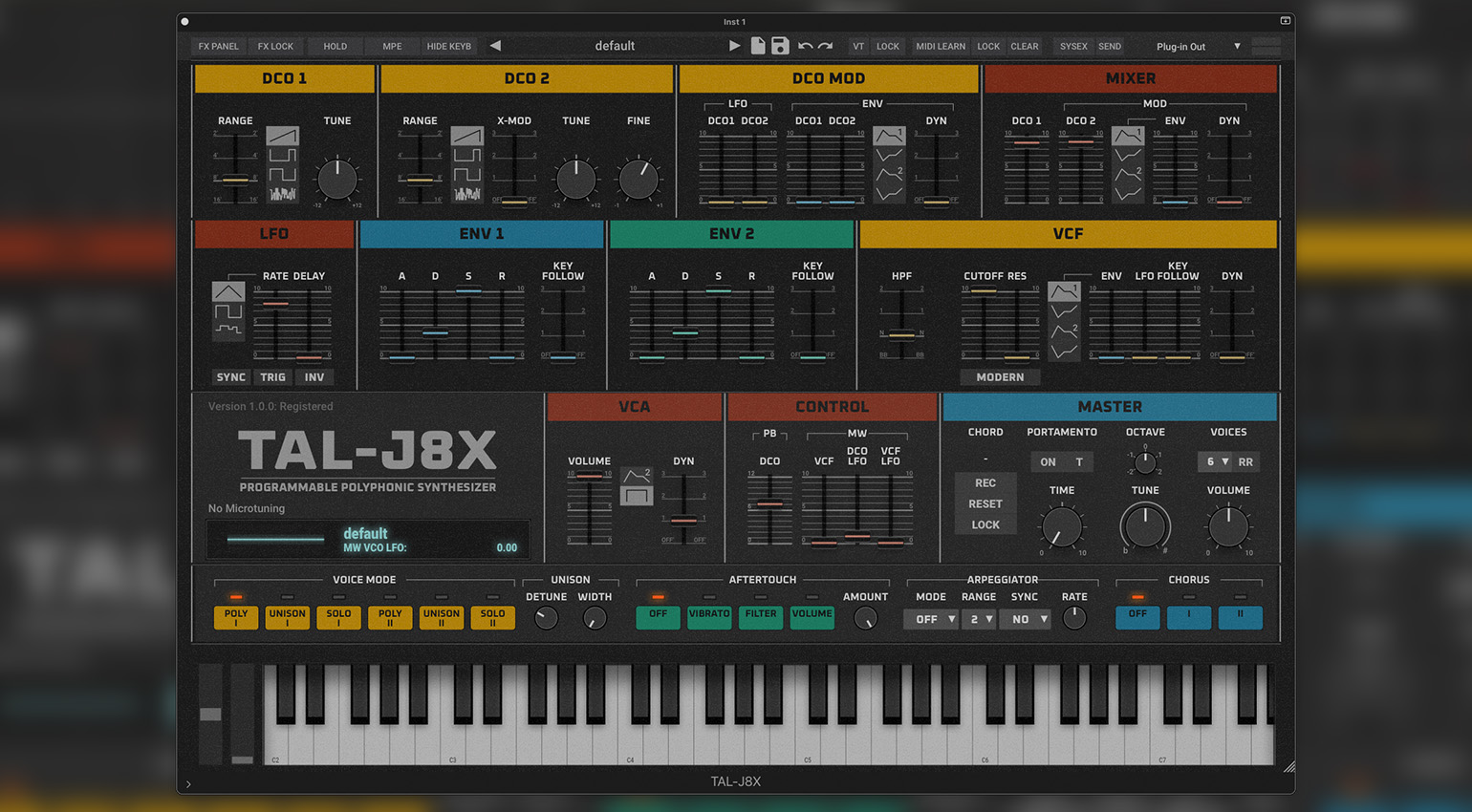
But TAL didn’t stop at faithful reproduction. They added a modern filter mode with self-oscillation capability, opening up aggressively resonant sounds that the original hardware was physically incapable of producing. This means you can dial in authentic 1985 filter character for vintage patches, then flip to modern mode for contemporary sound design that the original JX-8P owners could only dream of.
2. Dual DCOs with Cross-Modulation
The faithful dual-DCO architecture includes X-mod (cross-modulation), where DCO 1 modulates DCO 2’s pitch to create metallic textures and complex harmonics that occupy a fascinating sonic territory somewhere between subtractive and FM synthesis. This is where the JX-8P always had an edge over simpler single-oscillator synths — the interaction between two DCOs creates movement and depth that’s immediately recognizable in any mix.
TAL has enhanced the modulation section further. The LFO and envelope sections now feature inversion and dynamics modulation, dramatically expanding the expressive range beyond what the original could achieve. You can create patches that respond to velocity and aftertouch in ways the original JX-8P’s more limited modulation routing simply couldn’t accommodate, making this a genuinely more versatile instrument than the hardware it’s based on.
3. Sysex Hardware Bridge — The Real Game Changer
This is TAL-J8X’s most distinctive and arguably most innovative feature. It enables bidirectional Sysex communication with real Roland JX-8P, JX-10, and MKS-70 hardware. You can read patches directly from your vintage gear into the plugin, preserving every parameter exactly as it exists in the hardware. Going the other direction, you can craft patches in the plugin’s more comfortable software interface and send them back to the hardware for use in live performance or recording sessions.
For vintage hardware owners, this is an indispensable backup and editing tool — finally, a reliable way to archive decades of accumulated patches and edit them with a modern UI. For producers who don’t own the hardware, it opens the door to loading authentic Sysex dumps shared by the community, giving you access to patch libraries that were created on and verified against real hardware. That’s a level of authenticity no preset pack designed purely in software can match.
4. 600+ Professional Presets from Top Sound Designers
The factory preset library is substantial, featuring contributions from some of the most respected names in synth sound design. Electric Himalaya, Saif Sameer, Sound Author, Empty Vessel, VIC-20, Heat Audio, and FMR have all contributed patches that showcase the full range of TAL-J8X’s capabilities. The coverage spans classic 80s lush pads, punchy modern basslines, slowly evolving ambient textures, and experimental soundscapes that push the architecture into unexpected territory.
What’s particularly impressive is the genre diversity. Whether you’re producing synthwave, cinematic scores, ambient electronica, or mainstream pop, there are usable starting points throughout the library. And with the Sysex bridge, you can expand your preset collection indefinitely by importing patches from the active online community of JX-8P enthusiasts who’ve been sharing Sysex banks for decades.
5. MPE and Polyphonic Aftertouch Support
Full MIDI Polyphonic Expression support means modern controllers like the Roli Seaboard, Linnstrument, or Sensel Morph can drive per-note pitch bend, pressure, and slide independently. Imagine playing a JX-8P pad where each finger independently controls its own vibrato depth, filter cutoff, and volume — it’s 2026 expressiveness layered onto a 1985 synth architecture. The combination is more compelling than you might expect, transforming what was originally a fairly static instrument into something that responds to every nuance of your playing.
Even without an MPE controller, the polyphonic aftertouch implementation adds significant expressiveness. Standard aftertouch-capable keyboards can now drive the JX-8P’s sound in ways the original hardware’s monophonic aftertouch never allowed, adding dynamics and movement to sustained chords and pads.
6. Non-Resonant Highpass Filter
This is an addition the original JX-8P never had, but one that every modern producer will appreciate. The built-in non-resonant highpass filter lets you clean up low-end mud, thin out bass-heavy patches, or reshape the tonal character of any sound — all without reaching for a separate EQ plugin in your channel strip. It’s a seemingly small detail that makes a real difference in production workflow speed, especially when you’re layering multiple synth parts and need to carve out frequency space quickly.
7. Universal Format Support — VST/VST3/AU/AAX/CLAP
TAL-J8X supports every major plugin format currently in use: VST, VST3, AU, AAX, and the increasingly popular CLAP standard. This means it runs natively in Ableton Live, Logic Pro, Pro Tools, Cubase, Reaper, Bitwig Studio, and essentially any other modern DAW. Both macOS and Windows are fully supported, and the resizable UI adapts smoothly to any screen size — from laptop displays to ultra-wide studio monitors.
Competition Check — Spring 2026’s Vintage Synth Emulation Boom
In a striking coincidence, Cherry Audio released the Crumar DS-2 ($59) on the exact same day — March 31, 2026. While Cherry Audio went after an obscure 70s Italian gem described by MusicRadar as “the kind of forgotten, half-mythical synth you discover by accident on a forum thread,” TAL targeted one of the most sought-after 80s Japanese synths. Together, these same-day releases signal that spring 2026 is shaping up as a genuine golden era for vintage hardware emulation in plugin form.
Compared to existing JX-8P emulations on the market, Roland Cloud’s own JX-8P plugin carries the weight of the official license and access to Roland’s proprietary ACB modeling technology. However, TAL-J8X’s Sysex hardware bridge, modern self-oscillating filter mode, and full MPE support are significant differentiators that Roland’s own offering doesn’t provide. Arturia’s Jun-Xs (part of their V Collection suite) takes a different approach entirely, bundling multiple Roland synth emulations into one interface — convenient for breadth, but for dedicated JX-8P depth and authenticity, TAL-J8X has a clear edge.
There’s also the pricing factor to consider. At €55 intro (€69 regular), TAL-J8X significantly undercuts both Roland Cloud’s subscription model and Arturia’s V Collection pricing, while offering arguably the most feature-complete JX-8P emulation available. For producers who want specifically the JX-8P sound without paying for an entire suite of synths they might not need, the value proposition is hard to beat.
My Take: What 28 Years in Audio Taught Me About This Synth
I’ll be honest — TAL Software has always been the brand that makes me question my assumptions about price-to-quality ratios in the plugin world. When I first loaded TAL-U-NO-LX years ago, my immediate reaction was “this costs how little for this quality?” TAL-J8X continues that tradition without missing a beat, and in some ways raises the bar even further with the Sysex bridge innovation.
After 28 years working in studios with every synth from vintage hardware to the latest software instruments, here’s what I think most people get fundamentally wrong about the JX-8P: its magic isn’t “perfect analog warmth.” That’s the Jupiter-8’s domain. And it’s not “in-your-face character” — that belongs to the Prophet-5 and Minimoog. Unlike those synths that demand attention and dominate a mix, the JX-8P is a cooperative instrument. Lay down a pad, and it never fights the vocal. Stack a brass layer, and it coexists beautifully with the guitars. Add a string texture, and it fills the gaps other instruments leave behind without stepping on anyone’s toes. That subtle, almost self-effacing balance is exactly why session musicians and mix engineers kept a JX-8P in the rack as their not-so-secret weapon for decades. TAL-J8X captures this cooperative quality remarkably well.
The Sysex hardware bridge isn’t a marketing gimmick — it solves a genuine pain point I’ve witnessed in countless studios. When you work with vintage hardware long enough, patch management becomes a constant headache. Memory batteries die without warning, taking decades of accumulated patches with them. Backup methods are unreliable at best. Transferring sounds between hardware units or between hardware and software has always been a frustrating, error-prone process. TAL-J8X solves all of this cleanly with a simple, well-implemented bidirectional bridge. Even if you don’t own the hardware, you can load Sysex dumps shared by the global community of JX-8P owners — real hardware-verified presets that carry an authenticity no preset designer working purely in software can replicate.
The €55 intro price (regular €69) is almost aggressive for an emulation of this caliber and depth. In a market where most serious competitors position themselves between $99 and $199, TAL is once again redefining what “affordable” means for professional-grade synth plugins. They’re proving that exceptional quality doesn’t have to come with an exceptional price tag.
Who Should Buy TAL-J8X?
I’d recommend TAL-J8X to virtually any producer interested in 80s-flavored sounds or vintage analog character, but three groups in particular should consider this an essential purchase. First, JX-8P, JX-10, and MKS-70 hardware owners — the Sysex bridge alone is worth the price of admission, providing a backup, editing, and management solution that simply doesn’t exist anywhere else. Second, synthwave and retrowave producers — a significant portion of the 600+ presets are immediately usable in these genres, and the authentic JX-8P character is a cornerstone of the retro-futuristic aesthetic. Third, budget-conscious home producers who want serious vintage analog sound without serious vintage analog pricing — finding this level of character, depth, and authenticity for €55 is genuinely rare in 2026.
TAL-J8X is available now from the TAL Software official website, with the €55.20 intro pricing available for a limited time before it returns to the regular €69 price point. If vintage synth sounds have been sitting on your wish list, this is the moment to pull the trigger — both the price and the quality make it one of the easiest plugin purchase decisions of 2026.
Need professional mixing, mastering, or Dolby Atmos production? Sean Kim brings 28 years of studio experience to every project.
Get weekly AI, music, and tech trends delivered to your inbox.