Nano Banana Pro Leaked — Inside Google’s Next-Gen Image Generation Model
November 12, 2025
Suno AI WMG Settlement: How the $500M Lawsuit Resolution Reshapes AI Music Forever
November 13, 2025
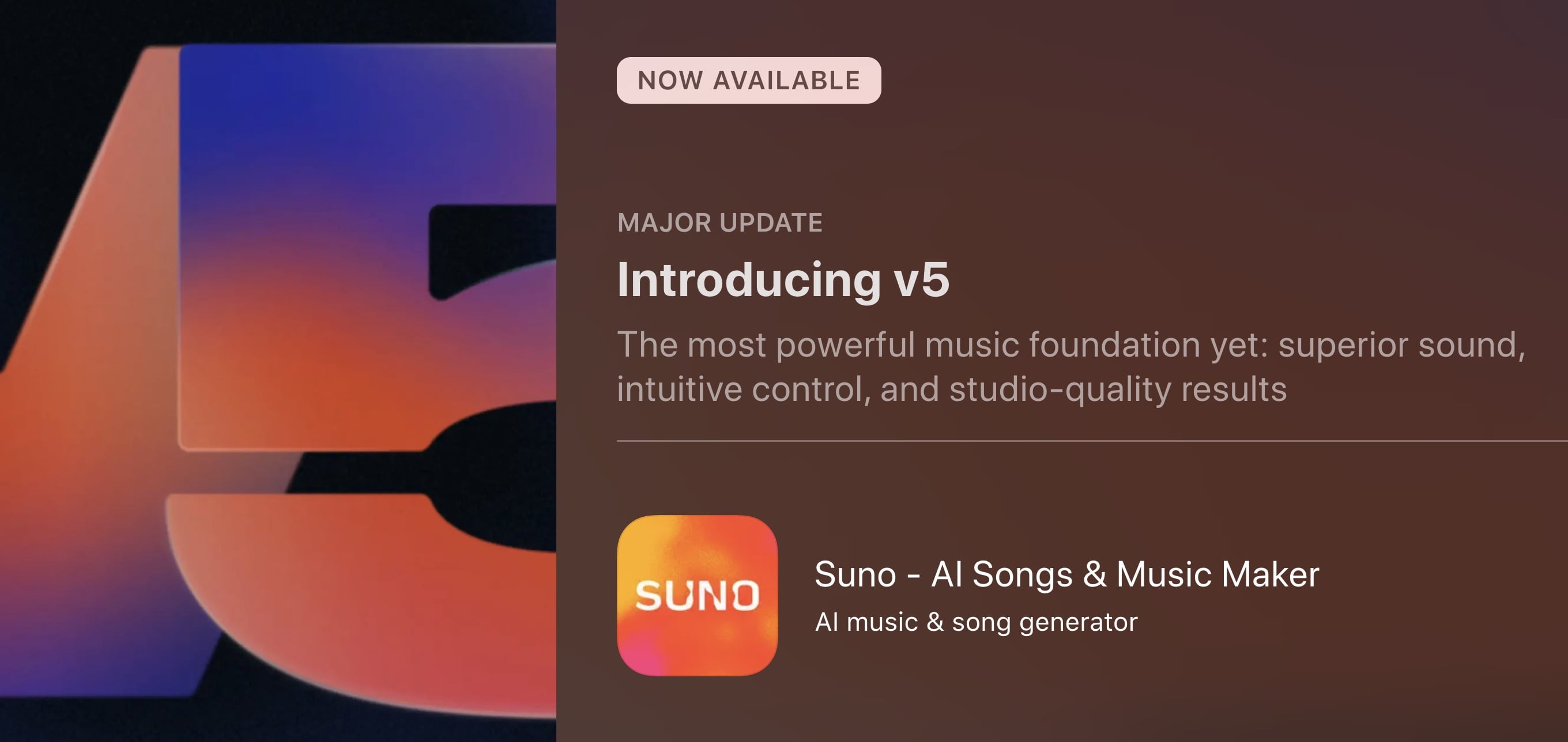
“There’s no way AI made this vocal.” That was my honest reaction after generating my first track with Suno AI v5. After 28 years of professional music production — from analog consoles to DAWs to AI-assisted workflows — I’ve developed a pretty sharp ear for synthetic artifacts. And Suno’s latest update had me doing a genuine double-take. Released on September 25, 2025, Suno AI v5 represents a paradigm shift in what AI music generation can actually deliver to working producers.
The AI music generation space has been crowded with incremental updates throughout 2025, but Suno v5 stands decisively apart from the pack. This isn’t a minor point release with polished marketing language — it’s a fundamental reimagining of how AI handles vocals, arrangement logic, and audio fidelity at every stage of the generation process. With Black Friday approaching in the coming weeks, if you’ve been on the fence about a Suno subscription, this comprehensive breakdown should help you make an informed decision about whether v5 justifies the investment.
Suno AI v5 Vocal Clarity: From Synthetic to Studio-Grade
The single most impressive advancement in Suno AI v5 is vocal quality — and it’s not even close. According to Suno’s official announcement, v5 introduces “Persistent Voice & Instrument Memory,” a sophisticated system that maintains consistent timbre and tonal characteristics across an entire generation session. Previous versions suffered from what I’d call mid-section vocal drift, where the AI’s voice would subtly but noticeably shift character between verse and chorus sections. In v5, that problem is essentially solved.
The technical improvements go considerably deeper than consistency alone. V4.5 vocals carried a telltale over-compressed quality that experienced producers could spot within seconds. The high-frequency range was particularly problematic, with digital artifacts and an unnatural sheen that immediately screamed “AI-generated” to trained ears. Suno AI v5 addresses this at a fundamental architectural level. Natural breathing patterns between phrases, realistic phrasing dynamics that respond to lyrical content, and genuine emotional nuance in delivery — the gap between AI-generated and human-recorded vocals has narrowed more dramatically than most of us expected this year.
The benchmark numbers tell a compelling story on their own. As reported by industry analysts, v5 scored 1,293 on ELO benchmarking compared to v4.5+’s 1,208 — an 85-point jump that represents a significant leap rather than an incremental improvement. That gap translates directly to perceptible audio quality improvements that don’t require golden ears to appreciate. Fuller, more three-dimensional mixes, significantly reduced noise floor, and markedly better instrument separation across all frequency ranges.
From a practical standpoint, the vocal improvements mean that AI-generated demos are now closer to release quality than ever before. For songwriters who need to pitch ideas to artists or labels, this changes the economics of demo production entirely. Instead of booking studio time and hiring session vocalists for demos, a Suno v5 generation can produce vocal performances convincing enough to communicate the vision of a song effectively.
The Intelligent Arrangement Engine: How Suno AI v5 Actually Composes
Vocal improvements alone would make v5 noteworthy, but the Intelligent Arrangement Engine transforms how the entire platform approaches musical composition. Suno describes it as delivering “flawless structural coherence from 30-second hooks to 8-minute epics” — and from my extensive testing over the past several weeks, that description is not marketing hyperbole. It’s remarkably accurate.
The arrangement engine automatically structures compositions with proper verses, choruses, bridges, pre-choruses, and outros — the complete structural vocabulary of modern songwriting. But what sets it apart from simple section-stamping algorithms is its musical intelligence. Transitions between sections feel organic and motivated. Build-ups have genuine kinetic momentum. Outros resolve naturally with appropriate harmonic and dynamic cadences instead of abruptly cutting off — a persistent and frustrating issue with earlier versions that made even the best AI music feel unfinished and amateurish.
For producers, the granular parameter controls are where v5 truly differentiates itself. You can now specify tempo, key signature, dynamic range, and arrangement structure with a level of precision that simply wasn’t possible in any previous version. This fundamentally shifts the user experience from rolling the dice and hoping for something usable to actively directing an AI collaborator toward a specific creative vision. That distinction matters enormously for professional workflows where consistency and intentionality are non-negotiable requirements.
The processing speed improvements compound these quality gains. Suno claims 10x faster generation compared to v4, and my experience confirms this is accurate. What previously took minutes now completes in seconds, which means you can iterate rapidly — generating multiple variations, comparing arrangement approaches, and fine-tuning your creative direction without the friction of long wait times breaking your flow state.
Suno Studio and Multi-Stem Export: Real Professional Integration
Alongside v5, Suno announced Suno Studio — and it signals exactly where the company is heading with unmistakable clarity. Music Business Worldwide reports that Suno is now valued at $500 million, and the Studio product reflects that level of ambition and investment. This is no longer a novelty tool for casual users. Suno is deliberately positioning itself as professional music production infrastructure.
The multi-stem export feature is the genuine game-changer for production workflows, and it’s the feature that most clearly demonstrates Suno’s professional aspirations. Being able to export separate vocal, bass, and drum stems means you can bring AI-generated elements directly into your DAW for professional-grade mixing and mastering. Need the AI’s vocal performance but want to replace the drum programming with your own? Now you can do exactly that. Want to keep the arrangement but re-record the bass with a real instrument? Completely possible. The “Sample to Song” feature adds yet another creative dimension, letting you feed short audio clips — a melody hummed into your phone, a chord progression from a practice session — and expand them into fully realized compositions.
This integration capability is precisely what separates Suno from competitors still treating AI music as a finished-product generator with no room for human intervention. The future of AI in music production isn’t AI replacing producers — it’s AI generating high-quality raw material that skilled producers then transform into polished, release-ready work. Suno v5 is the first platform to genuinely enable that hybrid workflow at professional scale, and that’s why it matters so much to the production community.

V5 vs V4.5: Genre-by-Genre Performance Breakdown
Let’s be completely honest about where v5 excels and where it still has room to grow. Based on extensive community testing — including one dedicated power user who invested over 10,000 credits and more than 50 hours of systematic comparative analysis — the performance picture is more nuanced than Suno’s marketing might suggest.
- V5 dominates: Acoustic, indie, pop, hip-hop, and R&B — genres where natural vocal quality, subtle dynamics, and rich layered harmonies are essential to the listening experience
- V4.5 holds its ground: Heavy metal and high-BPM electronic music — genres requiring extreme energy, aggressive processing, and sonic characteristics that don’t prioritize natural vocal realism
- Universal improvements: Studio-grade mix quality with professional headroom, significantly lower noise floor, and dramatically better instrument separation that makes stems actually usable
- Processing speed: 10x faster than v4 with simultaneously higher quality output — a rare engineering achievement where both speed and quality improve together
The layered harmonies in v5 deserve special and specific mention. Where v4.5 produced harmonies that sounded mechanically stacked — like multiple identical voices simply pitch-shifted and layered — v5 creates genuinely rich, interwoven vocal arrangements that sound like a real choir or professional backing vocal session. Each harmony voice has its own subtle character and movement. For pop and R&B production in particular, this improvement alone could justify the upgrade for many producers.
The Technology Roadmap: What’s Coming After v5
According to Music Ally’s in-depth interview with Suno CTO Georg Kucsko, the development roadmap beyond v5 includes advanced stem separation algorithms, granular individual track editing within the platform itself, and — perhaps most excitingly for working musicians — a recording feature that will let users add their own vocals and live instruments directly to AI-generated compositions. This last feature could be truly transformative: imagine generating a complete arrangement with AI, then recording your own vocal performance over it, seamlessly blending human expression with AI-generated musical beds.
The remastering capability already available in v5 deserves highlighting for existing Suno users with established libraries. If you’ve built a catalog of tracks using v3.5 or v4 over the past year, you can now remaster them with v5’s dramatically improved audio engine. It’s essentially a free quality upgrade for your entire back catalog — and having tested this with several of my older generations, the results are consistently and sometimes surprisingly impressive. Tracks that previously sounded obviously AI-generated now have a polish and depth that approaches professional standards.
Pricing and the Black Friday Opportunity
Suno v5 launched first for Pro ($8/month) and Premier ($24/month) subscribers, with free-tier users receiving limited but functional access to test the new model. For serious music creators and producers who are actively incorporating AI into their workflows, the Pro tier offers exceptional value given the magnitude of the quality leap from v4.5. With Black Friday deals approaching in the coming weeks of November, it’s absolutely worth monitoring for potential promotional pricing from Suno. If you’re considering a subscription but aren’t in a rush, holding out until late November could save you a meaningful amount on an annual plan.
Even at full price without any promotional discount, the combination of v5’s vocal quality improvements, the Intelligent Arrangement Engine, multi-stem export capabilities, and the remastering feature makes this one of the most compelling AI music production tools currently available at any price point. The $8/month Pro tier, in particular, offers a quality-to-price ratio that’s genuinely difficult to match anywhere in the current AI music landscape.
A Producer’s Honest Assessment of Where We Are
After 28 years in professional music production, I’ve seen more tools marketed as “game-changers” than I can count — and the vast majority turned out to be incremental improvements wrapped in aggressive marketing language. Suno AI v5 is one of the genuinely rare exceptions that actually delivers on its ambitious promises. The vocal clarity improvements alone would justify calling this a major update, but combined with the Intelligent Arrangement Engine, professional-grade export capabilities, and the remarkably fast processing speed, v5 marks the specific moment when AI music generation crossed the threshold from “interesting experiment worth watching” to “legitimate production tool worth integrating.”
That said, I want to be clear: this is not a replacement for skilled producers and musicians. It never will be, and that’s not the point. Suno v5 is an amplifier — a force multiplier for creative professionals who know how to use it intelligently. The producers who learn to integrate AI-generated stems into their established workflows — using Suno for rapid ideation, demo creation, and reference track generation, then applying their professional mixing, mastering, and artistic judgment — will have a significant competitive and creative advantage heading into 2026 and beyond. The hybrid workflow of AI generation plus human refinement and artistic direction is quickly becoming the new industry standard, and Suno v5 is the strongest argument yet for embracing that evolution rather than resisting it.
Interested in building AI-powered music production pipelines or integrating Suno v5 into your studio workflow? Let’s talk — 28 years of production experience meets cutting-edge AI.
Get weekly AI, music, and tech trends delivered to your inbox.