Google Pixel 10a Leak: Budget AI Phone Expected with Tensor G5 Lite Chip
July 11, 2025
Korg Modwave MkII Review: 60-Voice Wavetable Beast With Kaoss Physics
July 14, 2025
Finally — generating photorealistic 4K-quality AI images no longer requires a data center. Stability AI’s Stable Image Ultra — powered by the latest TensorRT-optimized Stable Diffusion 3.5, announced on June 12, 2025 — cuts generation time by more than half and drops VRAM requirements by 40%. If you’ve been waiting for the moment when high-end AI image generation becomes genuinely practical on desktop hardware, this is it.
What Stable Image Ultra Actually Delivers in 2025
Stable Image Ultra is Stability AI’s flagship image generation service, powered by Stable Diffusion 3.5 Large — the most capable model in the SD family. Unlike its predecessors, Ultra doesn’t just generate images; it understands complex prompts with near-human accuracy. Typography that actually reads correctly, multi-subject compositions that don’t melt into each other, and dynamic lighting that would make a cinematographer nod in approval.
The model outputs at 1 megapixel natively, and with Stability AI’s built-in upscaling pipeline, pushing to 4K resolution is now a realistic workflow — not a fantasy reserved for enterprise users. Three variants serve different needs: Large for maximum quality, Turbo for speed (just 4 diffusion steps), and Medium optimized for consumer-grade hardware.
The TensorRT Breakthrough: 2.3x Faster, 40% Less VRAM
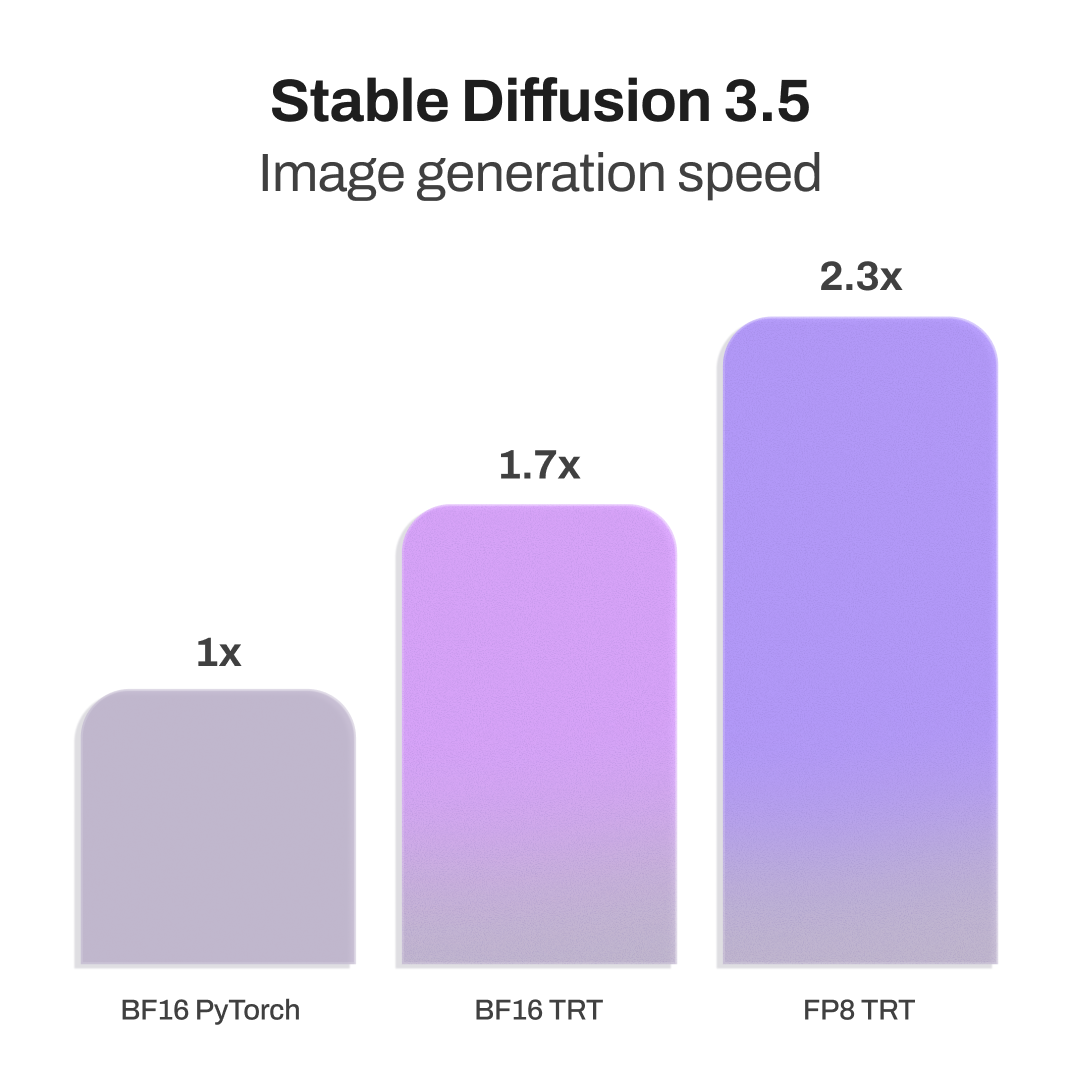
The June 2025 collaboration between Stability AI and NVIDIA changed the equation entirely. By applying TensorRT with FP8 quantization to SD3.5, the partnership achieved numbers that matter for real-world usage:
- SD3.5 Large: 2.3x faster generation compared to standard BF16 PyTorch inference
- SD3.5 Medium: 1.7x faster with proportional VRAM savings
- VRAM reduction: From 19GB down to 11GB — suddenly, a single RTX 4080 can handle what previously needed workstation GPUs
- RTX 50 Series scaling: Five systems can now run SD3.5 Large simultaneously where only one could before
For context, this means a high-quality 1-megapixel image on an RTX 4090 now generates in roughly 3-4 seconds, down from 8-10 seconds. Scale that to a batch of 100 product shots for an e-commerce client, and you’ve saved 10+ minutes per batch. Over a production day, that compounds dramatically.
Pricing That Actually Makes Sense: $0.08 Per Image
Stable Image Ultra through Stability AI’s API costs $0.08 per generation — and this is where the competitive picture gets interesting. Midjourney v7, launched in April 2025, remains the gold standard for artistic quality, but it operates on a subscription model ($10-$120/month) with no public API. If you’re building automated pipelines or integrating image generation into production workflows, Midjourney simply isn’t an option.
DALL-E 3, priced similarly at $0.04-$0.08 per image, is being actively deprecated in favor of OpenAI’s GPT Image model. That transition creates uncertainty for anyone building on the DALL-E API. Meanwhile, Stability AI has been expanding availability — Stable Image Ultra is now accessible through Amazon Bedrock, NVIDIA NIM, and Azure AI Foundry, giving enterprise users deployment flexibility that no competitor matches.
Stable Image Ultra vs Midjourney v7 vs DALL-E 3: The Real Comparison
Having tested all three extensively, here’s the honest breakdown for mid-2025:
Midjourney v7 still wins on pure aesthetic quality — its images have that unmistakable “wow factor” that makes designers reach for it first. But the Discord/web-only workflow and lack of API access limits it to manual, creative-driven workflows.
DALL-E 3 leads in prompt accuracy — when you need exactly what you described, nothing beats it. However, with the brand being sunset in favor of GPT Image, the long-term roadmap is uncertain.
Stable Image Ultra occupies the sweet spot for production use: open-weight models you can self-host, API access at competitive pricing, enterprise cloud deployment options, and now TensorRT-optimized performance that rivals dedicated hardware solutions. The quality gap with Midjourney has narrowed significantly with SD3.5, and for photorealistic content — product photography, architectural visualization, editorial illustrations — Ultra is now genuinely competitive.
What This Means for Creative Professionals
The practical implications of the TensorRT optimization extend beyond raw benchmarks. With 11GB VRAM as the new floor, SD3.5 Large now runs on mainstream GPUs like the RTX 4070 Ti Super and the entire RTX 50 Series lineup. This democratizes professional-grade image generation in ways that matter:
- Freelance designers can run local inference without cloud API costs
- Small studios can build internal asset pipelines with consistent quality
- Content teams can generate blog hero images, social media assets, and product mockups at scale
- Developers can integrate via Stability AI’s API or self-host using the permissive Community License
The permissive Stability AI Community License is particularly noteworthy — it allows both commercial and non-commercial use of the TensorRT-optimized weights, available on Hugging Face. This is a stark contrast to Midjourney’s closed ecosystem and DALL-E’s API-only access model.
The Road to Real-Time 4K: What’s Next
Stability AI’s trajectory is clear: make enterprise-quality image generation accessible everywhere. The SD3.5 Turbo variant already generates in just 4 diffusion steps — combine that with TensorRT optimization, and sub-second generation at standard resolution is within reach on next-gen hardware. Native 4K generation (as opposed to upscaled 4K) remains a research frontier, with projects like Diffusion-4K exploring direct ultra-high-resolution synthesis.
For now, the combination of SD3.5 Large at 1MP + Real-ESRGAN or Stability’s own upscaler delivers 4K output that’s genuinely production-ready. The TensorRT optimization makes this pipeline fast enough to be practical rather than theoretical.
Whether you’re building the next creative tool, running a design studio, or just want the best AI images on your desktop, the message is straightforward: Stable Image Ultra with TensorRT is the most complete package in AI image generation right now — fast, flexible, affordable, and open enough to build on.
Interested in building AI-powered creative pipelines or integrating image generation into your workflow? Sean Kim has 28+ years of experience bridging audio, tech, and AI.
Get weekly AI, music, and tech trends delivered to your inbox.