New Software Synths 2025: 5 Spring Releases That Deserve Your Attention
April 29, 2025
Nintendo Switch 2 Pre-Order Guide: $449.99 Price, Full Specs, and 25+ Launch Games (2025)
April 30, 2025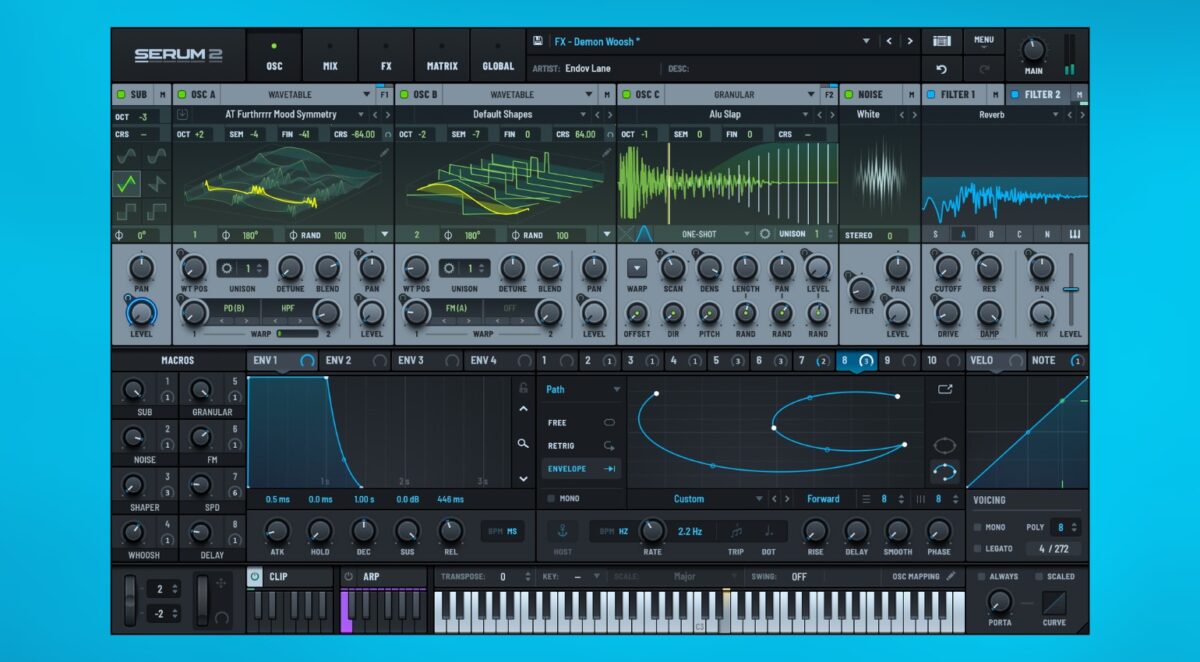
Six weeks ago, Steve Duda dropped Serum 2 and the producer world collectively held its breath. The synth that single-handedly democratized wavetable synthesis had just undergone its first major generational leap in over a decade. And existing users get it for free. After spending six weeks putting it through real production work, here’s what actually matters.
Why Serum 2 Took a Decade
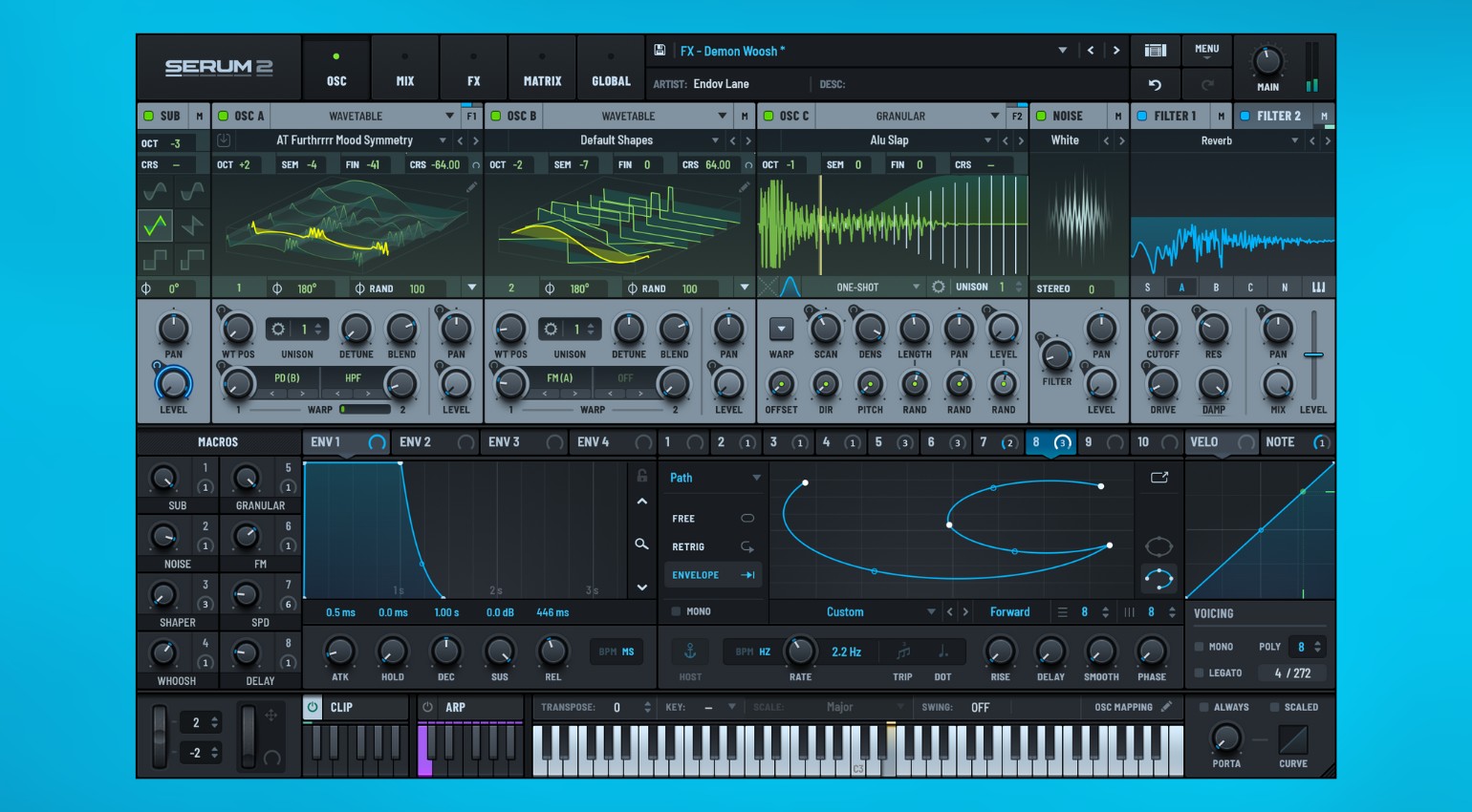
The original Serum launched in 2014 and fundamentally redefined what a wavetable synthesizer could be. Drag-and-drop wavetable editing, real-time visual feedback of waveform morphing, and a clean interface that didn’t require a PhD in DSP to navigate. It became the most popular soft synth in electronic music production, period.
But ten years is an eternity in music tech. Competitors emerged with features Serum never had. Vital brought granular capabilities to a free-to-use wavetable synth. Kilohearts’ Phase Plant introduced modular signal routing. Arturia’s Pigments offered spectral and granular engines alongside wavetables. The question wasn’t whether Serum needed an update, but whether the update could justify the wait.
On March 18, 2025, Steve Duda answered that question. Serum 2 isn’t a facelift. It’s a ground-up rethinking of what a hybrid synthesizer should be in 2025.
The Heart of Serum 2: 5 Oscillator Modes Explained
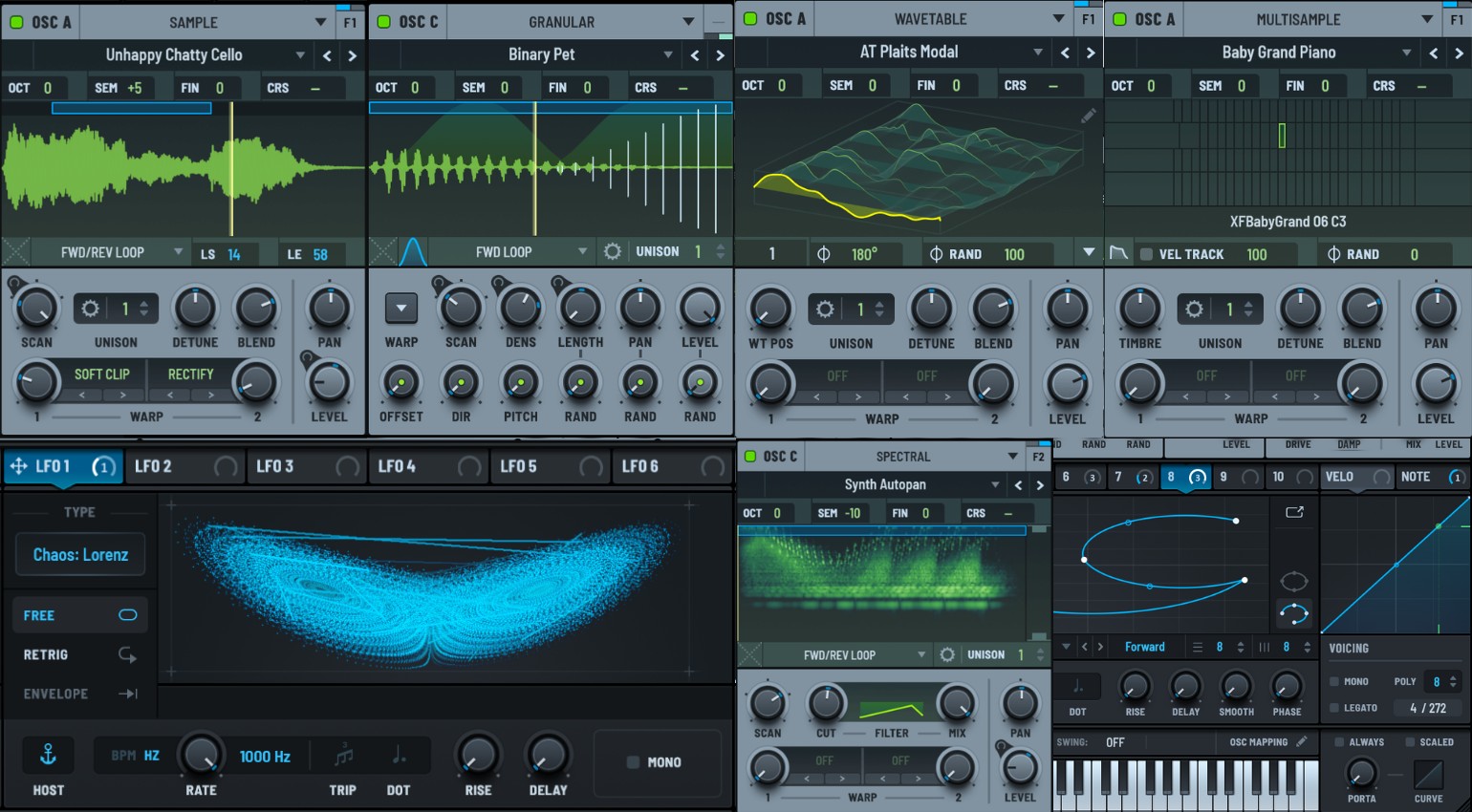
The biggest architectural change in Serum 2 is that each of the three oscillator slots can now switch between five distinct synthesis modes. This isn’t just adding features on top of features. It means you can run a wavetable oscillator, a granular engine, and a multisample player simultaneously within a single patch. Let’s break each mode down.
1. Wavetable Mode
This is the Serum you already know and love, carrying forward the full wavetable engine with 288 built-in wavetables. Every Serum 1 preset loads without issues. The wavetable editor retains its drag-and-drop workflow, and all the warp modes are still there. If wavetable synthesis is your bread and butter, nothing has been taken away — only added to.
2. Multisample Mode
This is where things get interesting. Each oscillator can now load SFZ-format multisamples, mapping different recordings across key ranges and velocity layers. Think pianos, strings, guitars, or any acoustic source that needs per-note sampling fidelity. Previously, you’d need a dedicated sampler like Kontakt for this. Now it lives inside Serum alongside your wavetable and granular oscillators, fully routable through Serum’s filter and effects chain.
3. Sample Mode
A streamlined single-sample player with pitch shifting, loop points, and crossfade controls. Load a vocal chop, a drum hit, or any one-shot and use it as an oscillator source. It’s simpler than multisample mode but fast and effective for creative sampling work. The key advantage here is speed — you can drag a sample directly into an oscillator slot and immediately start processing it through Serum’s filter and modulation engine without any mapping or zone setup. For producers who frequently chop and flip samples, this removes an entire step from the workflow.
4. Granular Mode
This is arguably the most significant addition. Granular synthesis takes an audio file, slices it into microscopic grains, and reassembles them in ways that can sound nothing like the original source. Inside Serum 2, you get full control over grain size, density, scan position, and randomization — all of which can be modulated through Serum’s drag-and-drop modulation matrix. For pad design, evolving textures, and ambient sound design, this mode alone justifies the update.
5. Spectral Mode
FFT-based spectral processing that decomposes audio into frequency bands for resynthesis. It’s the most experimental of the five modes and opens up territory that few synths explore at this level. The April 25 v2.0.17 update brought significant stability improvements to the spectral oscillator, along with key tracking for filter and distortion effects — a sign that Xfer is actively refining this engine.
626 Presets and a Rebuilt Effects Chain
Serum 2 ships with 626 factory presets, and these aren’t just rehashed Serum 1 sounds. A substantial portion leverages the new oscillator modes — granular textures, spectral pads, hybrid multisample-wavetable layers that simply weren’t possible before.
According to Gearnews, the effects section has been significantly expanded with a new PZSVF filter mode, 11 creative filter types, a Bode frequency shifter, convolution reverb, and a custom filter shape editor. The four envelopes are now BPM-syncable, and the integrated arpeggiator and clip sequencer can store up to 12 patterns. These aren’t minor quality-of-life improvements — they fundamentally expand what you can accomplish without leaving the plugin.
The Free Upgrade: Steve Duda’s Philosophy in Action
Perhaps the most talked-about aspect of Serum 2 has nothing to do with oscillators or filters. It’s the price: free for existing Serum owners. A decade’s worth of R&D, a completely rebuilt engine, five new synthesis modes — and if you already own Serum, you pay nothing.
This is nearly unprecedented in the plugin industry. When Native Instruments moved from Massive to Massive X, it was a separate purchase. Arturia charges for major Pigments upgrades. The subscription model is spreading across the industry. As RA reported, Steve Duda stuck to Xfer Records’ “lifetime free updates” principle. New users pay an introductory price of $189 (regular $249). It supports VST3, AU, and AAX on macOS High Sierra+ and Windows 10+.
In an era where every software company seems to be finding new ways to charge recurring fees, this kind of developer-user trust is worth acknowledging. It also creates a powerful network effect — when users know they’ll never be left behind, they invest more deeply in the ecosystem, building presets, sharing wavetables, and creating tutorials that benefit everyone.
The v2.0.17 Update: Rapid Iteration After Launch
The April 25 v2.0.17 patch is the third update since launch, and it signals that Xfer Records isn’t slowing down. Key additions include key tracking for filter and distortion effects, spectral oscillator bug fixes, velocity marker improvements, and expanded keyboard shortcuts. For a synth that just launched six weeks ago, this pace of iteration is reassuring. The spectral mode in particular has seen noticeable stability improvements since launch day.
\n\n\n\nThis rapid patch cycle also reflects how Steve Duda has always operated. Even Serum 1 received consistent updates for years after launch, each one refining CPU performance, adding wavetables, and squashing edge-case bugs. The v2.0.17 update specifically addressed issues that power users had reported in forums — spectral oscillator glitches when using extreme modulation depths, and inconsistent velocity response in certain multisample configurations. It’s the kind of developer responsiveness that builds long-term trust.
How Serum 2 Stacks Up Against the Competition
The soft synth landscape in 2025 is crowded, and Serum 2 doesn’t exist in a vacuum. Vital remains a compelling free option with solid wavetable capabilities. Phase Plant offers unmatched modular flexibility. Pigments 5 brings its own granular and spectral engines to the table. So where does Serum 2 fit?
The answer is integration. No other synth at this price point combines wavetable, granular, spectral, multisample, and sample playback within a single, unified interface with Serum’s legendary drag-and-drop modulation system. Individual modes might be deeper in dedicated plugins — Granulator II for pure granular work, or Falcon for advanced multisample scripting — but Serum 2’s strength is having everything under one roof with a workflow that millions of producers already know.
\n\n\n\nThere’s also the learning curve factor. If you already know Serum, you already know Serum 2. The new oscillator modes slot into the same interface paradigm — same modulation matrix, same drag-and-drop routing, same visual feedback philosophy. Switching to Phase Plant or Falcon means learning an entirely new environment. For working producers on deadlines, that familiarity has real dollar value.
The preset ecosystem matters too. Serum has the largest third-party preset market of any soft synth, and full backward compatibility means that entire library carries forward into Serum 2. No other competitor can match that ecosystem depth.
My Take: A Producer’s Perspective After 6 Weeks
I’ll be honest — before Serum 2 dropped, I’d largely moved to a Vital plus Phase Plant workflow for sound design. Granular work happened in dedicated plugins. Multisamples lived in Kontakt. Serum had become my “quick preset” synth rather than my go-to creative tool. That’s changed.
The ability to layer a granular oscillator with a wavetable oscillator inside a single instance, routing both through Serum’s new filter types and convolution reverb, has genuinely changed my approach to texture design. Tasks that used to require loading three plugins and carefully balancing levels between them now happen in one window. After 28 years in audio production, I’ve learned that the fastest path from idea to finished sound is always the one that wins — and Serum 2 has shortened that path significantly.
The granular engine isn’t perfect yet. Large sample files push CPU usage higher than I’d like, especially compared to dedicated granular synths like Quanta. But v2.0.17 already improved performance, and knowing Steve Duda’s track record with optimization over the past decade, I expect this to get better with every update.
What impresses me most is the philosophical consistency. Free upgrades for existing users. No subscription model. No feature-gating or tiered pricing. Just a great synth that keeps getting better. In 2025, that feels almost radical. Whether you’re deep into wavetable synthesis or looking for an all-in-one hybrid engine, Serum 2 at the current introductory price of $189 is difficult to argue against.
Need professional mixing, mastering, or sound design consultation? Greit Studios can help.
Get weekly AI, music, and tech trends delivered to your inbox.