Apple Mac Pro M4 Extreme Rumors: Server-Grade Desktop for Professionals
August 19, 2025
Sennheiser HD 660S2 vs Audeze LCD-X: The Definitive Open-Back Headphone Comparison for Audiophiles and Producers
August 20, 2025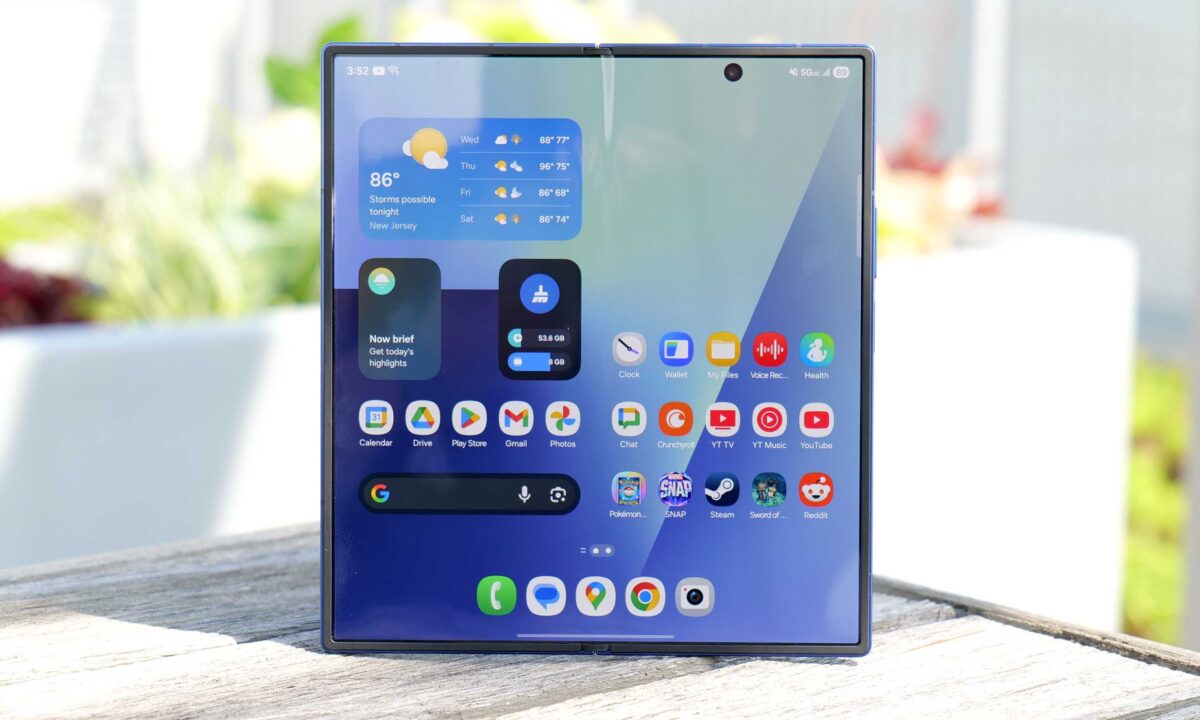
Galaxy Z Fold7 AI features just changed the conversation about what foldable phones can actually do. At 4.2mm unfolded and just 215 grams, Samsung has managed to cram multimodal AI, a 200MP camera, and Gemini Live screen sharing into the thinnest, lightest foldable ever manufactured — and after weeks of reviews flooding in since the July 9 Brooklyn Unpacked event, the verdict is remarkably consistent: this is the device that finally makes foldables worth buying. Not because it folds. Because of what it does when it unfolds.
The Thinnest Foldable Ever Built: Galaxy Z Fold7 Design Revolution
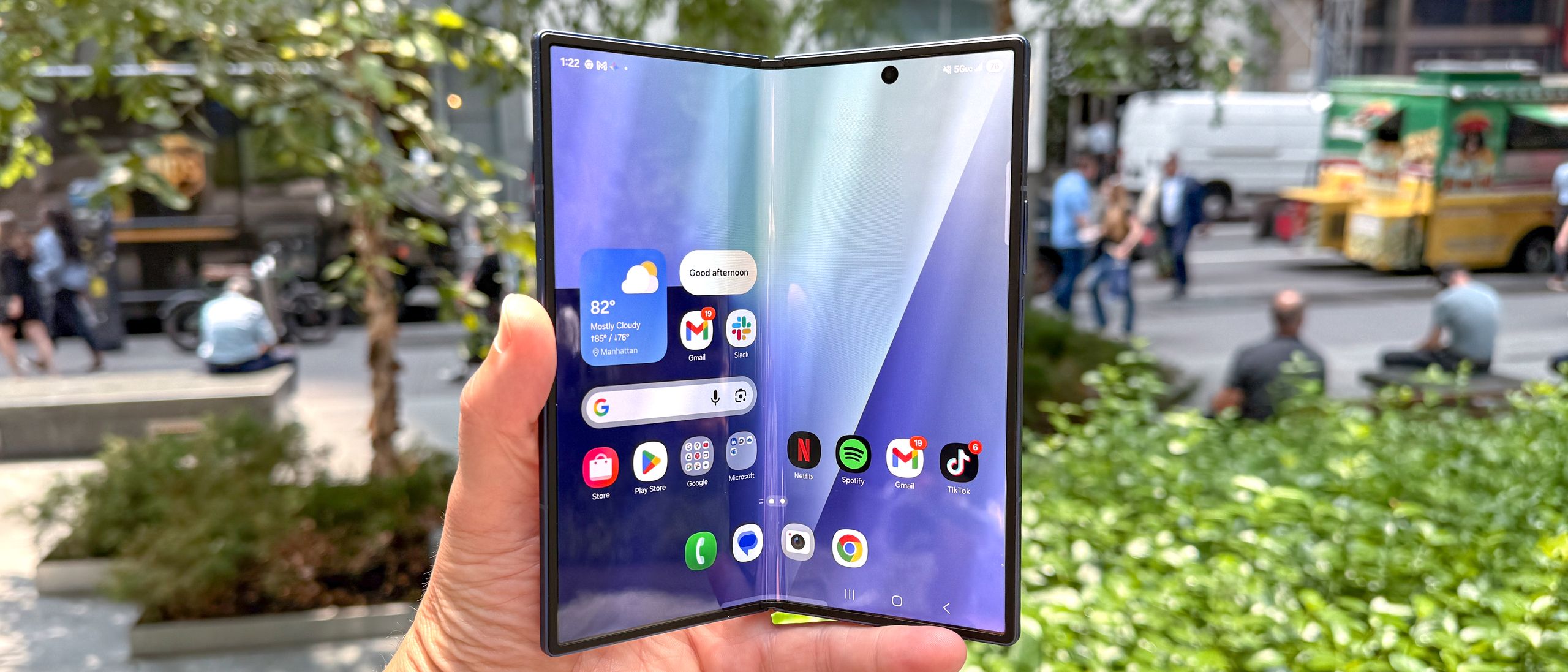
The numbers tell a story Samsung has been trying to write for years. 4.2mm unfolded. 8.9mm folded. 215 grams. That translates to 26% thinner and 10% lighter than the Galaxy Z Fold6. For anyone who has held a previous Fold and thought “interesting, but too thick for daily use,” the Z Fold7 demolishes that objection entirely. According to Samsung Global Newsroom, the redesigned Armor FlexHinge plays a crucial role here — it not only enables the slimmer profile but dramatically reduces the visibility of the center crease that has plagued every foldable since the category’s inception.
Durability hasn’t been sacrificed for thinness, either. Samsung claims the hinge mechanism has passed over 500,000 fold tests, which roughly translates to opening and closing your phone 100 times a day for nearly 14 years. The IP48 water resistance rating provides solid protection against dust and fresh water submersion, though it still falls short of the IP68 rating found on traditional flagships like the Galaxy S25 Ultra.
The displays received meaningful upgrades across the board. The inner screen now stretches to a full 8 inches — up from 7.6 inches on the Fold6 — while the cover display expanded to 6.5 inches. That cover screen alone is now larger than many standalone smartphones. Combined with 12GB or 16GB RAM options and storage configurations reaching up to 1TB, the Z Fold7 has the hardware credentials to serve as a genuine laptop replacement for mobile professionals. Engadget awarded it 88 out of 100, calling it “peak foldable phone design” — and after examining the specs, that assessment feels earned rather than hyperbolic.
Gemini Live Screen Sharing: The Galaxy Z Fold7 AI Feature That Changes Everything
If you remember only one Galaxy Z Fold7 AI feature from this article, make it Gemini Live with screen sharing. Previous AI assistants required you to describe what you were looking at or manually copy text into a chat window. Gemini Live eliminates that friction entirely. The AI now watches your screen in real time and responds conversationally to what it sees. You can show it a restaurant menu and ask for dietary recommendations. You can open a spreadsheet and ask it to explain trends in the data. You can browse a real estate listing and ask for a neighborhood analysis.
The implications for the foldable form factor are profound. On the Fold7’s 8-inch inner display, you can run an application on one half of the screen while chatting with Gemini Live on the other half. Imagine reviewing a contract on the left panel while the AI summarizes key clauses and flags potential issues on the right. Or shopping for flights on one side while Gemini Live cross-references hotel prices and local weather on the other. This is the kind of split-screen AI interaction that simply doesn’t work on a 6.1-inch traditional phone.
Google’s official blog announced four new Android AI updates arriving exclusively on Samsung Galaxy devices, with screen sharing integration sitting at the heart of the rollout. Samsung is bundling six months of free Google AI Pro with every Z Fold7 purchase, which unlocks access to Gemini 2.5 Pro — Google’s most capable model — along with Veo 3 Fast video generation. That’s roughly $120 in subscription value included out of the box, partially offsetting the device’s premium price tag.
200MP ProVisual Camera and Audio Eraser: Creative Tools That Justify the Price
Samsung finally addressed the Fold series’ biggest weakness: camera quality. For the first time, a 200MP sensor sits inside a foldable phone. Previous Fold models always compromised on camera specs compared to the Galaxy S Ultra line, but the Z Fold7 narrows that gap significantly. Samsung’s detailed specifications page confirms that the ProVisual Engine — Samsung’s AI-powered image processing pipeline — handles real-time enhancement of the massive 200MP captures. Pixel binning combines data from multiple sensor pixels to produce brighter, sharper 12.5MP images in low light, while the full 200MP resolution remains available for daylight shooting when you want maximum detail for cropping.
Portrait Studio now extends beyond humans to support pet photography, using AI to recognize and properly focus on dogs, cats, and other animals. It’s a seemingly small addition, but for the millions of smartphone users whose camera rolls are dominated by pet photos, it addresses a real pain point — blurry pet portraits have been a universal smartphone frustration.
For video creators, Audio Eraser might be the most practically useful AI feature on the entire device. After recording a video, Audio Eraser uses AI to separate and isolate different audio elements — wind noise, crowd chatter, traffic sounds, background music — and lets you selectively reduce or remove them. Think of it as a simplified, on-device version of professional audio source separation tools. No need to export footage to a desktop editing suite for basic noise cleanup. For content creators who shoot Instagram Reels, TikToks, or YouTube Shorts on location, this eliminates a significant post-production step.
Snapdragon 8 Elite for Galaxy: The AI Engine Powering It All
Every one of these AI features demands serious processing power, and the Snapdragon 8 Elite for Galaxy delivers the biggest generational leap in years. The NPU — the dedicated neural processing unit that handles AI workloads — jumped 41% in performance. CPU improved 38%, and GPU gained 26%. That NPU number is the most significant because it directly determines how quickly and efficiently the device can run on-device AI tasks without offloading work to cloud servers. Faster NPU means faster photo processing, faster audio separation, faster Gemini Live responses, and better battery life while running AI features since the processor completes tasks more efficiently.
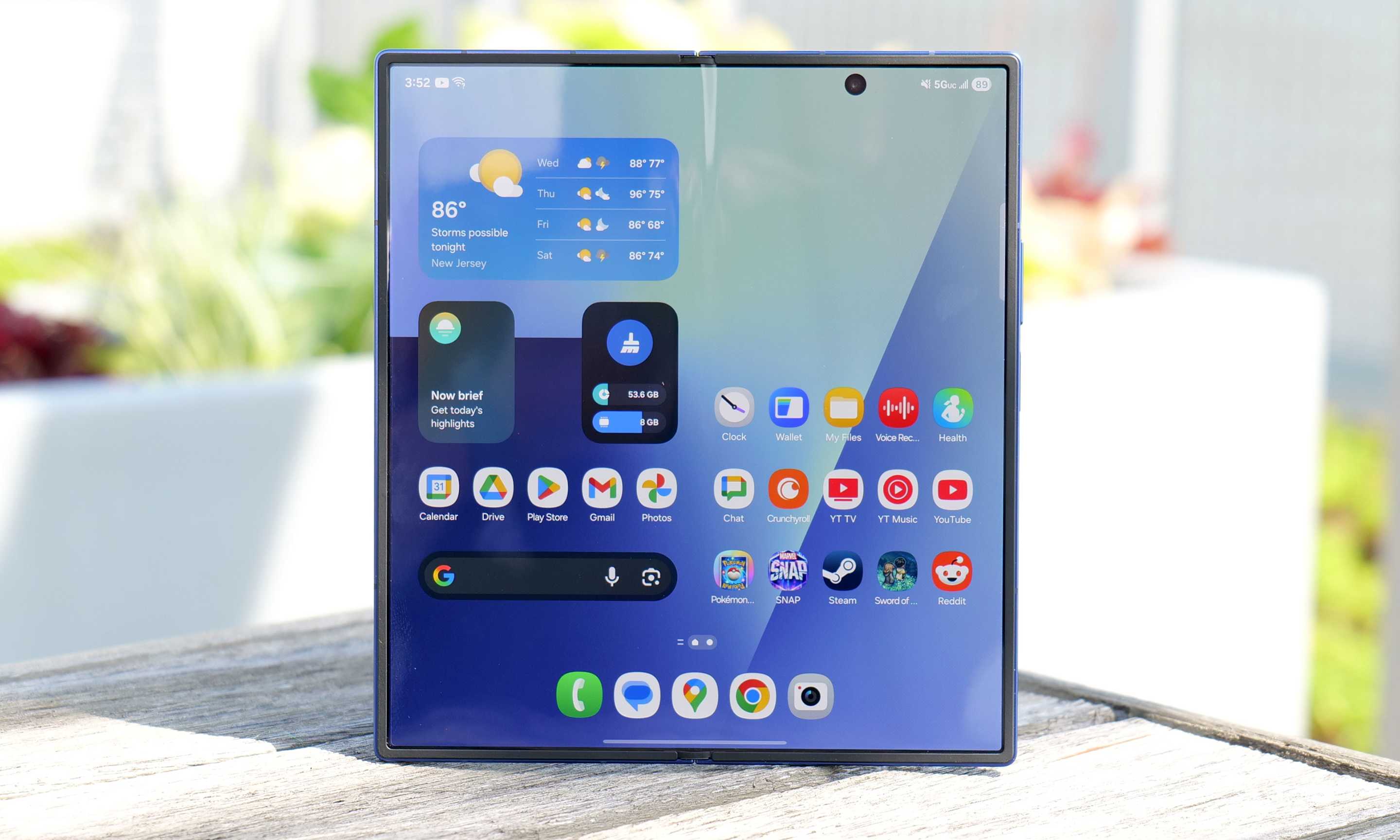
One UI 8 leverages this hardware foundation to weave AI throughout the entire operating system. The scope of integrated AI features is genuinely impressive:
- Chat Assist — rewrites messages in different tones (professional, casual, persuasive) directly in any messaging app
- Browser Assist — summarizes lengthy web articles and translates pages with context-aware accuracy
- Note Assist — transcribes voice recordings, organizes meeting notes, and generates action item summaries
- Circle to Search — draw a circle around anything on screen to instantly search for it
- Now Brief — delivers proactive, location-aware AI insights throughout your day based on your calendar, habits, and surroundings
Tom’s Guide awarded the Z Fold7 4.5 out of 5 stars, calling it “the first foldable phone I’d actually buy.” That’s particularly notable coming from a publication that has historically been skeptical of foldables’ value proposition. The consensus across major tech outlets is clear: Samsung has crossed a threshold where the foldable form factor isn’t just a novelty but a genuine advantage for AI-powered workflows.
The $2,000 Question: Who Should Buy and Who Should Wait?
Let’s be direct about the trade-offs. The Galaxy Z Fold7 starts at $2,000 — roughly $200 more than the Galaxy S25 Ultra and double the price of most mid-range flagships. S Pen support has been dropped entirely, which eliminates a feature that distinguished the Fold series from other large-screen devices. Battery life, while adequate for a full day, hasn’t seen the dramatic improvement that would silence critics. The 25W wired charging and 15W Qi2 wireless charging feel conservative when Chinese competitors are shipping 100W+ charging in their foldables.
But here’s the critical reframing: the Galaxy Z Fold7 isn’t competing as “a better foldable.” It’s positioning itself as a new form factor purpose-built for the AI era. Gemini Live screen sharing is transformative on an 8-inch display but cramped on a 6-inch screen. Multi-window AI workflows require real estate that only a foldable provides. The 200MP ProVisual camera combined with the unfolded viewfinder experience gives photographers and videographers a fundamentally different creative tool.
Samsung’s enterprise play reinforces this positioning. Samsung Business Insights published a dedicated analysis of business productivity use cases for the Z Fold7, highlighting multi-window AI assistant usage, presentation capabilities on the large inner screen, and secure folder functionality for separating work and personal data. For corporate buyers evaluating mobile device fleets, the Z Fold7 offers a compelling argument for foldables as productivity multipliers rather than consumer novelties.
The ideal buyer profile is clear: business professionals who live in their phones, content creators who need a pocket-sized production studio, and early adopters who want to experience AI features the way Samsung designed them to be used — on a big, foldable screen. If you’re primarily a social media scroller who makes calls and sends texts, the Galaxy S25 remains the smarter buy.
What Samsung proved with the Galaxy Z Fold7 is unmistakable: foldables are no longer a curiosity — they’re becoming the platform where AI delivers its most tangible, practical value. The next time you think about upgrading your smartphone, the question isn’t whether you want a phone that folds. It’s whether you’re ready for AI that unfolds.
Get weekly AI, music, and tech trends delivered to your inbox.