Ableton Live 12 Max for Live Essentials: 10 Must-Have Devices Every Producer Needs
August 26, 2025
AI Art Copyright Showdown: Jason Allen Takes the US Copyright Office to Federal Court
August 27, 2025
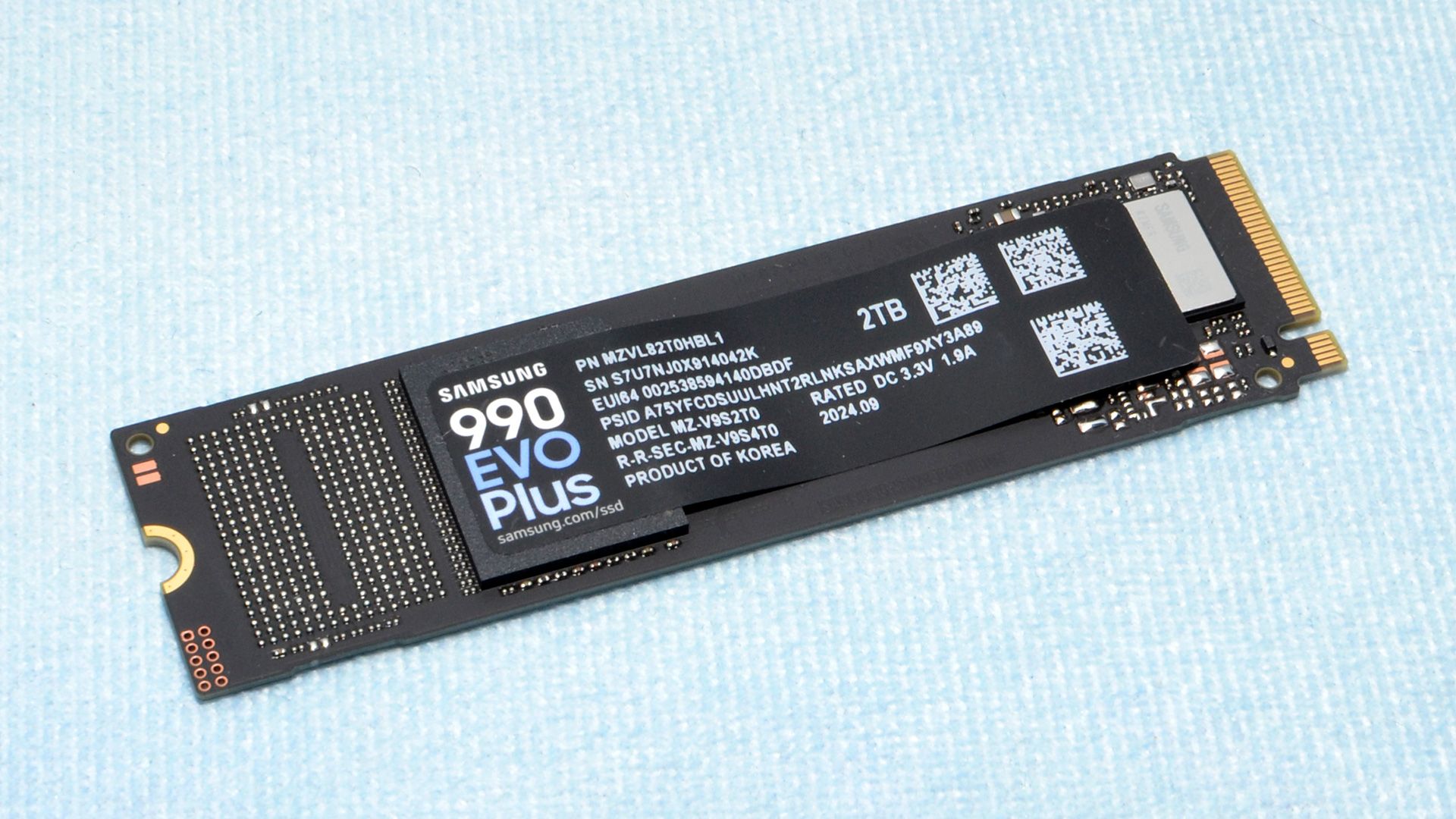
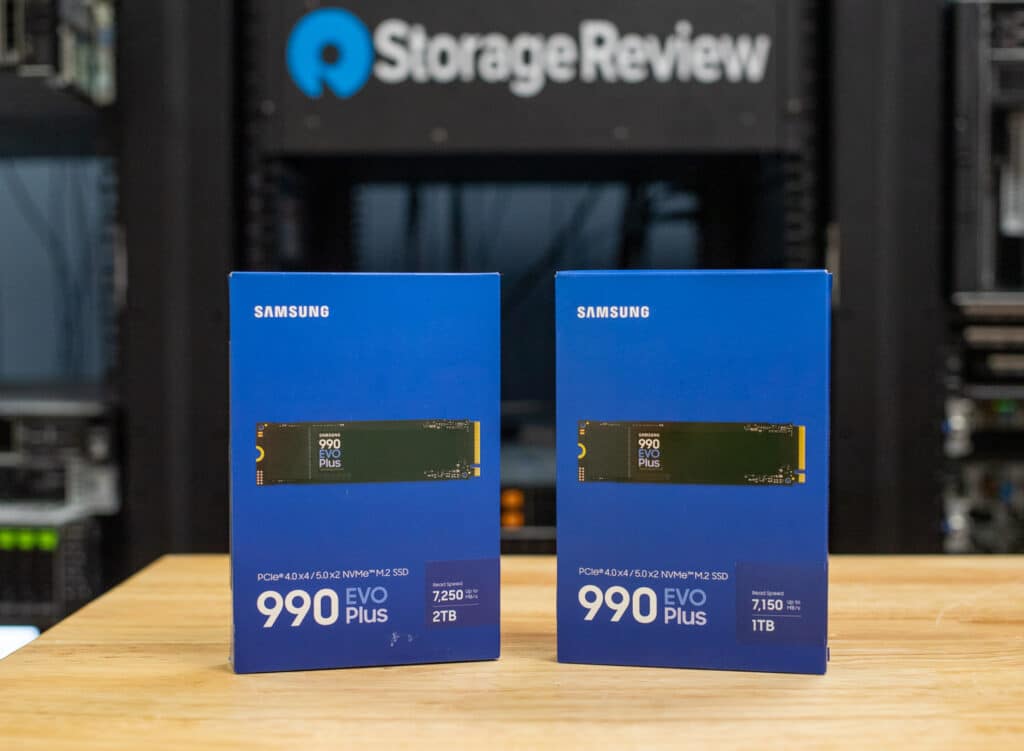
Samsung just dropped a 4TB NVMe SSD that hits 7,250 MB/s while sipping power like a drive half its speed — and at $345 MSRP, the Samsung 990 EVO Plus 4TB might be the most compelling high-capacity storage option of 2025. But there’s a catch that every buyer needs to know about before pulling the trigger.
What Makes the Samsung 990 EVO Plus 4TB Different
The original 990 EVO was, frankly, a disappointment. Samsung’s hybrid PCIe 4.0/5.0 concept was promising, but execution fell short — sluggish sustained writes, questionable value, and performance that didn’t justify the Samsung tax. The 990 EVO Plus is Samsung’s mea culpa, and the improvements are substantial.
At its core, the Samsung 990 EVO Plus 4TB uses 8th-generation V-NAND TLC paired with Samsung’s in-house 5nm controller. The drive operates on a hybrid PCIe Gen 4.0 x4 / Gen 5.0 x2 interface with NVMe 2.0 protocol, packaged in the standard M.2 2280 form factor. Instead of dedicated DRAM cache, Samsung opted for Host Memory Buffer (HMB) technology combined with their Intelligent TurboWrite 2.0 system.
The result? A 45% sequential speed increase over the original 990 EVO — jumping from 5,000 MB/s to 7,250 MB/s reads and 6,300 MB/s writes. Random performance sits at 1,050,000 read IOPS and 1,400,000 write IOPS at QD32. Perhaps more impressively, Samsung claims 73% greater power efficiency over its predecessor.
The HMB vs. DRAM Debate: Understanding the Trade-Off
Before diving into benchmarks, it’s worth understanding the most controversial design decision Samsung made with the 990 EVO Plus. Traditional high-performance NVMe SSDs use a dedicated DRAM chip as a cache buffer — this is a small but fast pool of memory that stores the drive’s mapping table, allowing the controller to instantly know where every piece of data lives on the NAND chips.
Samsung chose Host Memory Buffer (HMB) instead, which borrows a small portion of your system’s RAM for this mapping table. The upside is lower power consumption, reduced manufacturing cost, and a smaller physical footprint. The downside is that random I/O performance — particularly random 4K reads and writes at low queue depths — takes a hit compared to DRAM-equipped drives. This is the fundamental trade-off that defines the entire 990 EVO Plus product line.
In practice, this means the 990 EVO Plus excels at large sequential transfers (copying files, loading games, video editing timelines) but falls behind in workloads that involve many small random accesses (database queries, virtual machine disk operations, compiling large codebases). For most consumer use cases, you’ll never notice the difference. For professional workstation tasks, you absolutely will.
Samsung 990 EVO Plus 4TB Benchmark Results: Rated vs. Real-World
Marketing numbers are one thing — actual performance is another. Fortunately, the 990 EVO Plus 4TB mostly delivers on Samsung’s promises, though the story gets more nuanced under sustained workloads.
Sequential Performance
In CrystalDiskMark 8 sequential tests, the 990 EVO Plus easily outpaces most of its competition. PCWorld rated the drive 4 out of 5 stars, noting its “exceptional sequential performance with hybrid PCIe 4.0/5.0 design.” The numbers back this up — the drive consistently hits near its rated 7,250 MB/s reads in synthetic benchmarks.
Real-world testing tells a slightly different but still impressive story. StorageReview’s Blackmagic tests showed 5,470 MB/s reads and 4,880 MB/s writes — excellent numbers for actual file transfer and content creation workflows. The gap between synthetic and real-world numbers is typical for NVMe drives and shouldn’t cause concern. What matters is that the 990 EVO Plus delivers genuinely fast sequential performance in the applications people actually use.
Random 4K Performance — The Weak Spot
Here’s where the HMB decision bites. Random 4K performance is marginally faster than the original 990 EVO, but the drive loses ground to DRAM-equipped competitors like the WD Black SN850X and Crucial T500. For everyday computing, gaming, and content creation, you likely won’t notice the difference. For database-heavy workloads or virtual machine environments, you will. PCWorld specifically noted that while random 4K performance was “marginally faster than 990 EVO,” it “loses ground to DRAM competitors” — a fair assessment that potential buyers should weigh carefully.
Sustained Write Performance
Tom’s Hardware gave the drive 3.5 out of 5 stars, praising the improvements while noting the sustained write behavior. TurboWrite 2.0 keeps the drive fast for approximately 450GB of continuous writes — considerably better than the original 990 EVO. After that buffer is exhausted, write speeds drop to around 1.2 GB/s. For the vast majority of consumer workloads, you’ll never hit that wall, but it’s worth knowing for users who regularly transfer massive video files or datasets.
To put this in perspective, 450GB of continuous writing covers most real-world scenarios — even transferring an entire game library or a large video project won’t typically exceed this threshold in a single burst. The 1.2 GB/s fallback speed is still faster than most SATA SSDs at peak performance, so even the “slow” mode isn’t actually slow by any reasonable standard.
Power Efficiency: Where the Samsung 990 EVO Plus 4TB Shines
If there’s one area where the 990 EVO Plus genuinely leads, it’s power efficiency. Active read power draws just 5.5W, writes consume 4.8W, and the drive drops to a mere 5mW in L1.2 sleep mode. That 73% efficiency improvement over the original 990 EVO isn’t marketing fluff — it translates to real battery life gains for laptop users.
The nickel-coated heat shield also deserves mention. Multiple reviewers noted zero thermal throttling issues during sustained testing. One reviewer described it as delivering “100% solid performance, zero heat” — high praise for a 4TB NVMe drive that’s essentially cramming more NAND layers into the same M.2 footprint.
For laptop users, content creators working on battery, or anyone building a compact workstation where thermal management matters, this efficiency profile is a genuine differentiator. The combination of low active power draw and aggressive sleep states means the 990 EVO Plus won’t be the component draining your battery during light workloads — a meaningful advantage for mobile professionals who need both capacity and endurance on the go.
Security and Endurance Features
Samsung includes AES 256-bit hardware encryption with TCG/Opal v2.0 and Microsoft eDrive support. For enterprise environments or security-conscious users, this means full-disk encryption without the performance penalty of software-based solutions. The 2,400 TBW (terabytes written) endurance rating is generous for a consumer drive — at 100GB of writes per day, you’d need over 65 years to exhaust the drive’s rated lifespan. Samsung backs this with a 5-year limited warranty, which is standard for the premium NVMe segment.
Competitor Comparison: 990 EVO Plus vs. the 4TB Field
The 4TB NVMe market in August 2025 is surprisingly competitive. Here’s how the 990 EVO Plus stacks up against the drives most buyers will be cross-shopping:
vs. Samsung 990 Pro
Samsung’s own 990 Pro remains significantly faster in random I/O workloads, thanks to its dedicated DRAM cache. If raw performance is your priority and you don’t care about power draw, the 990 Pro is the better Samsung drive. The EVO Plus wins on efficiency and offers a different value proposition — good enough performance with excellent power characteristics.
vs. WD Black SN850X 4TB (~$280)
The SN850X has a DRAM cache and delivers faster random 4K performance. The 990 EVO Plus is competitive in sequential speeds thanks to its PCIe 5.0 x2 support and offers better power efficiency. At roughly $65 less, the SN850X is the harder value proposition to argue against — unless power efficiency is a priority for your specific build.
vs. Crucial T500 4TB (~$290)
Similar story here. The T500 features DRAM with a hybrid pSLC cache, giving it an edge in random workloads. The 990 EVO Plus matches or beats it in sequential reads while consuming less power. Again, the T500 undercuts Samsung on price while offering comparable or better performance in many scenarios.
Specs at a Glance
- Interface: PCIe Gen 4.0 x4 / Gen 5.0 x2, NVMe 2.0
- Form Factor: M.2 2280
- NAND: Samsung V-NAND TLC (V8, 8th generation)
- Controller: Samsung in-house 5nm
- Cache: HMB + Intelligent TurboWrite 2.0
- Sequential Read/Write: 7,250 / 6,300 MB/s
- Random Read/Write: 1,050K / 1,400K IOPS
- Endurance: 2,400 TBW
- Power: 5.5W read / 4.8W write / 5mW sleep
- Encryption: AES 256-bit, TCG/Opal v2.0
- Warranty: 5-year limited
- MSRP: $344.99 (street price: $235–$345)
Who Should Buy the Samsung 990 EVO Plus 4TB — and Who Shouldn’t
Buy it if: You need a high-capacity NVMe SSD with excellent power efficiency for a laptop or compact build. The combination of 4TB capacity, near-PCIe-5.0 sequential speeds, and class-leading efficiency makes it ideal for content creators, gamers with massive libraries, or anyone consolidating storage into a single fast drive. The 2,400 TBW endurance and 5-year warranty provide solid peace of mind.
Skip it if: You need the absolute best random I/O performance for professional workstation tasks. At $345 MSRP, the pricing is hard to justify when DRAM-equipped competitors like the WD Black SN850X 4TB sit around $280 with better random performance. If you’re building a desktop where power draw is irrelevant, cheaper and faster options exist.
The Samsung 990 EVO Plus 4TB is essentially the SSD equivalent of a fuel-efficient sedan — it won’t win any drag races against the sports cars in its class, but it’ll get you where you need to go quickly and without burning through resources. For the right use case, that’s exactly what you want. Samsung finally delivered what the original EVO should have been, even if the pricing still leaves room for debate in an increasingly competitive 4TB market.
Get weekly AI, music, and tech trends delivered to your inbox.