Tidal Direct-to-Fan Downloads: 90/10 Revenue Split vs Bandcamp’s 85/15 — How the New Feature Changes Independent Music Distribution
March 18, 2026
Korg microAudio 722 Filter Ark Review: A $269 Audio Interface With Built-In Analog Synth Filter
March 19, 2026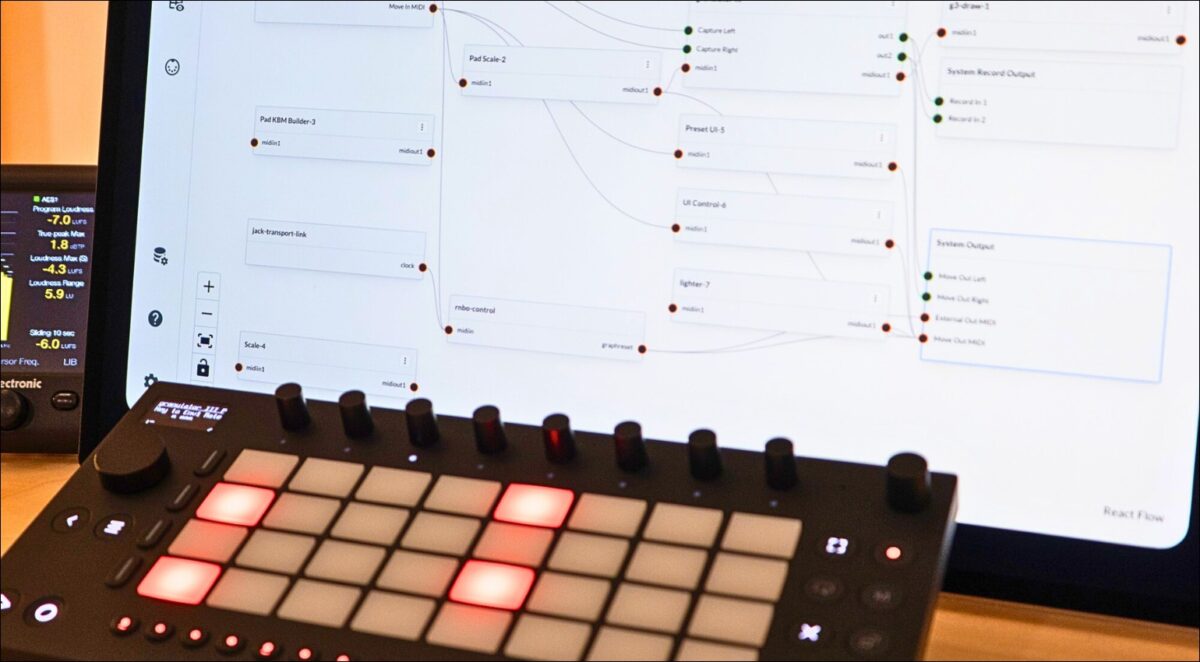
It finally happened. You can now load your own custom RNBO Move Takeover patches onto Ableton Move — that compact, standalone groove box — and run them natively on the hardware. Cycling 74’s experimental alpha release transforms Move from a dedicated beat-making device into a fully programmable sound design platform, and the implications are massive.
What Is RNBO Move Takeover?
RNBO Move Takeover is an experimental alpha project from Cycling 74 that lets you deploy Max patches directly to Ableton Move hardware via the RNBO compiler. If you’re already familiar with RNBO — the technology that exports Max patches to the web, VST/AU plugins, and Raspberry Pi — think of this as adding Ableton’s standalone hardware to that list of targets.
The name “Takeover” is literal. When you activate this mode, Move’s default firmware is temporarily replaced by your custom creation. Your synth, your effect, your MIDI tool — whatever you’ve built in Max — takes full control of the hardware. That means all 64 pads, 16 knobs, the OLED display, and the audio I/O are yours to map and program however you see fit.
Granulator 3 Standalone: Granular Synthesis in Your Hands
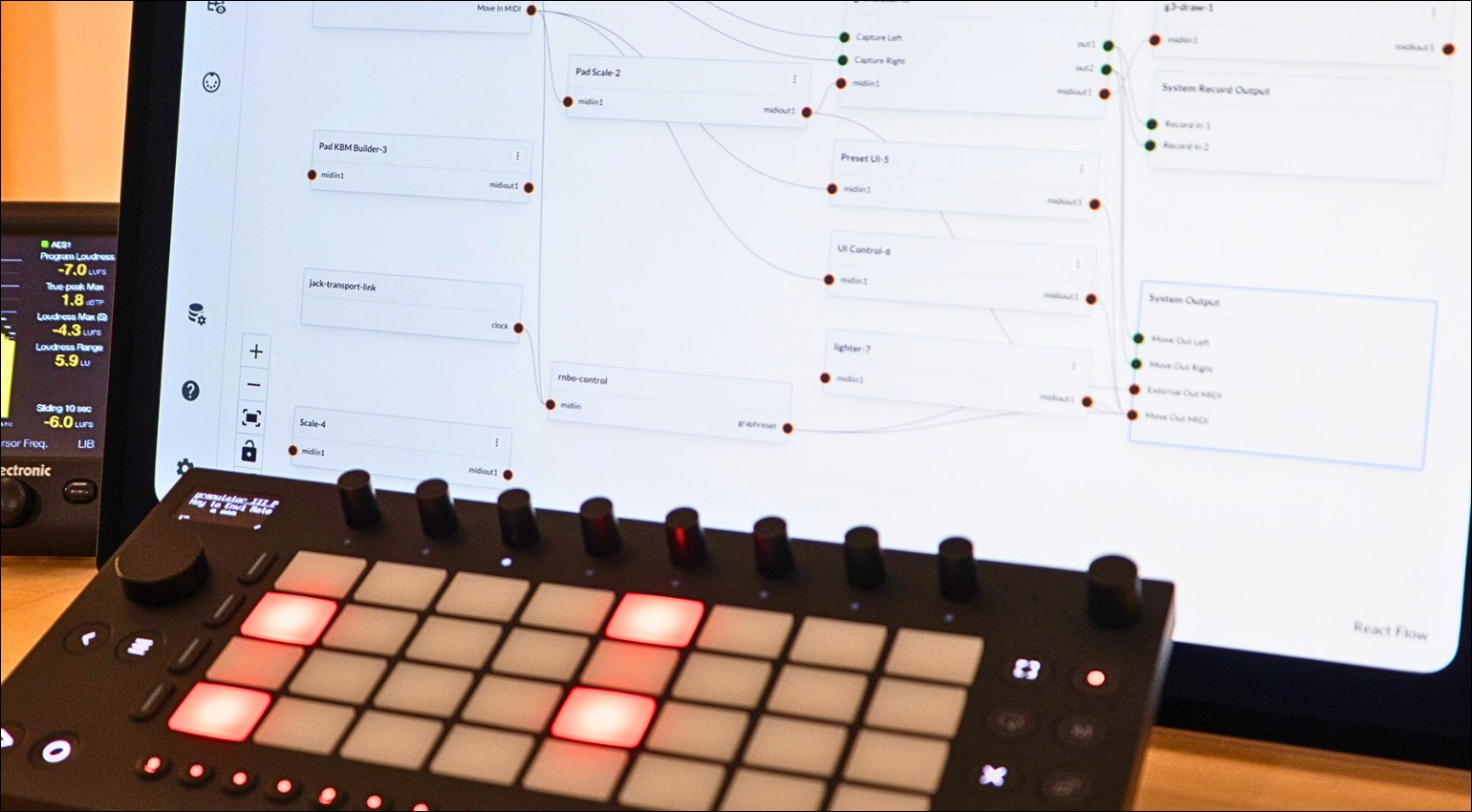
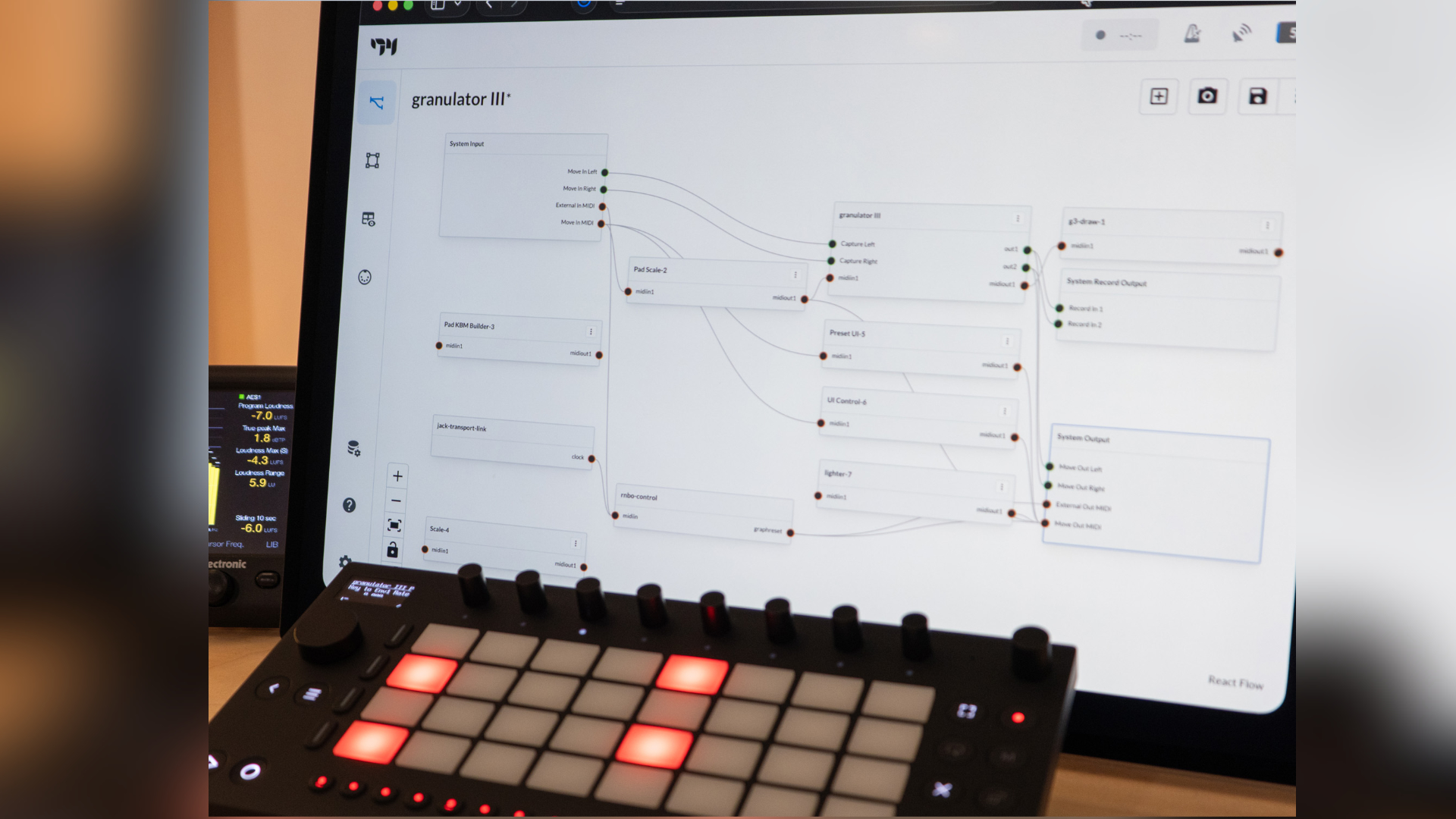
The showcase example that demonstrates RNBO Move Takeover’s potential is Granulator 3 running standalone on Move. Originally designed by Robert Henke (Monolake) as a Max for Live device, this legendary granular synthesizer now operates independently on Move hardware. No computer tethered. No DAW required. Just Move and granular sound design.
Granulator 3 on Move offers three distinct granular playback modes. The first is a classic granular mode that works with preset samples loaded onto the device. The second is a live capture mode that grabs real-time audio input and instantly decomposes it into grains for manipulation. The third is a hybrid mode combining both approaches. According to CDM’s coverage, these three modes alone make Move a viable tool for live textural performance — pads control grain position in real time while knobs handle grain size, pitch spread, and density.
For ambient producers, sound designers, and experimental musicians who have relied on Granulator inside Ableton Live, having it as a portable standalone instrument is genuinely exciting. Battery-powered granular synthesis you can take anywhere — that’s not a niche feature, that’s a paradigm shift for a specific but passionate community.
What makes the Move implementation particularly interesting is how the hardware’s physical interface maps to granular parameters. The 64 velocity-sensitive pads become a spatial grid for navigating grain position across the sample buffer, while dedicated knobs provide immediate tactile control over grain density, window shape, and pitch randomization. This kind of direct physical interaction with granular parameters has traditionally required expensive dedicated controllers or awkward mouse-driven workflows. Move collapses that complexity into an integrated, battery-powered package that weighs under a kilogram.
Technical Requirements and Setup Process
Since RNBO Move Takeover is in alpha, there are prerequisites to get started. You’ll need Max 9.1.3 or later with an active RNBO license. The setup process follows Cycling 74’s official documentation.
- Install Max 9.1.3+ and activate your RNBO license
- Download the Move Takeover package from Cycling 74’s official site
- Connect Move via USB and select ‘Move’ as the export target in RNBO’s sidebar
- Compile your patch and it auto-deploys to Move — reboot enters Takeover mode
- To return to stock firmware, perform a factory reset on Move
Because this is an alpha release, stability isn’t guaranteed. Cycling 74 explicitly recommends this for experimentation and prototyping rather than production environments. That said, if you’re the kind of musician who lives on the bleeding edge, alpha builds are where the most interesting discoveries happen.
Custom Patch Development: What’s Actually Possible
Granulator 3 is the proof of concept, but the real value of RNBO Move Takeover lies in what sound designers can build from scratch. Here’s what the platform enables.
Custom Synthesizers: FM, wavetable, subtractive, granular, additive — any synthesis architecture you can build in Max can now run standalone on Move. Map 64 pads to a custom scale layout, assign knobs to filter cutoff and envelope parameters, and you’ve got a fully independent hardware synth that doesn’t exist anywhere else.
Effect Processors: Using Move’s audio input, you can build real-time effects processors that handle external audio sources. Granular delays, spectral processors, custom reverb designs, resonators — Max’s powerful DSP capabilities are now deployable to portable hardware. Imagine a guitarist feeding their signal through a custom spectral freezer running on Move during a live set.
MIDI Tools: Move can become a fully custom MIDI controller with programmable logic. Redesign the pad and knob MIDI mapping entirely, build custom sequencers, arpeggiators, chord generators, or generative MIDI tools. The possibilities for live performance control are essentially unlimited.
Why Open Hardware Sound Design Matters
This project matters beyond its immediate functionality because it challenges how commercial music hardware has always worked. Until now, the deal was simple: you buy a hardware instrument, and you get exactly the features the manufacturer built into the firmware. Want something different? Wait for an update or buy a different device.
RNBO Move Takeover breaks that contract. As major music tech publications have analyzed, this represents Ableton’s first deliberate step toward positioning their hardware as an open platform. While Teenage Engineering’s OP-Z experimented with Unity integration and the Daisy platform offered open-source hardware from the start, a company of Ableton’s scale opening up an existing commercial product to custom programming is unprecedented.
If this direction succeeds, it could reshape how we think about buying music hardware. Instead of purchasing an instrument, you’re purchasing a platform. A community that shares patches, sound designers who distribute custom instruments, hardware that becomes more valuable over time as its ecosystem grows — that’s the potential here.
Realistic Limitations of the Alpha
Excitement aside, there are practical limitations worth understanding. First, Move’s hardware performance. Running on an ARM processor, Move has finite processing power compared to a desktop machine. Complex FFT-based processing or patches demanding high polyphony will hit the CPU ceiling. Part of the design challenge will be optimizing patches for Move’s specific constraints — a skill that takes time to develop.
Second, the alpha status means bugs are expected. Returning from Takeover mode requires a factory reset, which isn’t ideal for quick switching between custom patches and Move’s native functionality. For live performers, this friction could be a dealbreaker until a more elegant switching mechanism is implemented.
Third, the dependency on Max’s ecosystem creates a barrier to entry. You need both a Max license and an RNBO license to develop custom patches, which represents a significant investment. For users who don’t already work in Max, the learning curve is steep. That said, Cycling 74 is mitigating this by providing pre-built patches like Granulator 3 that work out of the box — no Max programming required.
Practical Use Cases: Who Benefits Most
Live Performers: Ambient, electronic, and experimental musicians get the most immediate value. Real-time granular texture manipulation, live audio processing, generative sequences — all without a laptop on stage. Move’s battery operation and compact form factor amplify this use case significantly. Picture a busker with a Move running a custom generative ambient synth, performing in a park with no power outlet in sight.
Sound Designers: Film, game, and media sound designers gain a portable custom sound generator for field work. Process field recordings through real-time granular effects, or carry project-specific sound palettes loaded onto hardware. Industry observers have noted that this could establish Move as a standard tool in sound design kits alongside field recorders.
Educators and Students: Interactive sound installations, media art projects, and DSP education all benefit. Demonstrating Max patches on actual hardware rather than just in software creates a tangible learning experience. Students designing their own instruments and deploying them to physical hardware? That’s an educational experience that software alone can’t replicate.
Hardware Prototypers: If you’re developing a hardware instrument concept, Move + RNBO serves as a rapid prototyping platform. Test your synth architecture, gather user feedback, and iterate on the design before committing to custom PCB production. It’s enormously cheaper and faster than building from scratch.
Looking Ahead: Beyond Move
If RNBO Move Takeover graduates from alpha to a stable release, the ripple effects extend well beyond Move itself. The obvious next question is whether Push 3 Standalone gets the same treatment. With its more powerful processor, larger display, and expanded I/O, Push running custom RNBO patches could be even more transformative.
There’s also an intriguing community dimension. If Cycling 74 builds out a patch-sharing ecosystem — similar to Max for Live’s existing community library — Move owners could download and install community-created instruments without ever opening Max themselves. A marketplace of custom Move instruments, effects, and tools could dramatically expand the device’s appeal beyond its current user base.
Zooming out further, this fits into a broader trend where the boundary between music software and hardware continues to dissolve. The “write once, run anywhere” paradigm — design in Max, deploy to web, plugin, or embedded hardware — is now becoming reality for music tools. It’s the same trajectory that transformed general software development decades ago, finally arriving in our creative domain.
The smartest move right now is to start experimenting early. Building experience during the alpha phase means you’ll be ahead of the curve when the stable release arrives. If you already own a Move, head to Cycling 74’s official guide and start exploring. If Max is new to you, begin with the pre-built Granulator 3 patch and work your way up from there. Open hardware sound design isn’t coming — it’s already here.
Looking to optimize your live performance setup, build custom sound design workflows, or explore hardware-software integration for your studio?
Get weekly AI, music, and tech trends delivered to your inbox.