Mistral AI Studio Launch: Europe’s Answer to Enterprise AI Agent Deployment and Monitoring
October 6, 2025
Apple iMac M5 Launch: All-in-One Desktop Gets Desktop-Class AI
October 6, 2025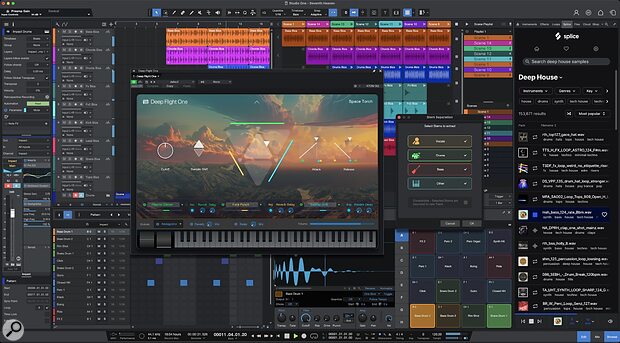
Finally. PreSonus just dropped Studio One 7 with a tagline that’s either audacious or prophetic: “The DAW for All.” AI-powered stem separation, the first-ever native Splice integration in any DAW, State Space Modeling-based Mix Engine FX, and 30+ new features — all for $199.99. Whether you’re on Logic Pro, Ableton Live, or Cubase, this update demands your attention. Here’s everything that matters.
AI Stem Separation: Studio One 7 Enters the AI Race
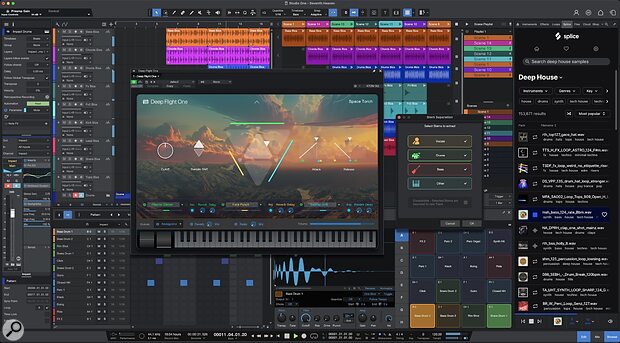
The headline feature of Studio One 7 is AI-powered stem separation, and it works right on the timeline. Drop any mixed audio file and split it into four stems — vocals, drums, bass, and chords — without leaving your project. Apple introduced a similar feature in Logic Pro 11 earlier this year, and Sound On Sound has already noted the emerging competition between the two implementations.
What makes this more than a remix toy is the workflow integration. Previously, isolating stems meant round-tripping through iZotope RX or a standalone AI tool. Now you can extract the drum bus from a live recording and slap reverb on it, or pull a vocal line from a reference track for arrangement purposes — all within the same session. For producers who work with sample-heavy productions or live recordings, this eliminates an entire category of friction.
Mix Engine FX: State Space Modeling Brings Analog Console Character
If the AI features grabbed the headlines, the Mix Engine FX evolution is what audio engineers should really be watching. The CTC-1 Pro Console Shaper uses State Space Modeling (SSM) to recreate the character of legendary analog consoles — but not the way most emulations work. Instead of approximating the entire signal path with a single processing stage, SSM models each individual electronic component and applies it at the appropriate point in the signal chain.
The architectural brilliance of Mix Engine FX is in its efficiency. Insert a single plugin instance on a bus channel or main output, and every signal routed into that channel gets processed independently at the source. Put Console Shaper on your master bus with 32 tracks routed in, and each track passes through its own individually modeled analog channel strip. This delivers both CPU efficiency and the kind of subtle per-channel variation that makes mixes on large-format consoles sound alive.
After 28 years of mixing on both analog desks and ITB, I can tell you this approach mirrors what actually happens in a real studio. Each channel on an SSL or Neve has its own subtle character — tiny component-level variations that create a natural stereo image. Applying identical processing to every channel is fundamentally different from this, and Studio One’s SSM approach gets closer to the real thing than most console emulation plugins I’ve used.
Native Splice Integration: A DAW Industry First
Studio One 7 is the first DAW to integrate Splice directly into its browser. No more switching to the Splice desktop app, downloading samples, and manually importing them. You can search, preview, and drag-and-drop Splice content directly from Studio One’s browser — and samples automatically sync to your project’s rhythm, key, and tempo.
The “Search with Sound” feature is particularly clever: it finds samples that match your current project context. This requires a separate Splice subscription ($12.99/month), but new users get 2,500+ royalty-free samples included. For beatmakers and sample-heavy producers, this integration alone could be worth the upgrade — the time savings from eliminating app-switching add up fast.
Integrated Launcher: Ableton’s Session View Meets Linear Workflow
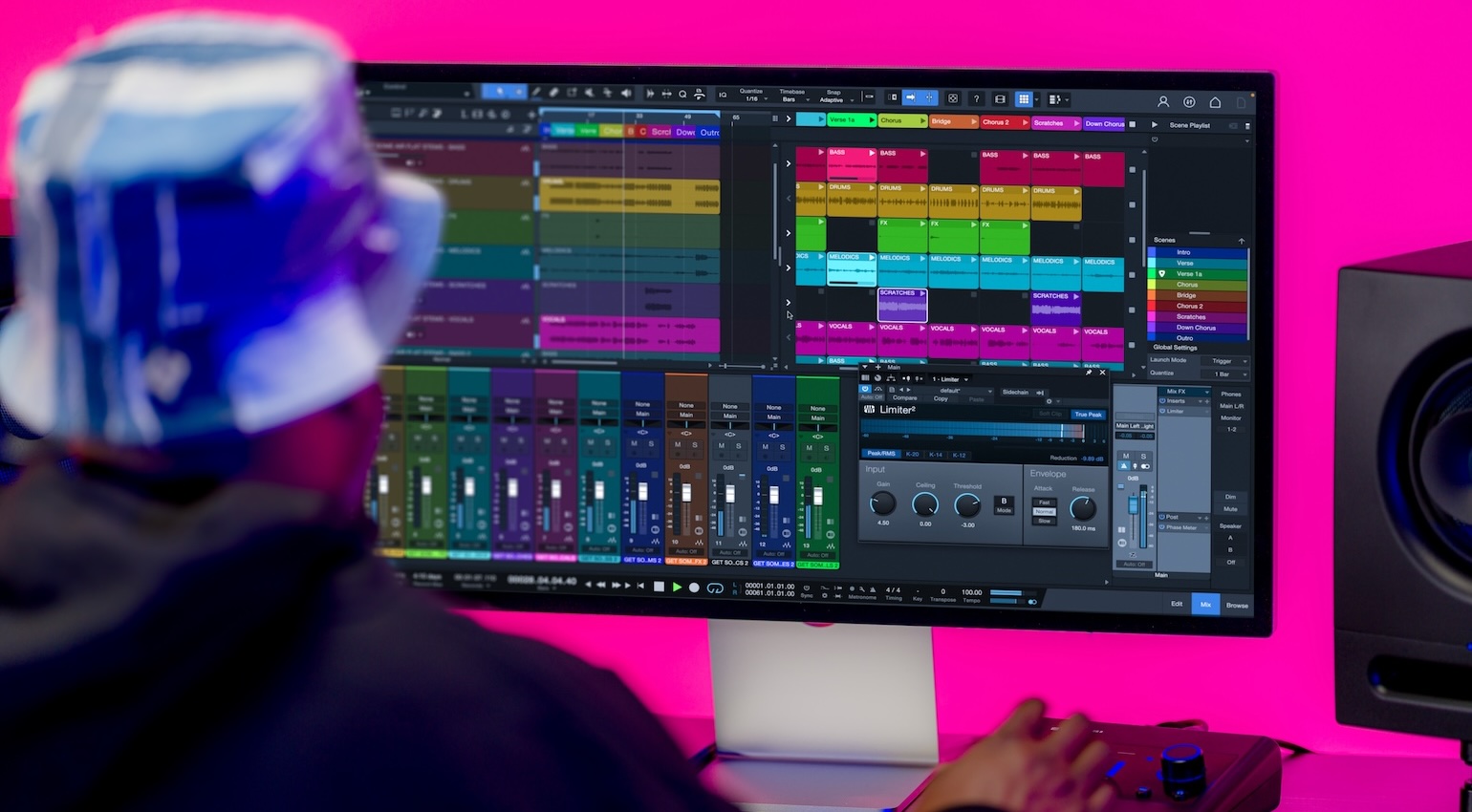
If you’ve ever wished you could have Ableton Live’s Session View inside a traditional DAW, Studio One 7’s Integrated Launcher is your answer. A dynamic grid sits alongside the timeline, letting you trigger audio and MIDI loops and patterns in real time. The key difference from Ableton: the grid and traditional linear timeline coexist in a single window.
The workflow is intuitive — jam with clips in the Launcher, then drag ideas directly onto the timeline to build your arrangement. No more switching between clip launching for live performance and linear editing for studio work. Combined with the new Global Transpose feature, you can shift your entire song’s key with one click, and Launcher clips transpose along with everything else.
Deep Flight One, CV Instrument, and Production Tool Upgrades
The new Deep Flight One virtual instrument upgrades what was originally a 2020 Presence XT library into a standalone synth. It covers soundscapes, drones, pads, percussive sounds, and leads — particularly useful for ambient and synthwave producers. The CV Instrument addition enables direct CV/Gate control of analog synthesizers from within the DAW, a meaningful addition for eurorack modular users.
The Impact drum machine gets a Note Editor integration for in-place pattern creation and sample editing. Advanced Tempo Detection extracts original tempo from audio events of any length with one click. Interactive Scale and Loop Tools make note editing and event population more intuitive. And CLAP plugin format support positions Studio One for the emerging post-VST plugin ecosystem.
Pricing, Licensing, and What the Model Change Means
Studio One 7’s pricing structure reflects an industry in transition. Perpetual license: $199.99. Upgrade from any previous version: $149.99. Monthly subscription: $19.99. Six-month plan: $99.99. The significant announcement is that Studio One Pro 7 is the final major version release — future updates will ship multiple times per year, and perpetual license holders get 12 months of updates included.
This follows the broader trend set by Avid’s Pro Tools subscription pivot and Steinberg’s Cubase licensing changes, but crucially, PreSonus isn’t killing the perpetual license entirely. The hardware bundle deal — free perpetual license plus 12 months Pro+ with StudioLive mixers, Quantum HD interfaces, or Eris Pro monitors — adds additional value for producers building out a PreSonus ecosystem.
PreSonus GM Arnd Kaiser stated that “Studio One Pro 7 is the culmination of years of research, development, and collaboration with the musicians and audio pros who bring our software to life.” With CLAP support, UI refinements (rounded corners, expanded color options, detachable browser), and CPU optimization, the value proposition at this price point is hard to argue with.
The bottom line: Studio One 7 advances simultaneously on three fronts — AI integration, analog emulation, and modern workflow. If you’ve been looking for an alternative to Logic Pro’s ecosystem lock-in or Ableton’s premium pricing, this is the moment to give Studio One a serious look.
Need professional mixing, mastering, or help optimizing your Studio One workflow? 28 years of production experience at your service.
Get weekly AI, music, and tech trends delivered to your inbox.