Prime Day 2025 Gaming Deals: GPUs Below MSRP, 87% Off Games, and OLED Monitors at Record Lows
July 31, 2025
ElevenLabs Eleven Music Review: The AI Music Generator That Actually Cleared Its Licensing (2025)
August 1, 2025
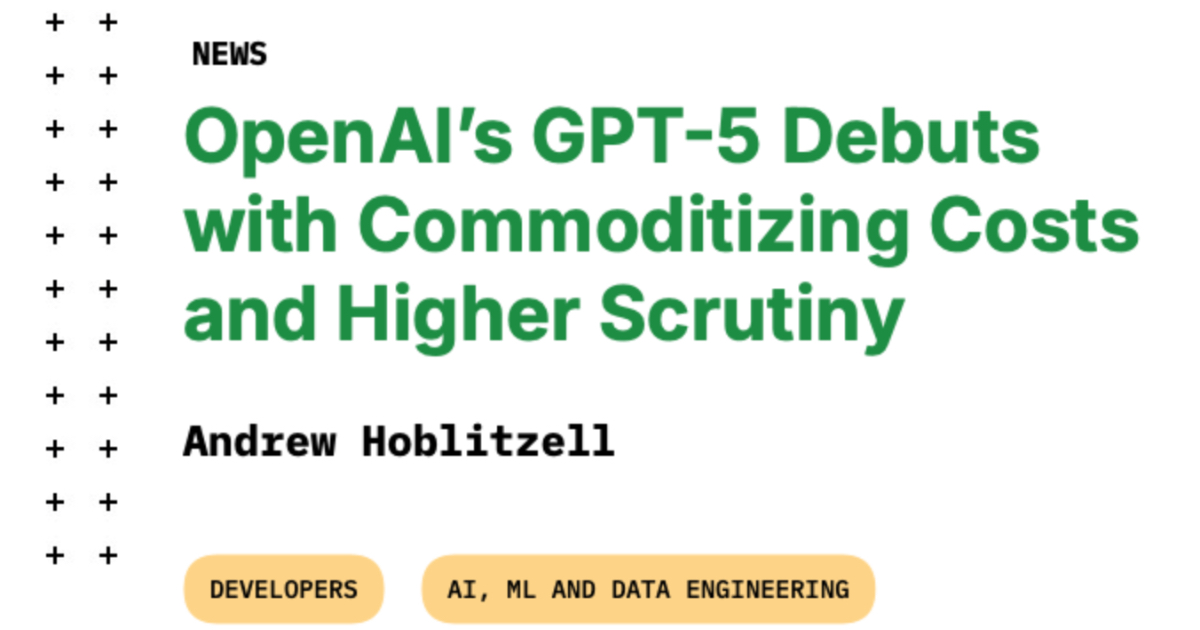
OpenAI GPT-5 is here — and it’s not just a bigger version of what came before. As of the Axios scoop on July 24 and the imminent August launch, GPT-5 represents the most significant architectural shift OpenAI has shipped since the original ChatGPT: a single unified system that automatically decides when to think fast and when to think deep. No more manually toggling between GPT-4o and o3. The model routes itself.
The Architecture: Why OpenAI GPT-5 Is Fundamentally Different
For the past two years, using OpenAI’s best models required a frustrating tax on your attention: know which model fits which task, switch endpoints, manage different API behaviors. GPT-5 eliminates that entirely through a three-component architecture described in the official GPT-5 System Card:
- Fast model — optimized for speed and low-latency responses
- Thinking model (GPT-5 thinking) — extended reasoning with chain-of-thought
- Real-time router — continuously trained on actual user signals to dispatch queries to the right sub-model
The router isn’t a static classifier. It learns from real usage: how often users switch models, which model gets higher preference ratings, and measured correctness on different query types. This means GPT-5 gets smarter at routing over time as more users interact with it.
According to the system card, GPT-5 thinking outperforms o3 while using 50–80% fewer output tokens on visual reasoning, agentic coding, and graduate-level science tasks. That’s not a marginal improvement — it’s a substantial efficiency gain that translates directly to lower costs for complex tasks.
OpenAI GPT-5 Benchmarks: State-of-the-Art Across Every Domain
The numbers from the official GPT-5 launch announcement are striking:
- Math — AIME 2025: 94.6% — near-perfect on Olympiad-level high school mathematics
- Coding — SWE-bench Verified: 74.9% / Aider Polyglot: 88% — resolving real GitHub issues autonomously
- Multimodal — MMMU: 84.2% — understanding images, charts, and formulas in context
- Medical — HealthBench Hard: 46.2% — complex clinical question answering
Beyond raw benchmarks, GPT-5 is approximately 45% less likely to produce factual errors in web-search-enabled responses compared to GPT-4o. For anyone who has dealt with hallucination issues in production, this is a meaningful quality-of-life improvement.
400K Token Context Window: What It Actually Enables
GPT-5 ships with a 400,000 token input context window (32K output), exactly double GPT-4’s capacity. To put that in perspective:
- A 400K context fits roughly 300,000 words — an entire long novel
- You can feed in a large codebase (tens of thousands of lines) in a single call
- Long legal documents, financial filings, research corpora — all processable in one shot
- Multi-turn agent conversations with extensive tool call history stay in context much longer
For developers building agentic applications — where context accumulates over many steps — 400K tokens is a game-changer. You won’t need to implement complex memory systems for most real-world agentic workflows.
Pricing Strategy: Half the Cost, 90% Cache Discount
OpenAI has priced GPT-5 aggressively. API rates at launch:
- Input: $1.25 per million tokens (~50% cheaper than GPT-4o input)
- Output: $10 per million tokens
- Cached input tokens: $0.125 per million tokens — a 90% discount for repeated prompts
InfoQ noted this positions GPT-5 to “commoditize frontier AI” — making the most capable model accessible at a price that previously only mid-tier models commanded. Three model IDs cover different use cases: gpt-5 for the full unified system, gpt-5-mini for low-latency applications, and gpt-5-nano for extreme speed/cost optimization. The pinned version gpt-5-2025-08-07 is available for production stability.
Developers also get a new reasoning_effort parameter in the API — allowing direct control over how aggressively the router prefers the thinking model vs. the fast model. You can tune the cost/quality tradeoff at a per-request level.
Availability and What Changes for Everyday ChatGPT Users
GPT-5 rolls out across all ChatGPT tiers at launch:
- Free users: access to GPT-5 (with rate limits)
- Plus subscribers: higher usage limits
- Pro subscribers: GPT-5 Pro with extended reasoning capabilities
For free users, this is the biggest ChatGPT upgrade since the original GPT-4 release. They’ll now have access to a model that surpasses what paid users had just months ago. For developers, the API is available immediately via openai.com and the GitHub Models Playground, supporting function calling, structured outputs, vision, and file inputs from day one.
The Bigger Picture: Agentic AI and Hot Chips 2025
OpenAI has explicitly positioned GPT-5 as the foundation for agentic workflows — replacing the need to juggle separate o-series and GPT-4o endpoints. The unified router makes it far simpler to build multi-step agents: you send requests to a single endpoint, and the system figures out whether to sprint or deliberate.
This matters enormously in the context of where AI hardware is heading. The Hot Chips 2025 conference at Stanford (August 24–26) will showcase next-generation AI accelerators from NVIDIA, AMD, and Google — all designed to run increasingly complex workloads more efficiently. GPT-5’s architecture is designed to map well onto these heterogeneous compute environments: fast queries use fewer resources, heavy reasoning gets the full compute budget.
The model fragmentation era — where users had to be mini-experts in OpenAI’s model lineup to get good results — is over. GPT-5 is a single, intelligent surface that adapts to your needs. Combined with aggressive pricing and the widest context window in OpenAI’s history, it makes a compelling case for being the default model for virtually every use case from here on out.
Interested in AI-Powered Music Production Pipelines?
If you’re exploring how models like GPT-5 can power automated creative workflows — from music production to content pipelines — I’d love to talk. Let’s discuss how AI can extend your creative process.
→ Get in touch (imseankim.com/contact)
Get weekly AI, music, and tech trends delivered to your inbox.
Sources:
Introducing GPT-5 | OpenAI · GPT-5 System Card | OpenAI · GPT-5 for Developers | OpenAI