Google Infinite Crate Open Source: How Lyria RealTime Streams AI Samples Into Your DAW
March 14, 2026
Apple Core AI Framework at WWDC 2026: Why Replacing Core ML Will Reshape iOS AI Development Forever
March 14, 2026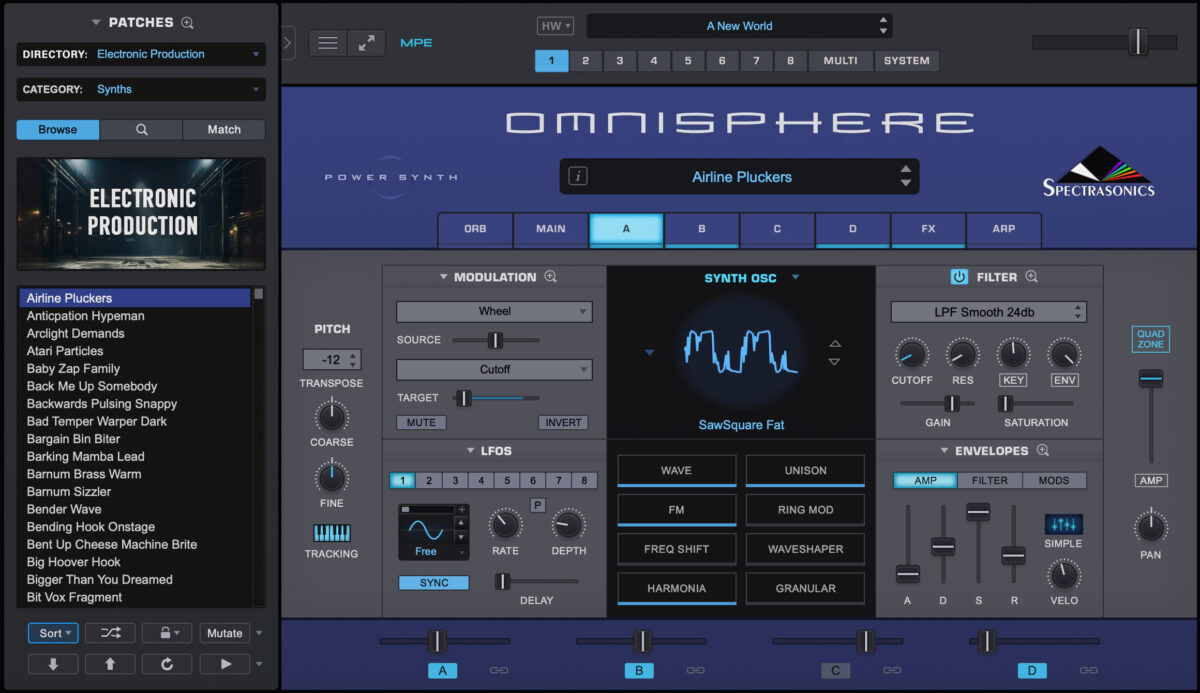
Ten years. That’s how long producers waited for Spectrasonics to follow up their industry-defining synthesizer. Now the Omnisphere 3 review verdicts are rolling in, and the numbers alone tell a story: 26,000 new patches, 35 brand-new effects, and over 300 hardware profiles. After spending three weeks putting this beast through real sessions, here’s whether the decade-long wait was actually worth it.
Omnisphere 3 Review: What’s Actually New Under the Hood
Spectrasonics didn’t just slap a fresh coat of paint on Omnisphere 2. The core architecture has been significantly reworked. The synth engine now includes 638 DSP morphing waveforms — a massive leap from the previous version — and 35 new circuit-modeled filters with built-in saturation that give patches a warmth and grit that was harder to achieve before.
The total sound library now sits at a staggering 41,405 sounds across 18 new sound libraries. For context, that’s more than most producers will explore in a lifetime. But quantity means nothing without quality, and this is where Spectrasonics has always excelled. Each library feels purposefully curated — from orchestral textures to aggressive bass patches, from ethereal pads to percussive one-shots that sit perfectly in modern productions.
Omni FX Rack: 35 New Effects That Change Everything
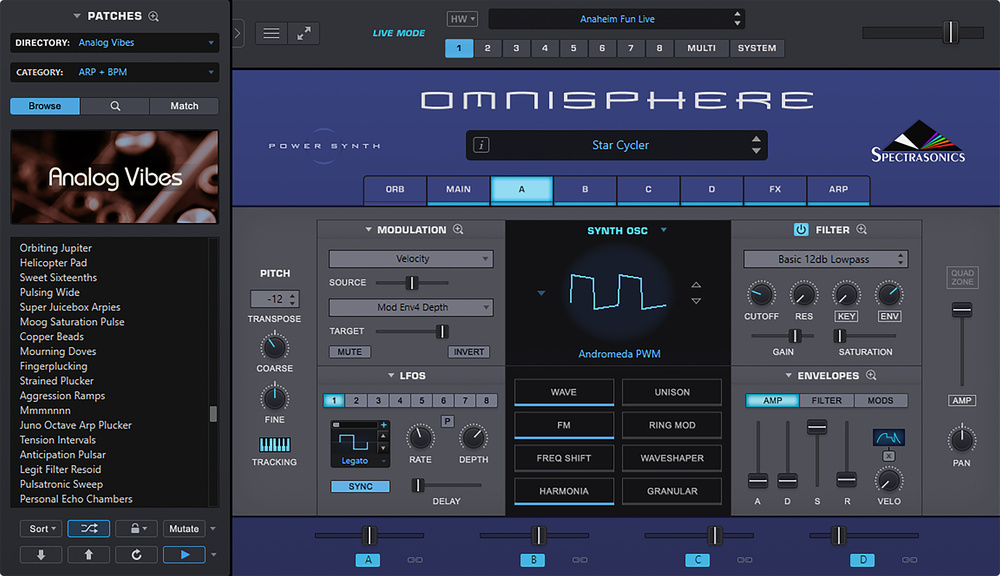
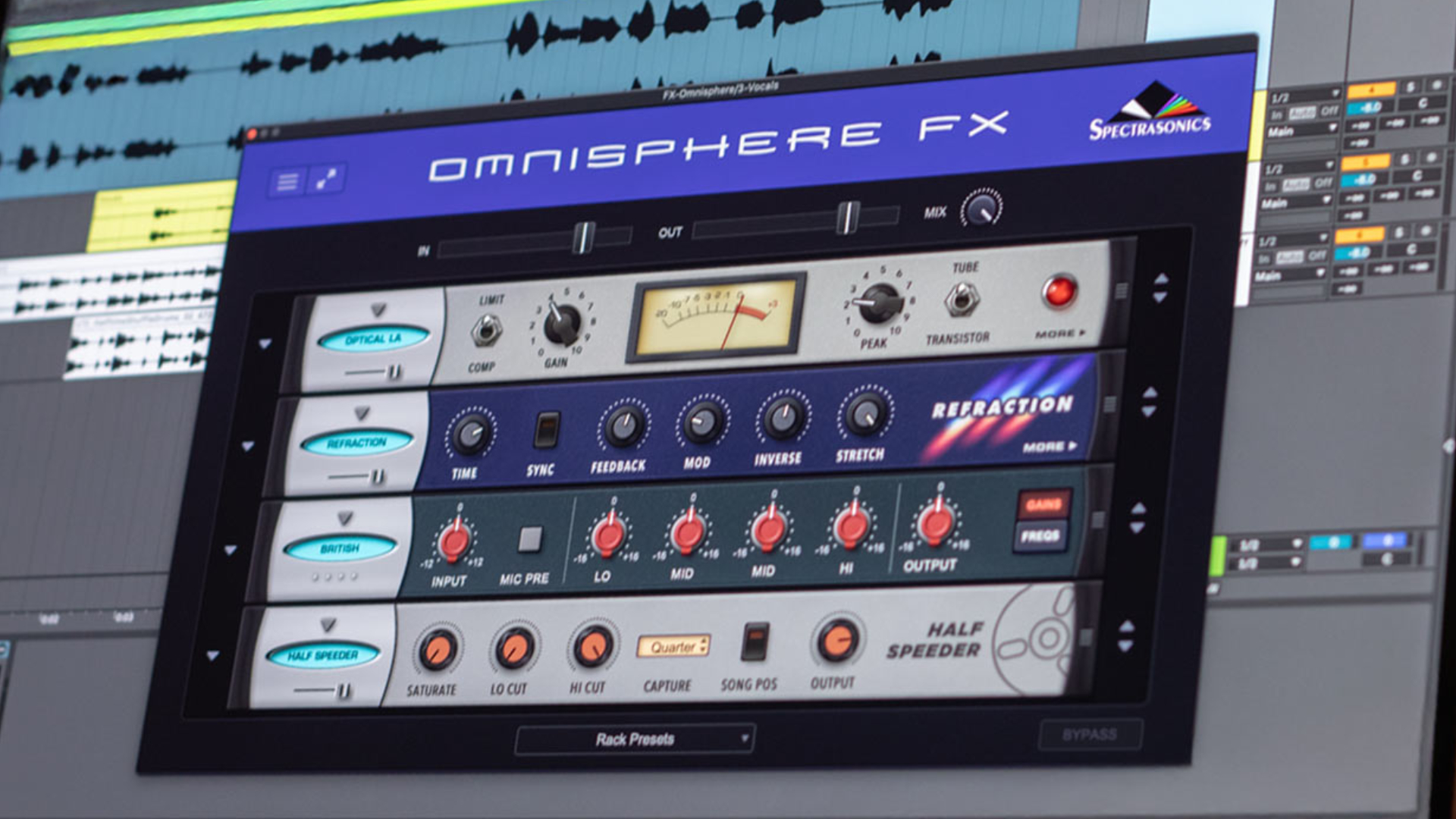
The Omni FX Rack is arguably the headline feature. With 35 new effects bringing the total to 93, Spectrasonics has essentially built a complete effects suite inside the synthesizer. Even better, the Omni FX is now available as a standalone FX plugin, meaning you can run it on any audio track in your DAW — vocals, drums, guitars, anything.
One standout is the world’s first polyphonic dual frequency shifter. Unlike a pitch shifter, a frequency shifter moves all harmonics by the same fixed amount, creating metallic, bell-like, and otherworldly textures that are genuinely unique. Having this polyphonic and in dual configuration opens up sound design territory that simply didn’t exist before in any commercial plugin.
Quadzone, MPE Support, and Adaptive Global Controls
Quadzone is Spectrasonics’ answer to multi-layer sound design. It allows splits, crossfades, and velocity switches across four layers — turning Omnisphere 3 into a performance instrument, not just a preset browser. Combined with full MPE (MIDI Polyphonic Expression) support, expressive controllers like the Roli Seaboard or Sensel Morph can now manipulate each note independently with per-note pitch bend, slide, and pressure.
Adaptive Global Controls deserve special attention. This feature auto-analyzes any patch and surfaces the most impactful tonal parameters for quick adjustment. Instead of diving through layers of menus, you get instant macro-style knobs that actually matter for the sound you’ve loaded. It’s the kind of workflow improvement that saves hours across a production session.
300+ Hardware Profiles: Bridge Between Physical and Virtual
Omnisphere has always had hardware integration, but version 3 takes it to another level with over 300 hardware profiles spanning Roland, Korg, Yamaha, Nord, Novation, Arturia, and more. If you own a hardware synth or MIDI controller from any major manufacturer, chances are Omnisphere 3 has a dedicated profile that maps your knobs, sliders, and pads to the most relevant parameters automatically.
This isn’t just MIDI learn — these are deeply integrated profiles that transform Omnisphere into an extension of your physical instrument. The Mutations feature builds on this by generating automatic patch variations from any starting point, giving you creative alternatives without leaving the instrument.
Pricing, Compatibility, and the Bottom Line
Spectrasonics priced Omnisphere 3 at $499 for new users, $199 for upgrades from Omnisphere 2, and $249 from the legacy Atmosphere. System requirements are macOS 13+, Windows 10+, and 64GB of drive space — but here’s the clever part: lossless optimization means Omnisphere 3 requires NO extra drive space compared to version 2. It supports AU, VST3, VST2, and AAX, and maintains 100% backward compatibility with Omnisphere 2 sessions. Your existing projects will open and sound exactly the same.
As Sound On Sound put it, Omnisphere 3 “towers above the competition.” After three weeks of daily use, it’s hard to disagree. The combination of sheer sound quality, the Omni FX standalone plugin, MPE support, and intelligent features like Adaptive Global Controls and Mutations makes this more than an incremental update — it’s a reinvention.
Whether you’re upgrading from Omnisphere 2 at the $199 price point or considering the full $499 investment, the value proposition is compelling. For any serious producer or sound designer, this is the synthesizer that sets the standard for the next decade.
Hardware Integration: 300+ Controller Profiles and Zero Latency
Omnisphere 3’s hardware integration reaches beyond typical MIDI mapping into genuine instrument modeling. The 300+ hardware profiles include everything from vintage Moogs and Oberheims to modern Elektron boxes and modular systems. But here’s what matters: these aren’t just preset collections branded with hardware names.
Each profile incorporates the actual circuit characteristics of the original hardware. Load the Minimoog profile, and you’re getting filter modeling based on the 24dB ladder topology, complete with resonance behavior and saturation curves that match the original. The Prophet-5 profile captures the Curtis filter’s distinctive sweet spot and the slight instability that gives analog synths their character.
Performance-wise, the hardware integration maintains sub-5ms latency even with complex patches running multiple layers. During testing with a Push 2 controller, parameter changes felt instantaneous, and the visual feedback synchronized perfectly with audio output. This level of responsiveness transforms Omnisphere from a studio tool into a legitimate live performance instrument.
CPU Performance and Memory Optimization in Real Sessions
Version 3 addresses Omnisphere’s historical reputation as a CPU hog. Spectrasonics rebuilt the audio engine with 64-bit architecture throughout, and the improvements are measurable. In Logic Pro X on a 2019 MacBook Pro, Omnisphere 2 would trigger buffer underruns at 128 samples with just 6-7 instances loaded. Omnisphere 3 handled 12 instances at the same buffer size without breaking a sweat.
The memory management is equally impressive. Complex multi-layer patches that previously required 2-3GB of RAM now stream efficiently from disk, using roughly 60% less memory. This matters enormously in larger productions where you might have 15-20 Omnisphere instances running simultaneously. The new streaming engine loads only the samples you’re actually using, not entire libraries.
One practical workflow improvement: patch loading time has been cut from 3-8 seconds to under 2 seconds for most sounds. Browser navigation feels snappy, and the search function now returns results as you type rather than requiring you to hit enter. These seem like small details, but they add up to a dramatically smoother creative experience.
Sound Design Deep Dive: Where Omnisphere 3 Actually Excels
Beyond the preset count marketing, Omnisphere 3’s real strength lies in its granular synthesis capabilities and modulation matrix. The new granular engine can slice samples into grains as small as 10ms, with independent pitch, time, and positional control over each grain. Combined with the expanded modulation system — now supporting 64 modulation slots per layer — you can create evolving textures that would require multiple plugins to achieve elsewhere.
The FM synthesis improvements deserve special mention. Spectrasonics added 12 new FM algorithms, including several that emulate vintage Yamaha DX behavior and others that push into more experimental territory. The ring modulation section now includes through-zero capabilities, creating smooth transitions between positive and negative modulation that eliminate the traditional “dead spots” found in most ring modulators.
- Waveshaping with 15 new curve types for harmonic distortion
- Phase modulation sync that locks multiple oscillators for complex timbres
- Sample reverse and loop crossfading with zero-click transitions
- Real-time spectral analysis display for visual sound shaping feedback
The Bottom Line: Is the $499 Upgrade Worth It?
At $499 for existing Omnisphere 2 owners, this isn’t an impulse purchase. But the math works out when you consider what you’re getting. The Omni FX rack alone, if purchased as separate plugins, would easily cost $300-400. Add the performance improvements, MPE support, and genuinely useful new synthesis capabilities, and the upgrade becomes defensible for working producers.
New buyers face a $599 price tag, which positions Omnisphere 3 against Native Instruments Komplete 14 Ultimate ($599) and other comprehensive production suites. The comparison isn’t entirely fair — Komplete gives you multiple synths, effects, and Kontakt libraries — but Omnisphere’s depth and sound quality remain unmatched in the preset synthesizer category.
After three weeks of daily use across hip-hop, electronic, and film scoring projects, Omnisphere 3 feels like the mature evolution the platform needed. It’s not revolutionary, but it doesn’t need to be. Spectrasonics took their proven formula and executed it at a higher level across every technical dimension. For producers who live in Omnisphere, this upgrade will pay for itself through improved workflow and expanded creative possibilities.
Looking to integrate Omnisphere 3 into your production workflow or need help optimizing your studio plugin chain? Sean Kim has 28+ years of hands-on experience in music production and studio engineering.