How to Create Professional Mix Templates: Speed Up Your Workflow by 2 Hours Per Session
November 25, 2025
DistroKid vs TuneCore vs CD Baby 2025: Which Music Distributor Actually Wins Your Money?
November 26, 2025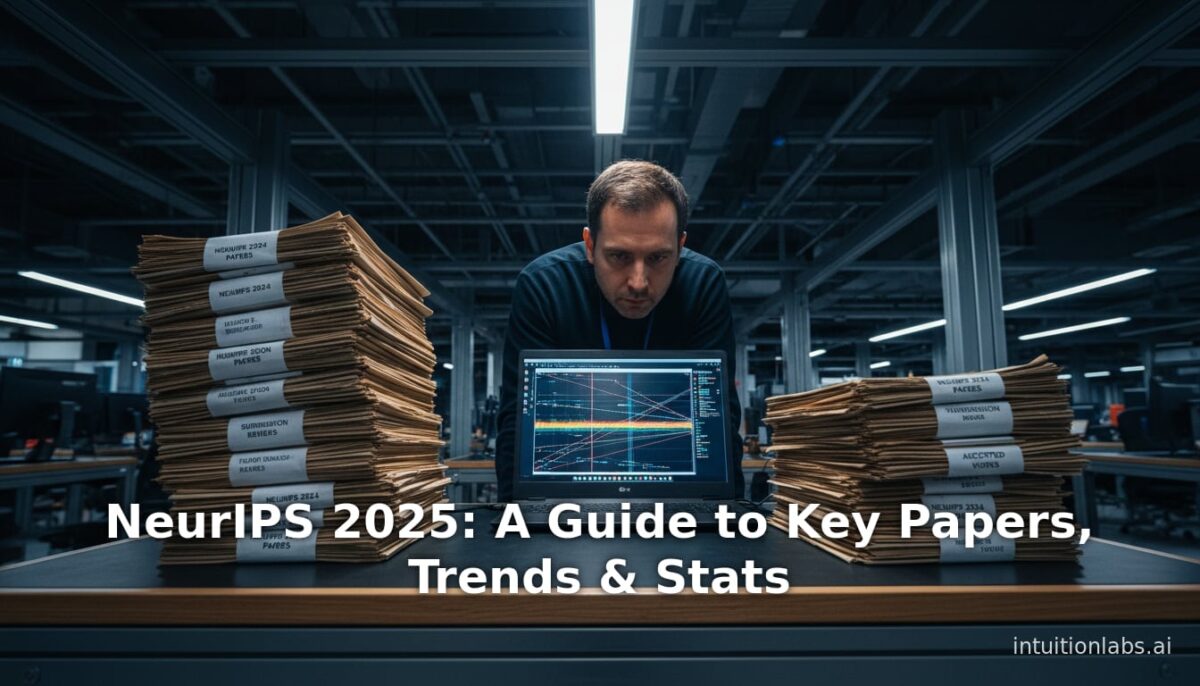
The awards are in — and they’re not what most people expected. NeurIPS 2025, the world’s largest AI research conference, just announced its 7 Best Paper Awards from a record-breaking 21,575 submissions, and the winners reveal exactly where AI is headed in 2026.
From Alibaba’s Qwen team shipping a gated attention mechanism that’s already live in production models, to a bombshell paper proving that 70+ language models essentially think alike, these NeurIPS 2025 best papers aren’t just academic exercises — they’re blueprints for the next generation of AI systems you’ll actually use.
NeurIPS 2025 by the Numbers: A Record-Breaking Year
Before diving into the papers, the scale of NeurIPS 2025 deserves attention. The conference, running December 2–7 in San Diego (with a simultaneous site in Mexico City), received 21,575 valid paper submissions — a staggering 61% increase over 2024. Of those, approximately 5,290 were accepted at a 24.5% acceptance rate, reviewed by 20,518 reviewers and 1,663 area chairs.
The dominant research theme? LLM reasoning, with roughly 766 papers focusing on reasoning as a core topic. Google alone had 175 accepted papers across NeurIPS 2025 programs. Two new tracks debuted this year: a Position Paper Track for societal impact discussions and a Journal Track integrating 34 papers from leading statistics and ML journals.
Best Paper #1: The Artificial Hivemind Problem — 70+ LLMs Think Alike
The most provocative NeurIPS 2025 best paper comes from the University of Washington, CMU, and the Allen Institute. Researchers Liwei Jiang, Yejin Choi, and their team tested over 70 language models and discovered something unsettling: they all generate eerily similar responses.
The paper, titled “Artificial Hivemind: The Open-Ended Homogeneity of Language Models (and Beyond),” introduces Infinity-Chat — a dataset of 26,000 diverse queries with 31,000 human annotations. The findings reveal pronounced intra- and inter-model homogenization that goes far beyond what researchers expected. Whether you’re using GPT-4, Claude, Gemini, or open-source alternatives, the outputs cluster around suspiciously similar patterns.
Why this matters for 2026: If AI models are essentially converging on the same “thinking patterns,” the long-term risks to human creativity, value plurality, and independent thinking are significant. Expect a wave of research focused on diversity-aware training methods and evaluation benchmarks that go beyond accuracy to measure genuine originality.
Best Paper #2: Gated Attention — Alibaba’s Fix Already Shipping in Production
If the Artificial Hivemind paper is the philosophical bombshell, the Gated Attention paper from Alibaba’s Qwen team is the engineering one. Lead author Zihan Qiu and colleagues introduce head-specific sigmoid gating after attention operations — a deceptively simple modification that consistently improves performance across 30 model variants.
The key innovations: the gated attention mechanism eliminates the notorious “attention sink” problem (where models waste capacity attending to irrelevant tokens), enhances training stability, and dramatically improves long-context extrapolation. This isn’t theoretical — it’s already shipping in Qwen3-Next with open-source code available.
Industry timeline: Analysts expect gated attention adoption in GPT-5 and Gemini 2.0 within 6–12 months. For developers building on LLM APIs, this means more coherent conversations in longer exchanges — a tangible improvement you’ll notice in daily use.
Best Paper #3: 1,024-Layer RL Networks — Robots That Learn Without Teachers
Reinforcement learning has traditionally been stuck with shallow networks — typically 2 to 5 layers. Kevin Wang, Ishaan Javali, and their team shattered that assumption by successfully scaling self-supervised RL networks to 1,024 layers, achieving 2 to 50x performance improvements on locomotion and manipulation benchmarks.
The paper, “1000 Layer Networks for Self-Supervised RL: Scaling Depth Can Enable New Goal-Reaching Capabilities,” demonstrates that extreme depth unlocks entirely new capabilities in goal-conditioned tasks. Robots can learn to reach complex goals without any human guidance — no reward engineering, no demonstrations, no step-by-step instructions.
For the robotics and autonomous systems industry, this is a paradigm shift. The scaling hypothesis that drove LLM progress is now proven to work for physical AI agents. Expect embodied AI startups to aggressively adopt deep RL architectures throughout 2026.
Best Paper #4: Why Your AI Images Aren’t Stolen — The Math Behind Diffusion
The copyright debate around AI-generated images just got a crucial piece of scientific evidence. Tony Bonnaire, Raphaël Urfin, Giulio Biroli, and Marc Mezard published “Why Diffusion Models Don’t Memorize,” identifying the precise mathematical mechanism that separates genuine image generation from training data memorization.
Their discovery: diffusion models exhibit “implicit dynamical regularization” operating on two distinct timescales. An early, dataset-independent generalization phase is followed by a later memorization phase — and crucially, the generalization window expands linearly with training set size. This explains why tools like DALL-E and Midjourney generate novel images rather than regurgitating their training data.
This paper will be cited in every AI copyright lawsuit from 2026 onward. It provides the mathematical framework that companies like OpenAI, Stability AI, and Midjourney need to defend their models’ creative outputs as genuinely novel rather than derivative.
The Runner-Ups: Three Papers That Deserve Your Attention
Does RL Actually Make LLMs Smarter?
Yang Yue and colleagues tackled one of AI’s hottest debates: does reinforcement learning from human feedback (RLHF) truly improve LLM reasoning, or just make models better at sampling good answers? Their finding is sobering — current RLVR methods improve sampling efficiency but don’t “elicit fundamentally new reasoning patterns.” The reasoning capabilities remain bounded by the base model’s training distribution. This challenges the assumption behind billions of dollars in RLHF investment.
A 30-Year-Old Math Problem, Solved
Zachary Chase, Steve Hanneke, Shay Moran, and Jonathan Shafer resolved a three-decade-old open problem in learning theory. Their work on “Optimal Mistake Bounds for Transductive Online Learning” proves that transductive learning achieves quadratic gap advantages over standard learning, establishing tight mathematical bounds. Pure theory, but the kind that quietly reshapes algorithm design for years to come.
Why Bigger Models Keep Getting Better — Superposition Explains Scaling Laws
Yizhou Liu, Ziming Liu, and Jeff Gore’s paper on “Superposition Yields Robust Neural Scaling” finally explains why neural scaling laws work. Representation superposition — where models represent more features than available dimensions — drives the consistent inverse relationship between model size and loss. This isn’t just elegant theory; it gives engineers a principled way to predict model performance before spending millions on training runs.
Google’s 175 Papers: Corporate Research Dominance at NeurIPS 2025
Beyond the best paper awards, the corporate research landscape at NeurIPS 2025 tells its own story. Google led with 175 accepted papers across the conference’s programs, followed by Meta AI, Microsoft Research, and DeepMind. Notable corporate contributions included Google’s Titans and MIRAS architectures, which introduce genuine long-term memory through “surprise metrics” — storing unexpected information while filtering routine data. Titans handles contexts exceeding 2 million tokens, addressing one of the most critical limitations in current AI systems.
The growing corporate presence raises important questions about the future of academic AI research. With 84% of accepted datasets introducing new successor benchmarks, the conference is clearly prioritizing reproducibility and open evaluation — a trend that benefits both academic and industry researchers. The new Position Paper Track, debuting this year, also signals that the AI research community is taking societal impact seriously, not just technical performance.
What NeurIPS 2025 Best Papers Mean for You in 2026
Here’s the practical takeaway from the NeurIPS 2025 best papers: the age of “just make it bigger” is giving way to “make it smarter.” Gated attention improves existing architectures without scaling compute. Deep RL scales depth, not parameters. Diffusion theory guides training efficiency. And the Hivemind paper warns us that current approaches produce dangerously homogeneous outputs.
For AI developers, the message is clear: 2026 will reward architectural innovation over brute-force scaling. For AI users, expect more coherent long conversations, more capable autonomous agents, and a growing conversation about whether your AI assistant’s creativity is real — or just a sophisticated average of everyone else’s thinking.
The NeurIPS 2025 conference runs December 2–7 in San Diego. With 5,290 accepted papers, seven tracks, and over 70 workshops and competitions, the full proceedings will keep the research community busy well into the new year. Seven affinity events — including Women in ML, LatinX in AI, and Queer in AI — highlight the conference’s growing commitment to diversity in AI research. The award winners, however, will have outsized impact: gated attention mechanisms will ship in major LLMs, deep RL will accelerate robotics, and the Hivemind paper will force the entire industry to reckon with the homogeneity problem. These aren’t just papers — they’re the foundation of the AI products you’ll use in 2026 and beyond.
Want to build AI-powered pipelines or integrate the latest research into your workflow? Sean Kim has been shipping production AI systems for years.
Get weekly AI, music, and tech trends delivered to your inbox.