Snapdragon X Elite Laptop Performance Review: 15+ Hour Battery, Benchmarks, and the App Compatibility Truth
June 24, 2025
Best Father’s Day Tech Gifts 2025: Gadgets for Every Budget
June 24, 2025
Here’s a number that should make every musician pause: 1,000 streams on Tidal earns you $12.84. The same 1,000 streams on Spotify? Just $3.18. That’s a 4x difference — and in June 2025, with Spotify having just paid out $11 billion to the music industry while simultaneously maintaining the lowest per-stream rate among premium platforms, the royalty debate has never been more complex.
Music Streaming Royalty Rates 2025: The Complete Per-Stream Breakdown
Let’s cut straight to the numbers. Based on aggregated data from Royalty Exchange, Disc Makers, and distributor reports, here’s what each major platform pays per stream in mid-2025:
- Tidal: $0.01284 per stream ($12.84 per 1,000 streams)
- Apple Music: $0.01 per stream ($10.00 per 1,000 streams)
- Amazon Music: $0.004 per stream ($4.00 per 1,000 streams)
- Spotify: $0.00318 per stream ($3.18 per 1,000 streams)
- Deezer: $0.0011 per stream ($1.10 per 1,000 streams)
- YouTube Music: $0.00069–$0.002 per stream ($0.69–$2.00 per 1,000 streams)
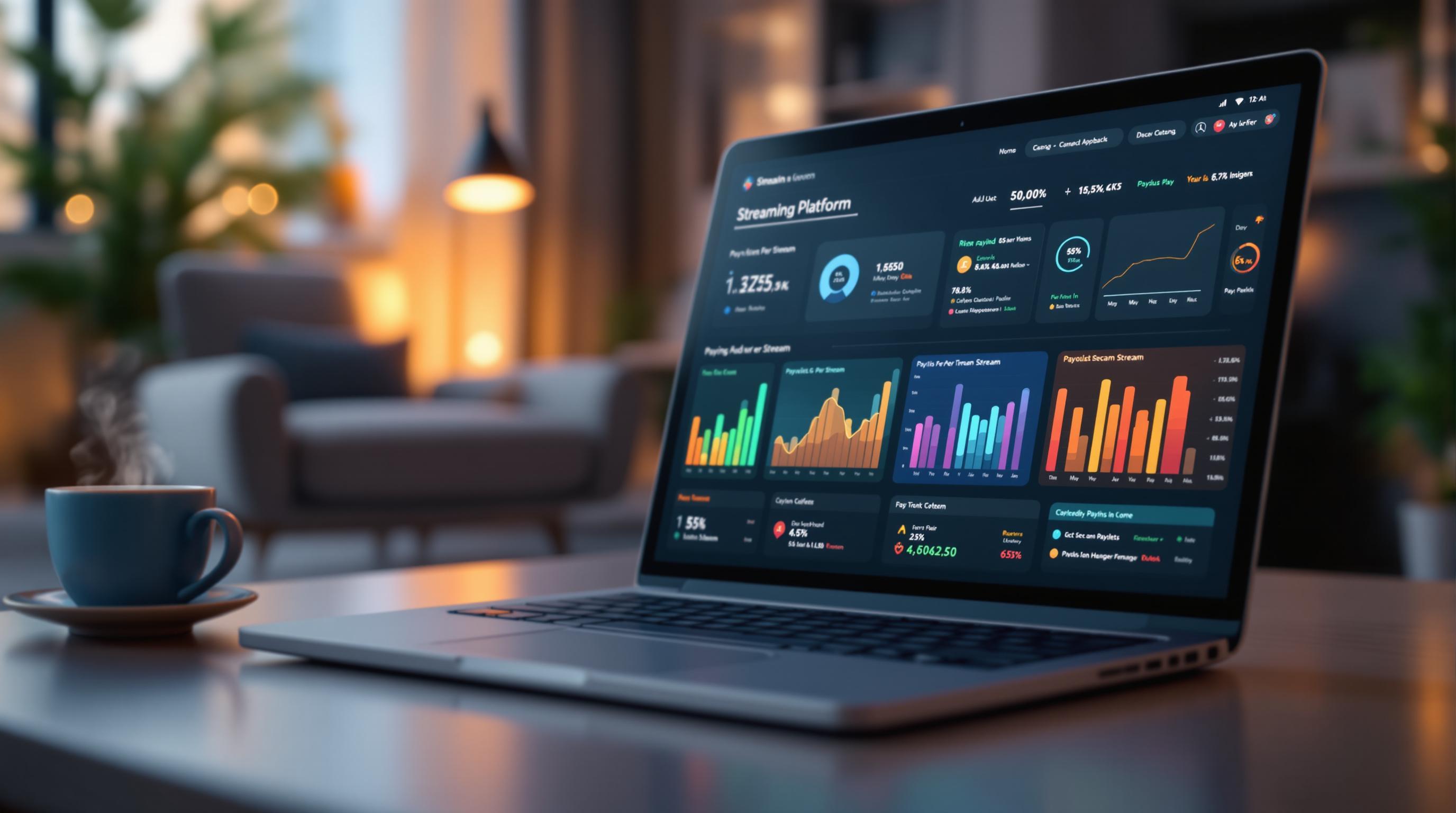
These figures represent averages — actual payouts vary based on listener geography, subscription tier, and distribution agreements. A stream from a premium subscriber in the United States generates significantly more than one from an ad-supported listener in a developing market.
Why Spotify’s Per-Stream Rate Is the Lowest Among Premium Platforms
Spotify and Tidal both allocate roughly 70% of gross revenue to rights holders. So why does Tidal pay four times more per stream? The answer lies in three structural factors that have nothing to do with generosity — and everything to do with business model design.
1. The Free Tier Dilution Problem
Spotify’s 700+ million users include a massive free, ad-supported tier. While premium subscribers represent 42% of users, they generate 90% of the platform’s revenue. The remaining 58% of users — hundreds of millions of people — generate just 10% of revenue through ads. When the royalty pool is divided across all streams from both tiers, each individual stream is worth far less.
Apple Music and Tidal have no free tier. Every listener is a paying subscriber, which means more revenue per user flowing into the royalty pool.
2. Global Pricing and Family Plans
Spotify operates in 184 markets worldwide, including many where subscription prices are significantly lower than the $10.99/month US rate. A premium subscription in India costs around $1.50/month. Discounted family plans (up to 6 members for $16.99) further reduce the per-user revenue contribution. This global scale drives total payouts up but pushes per-stream rates down.
3. Streaming Volume Dilution
Spotify users stream more than users on any other platform. Higher engagement sounds positive, but under the market-share payment model, it means the fixed royalty pool is split across more total streams. If a Spotify user streams 1,500 songs per month versus 800 on Apple Music, each Spotify stream receives a proportionally smaller slice of the pie.
Spotify’s 2025 Royalty Reforms: The 1,000-Stream Threshold
In response to growing criticism, Spotify implemented significant royalty system changes starting in April 2024 that are now fully in effect. The most impactful: tracks must reach at least 1,000 streams in the previous 12 months to generate recorded royalties. Additionally, a minimum number of unique listeners is required to prevent gaming through repeat plays.
Spotify also raised the minimum track length for functional noise recordings (white noise, nature sounds, ASMR) to two minutes, targeting bad actors who were cutting whale sound tracks to 30 seconds and stacking them in playlists to farm streams. According to Spotify, these changes aim to redirect approximately $1 billion toward emerging and professional artists over five years.
The impact is measurable: Spotify paid out $11 billion to the music industry in 2025 — the largest annual payment from any music retailer in history, representing over 10% growth year-over-year. Independent artists and labels accounted for half of all royalties paid.
Tidal’s Fan-Centered Royalties: The User-Centric Alternative
While Spotify and Apple Music use the traditional market-share model — where all subscription revenue is pooled and distributed based on each artist’s share of total streams — Tidal is pioneering a different approach with its HiFi Plus tier ($19.99/month).
Under Tidal’s fan-centered royalties, a HiFi Plus subscriber’s payment goes directly to the artists they actually listen to, rather than being pooled. If you spend 80% of your listening time on indie artists, 80% of your subscription fee (minus Tidal’s cut) goes to those artists. This user-centric payment system (UCPS) fundamentally changes the economics for niche and independent musicians who would otherwise see their fans’ money subsidize top-charting hits they never play.
Deezer has also championed UCPS since 2019, though its overall per-stream rate remains low at $0.0011 due to lower subscription revenue. The model is sound in theory — the challenge is scale.
Apple Music’s Quiet Advantage: No Free Tier, Double the Rate
Apple Music occupies an interesting middle ground. At $0.01 per stream, it pays roughly double Spotify’s rate while maintaining a straightforward subscription-only model. A January 2025 study confirmed that Apple Music’s per-stream royalty rate is approximately twice Spotify’s — a significant margin that directly benefits artists.
However, there’s an important nuance: Spotify allocates 65–70% of its revenue to rights holders, while Apple Music pays a fixed rate of 52% across all labels. The per-stream rate appears higher for Apple, but Spotify may actually return a larger percentage of total revenue to the industry. With Spotify’s user base dwarfing Apple Music’s (700M+ vs ~100M subscribers), Spotify distributes far more total royalty dollars despite lower per-stream rates.
The CRB Factor: Mechanical Royalties and the Songwriter Gap
Beyond per-stream rates for recording artists, the Copyright Royalty Board (CRB) sets mechanical royalty rates that determine what songwriters earn from streaming. In June 2025, the CRB held streaming mechanical rates steady for 2025 as inflation cooled, following the landmark Phonorecords III settlement covering 2023–2027.
This matters because songwriters typically earn far less than performing artists from streaming. A songwriter might receive $0.00091 per stream from Spotify — less than a third of what the recording rights holder gets. The CRB’s rate-setting process, which occurs every five years, remains one of the most consequential decisions in the music industry.
What This Means for Independent Artists in 2025
The streaming royalty landscape presents a genuine strategic decision for independent musicians. Should you optimize for the highest per-stream rate or the largest potential audience? The math tells a nuanced story:
- 100,000 streams on Tidal = ~$1,284
- 100,000 streams on Apple Music = ~$1,000
- 100,000 streams on Spotify = ~$318
But reaching 100,000 streams is dramatically easier on Spotify due to its algorithmic discovery engine, editorial playlists, and sheer user base. Many artists report that Spotify generates 5–10x the stream volume of other platforms, partially offsetting the lower per-stream rate. The practical reality: distribute everywhere, but understand that each platform serves a different role in your revenue strategy.
With streaming now accounting for 84% of U.S. music industry revenue, these royalty rates aren’t just numbers on a spreadsheet — they’re the foundation of modern music economics. The 4x gap between Tidal and Spotify per-stream rates will likely persist as long as their business models remain fundamentally different. For artists, the smartest play in mid-2025 remains a multi-platform strategy: leverage Spotify for discovery, Apple Music and Tidal for revenue per stream, and direct-to-fan platforms for the highest margins of all.
Navigating streaming royalties, distribution strategy, or music production workflows? Sean Kim brings 28+ years of music and audio industry experience.
Get weekly AI, music, and tech trends delivered to your inbox.