Devin AI Review: From $500 to $20 — 6 Weeks With Cognition’s AI Software Engineer
May 20, 2025
Samsung 990 Pro 4TB Review: Why This Gen4 NVMe Still Destroys Gen5 Drives for Content Creators
May 20, 2025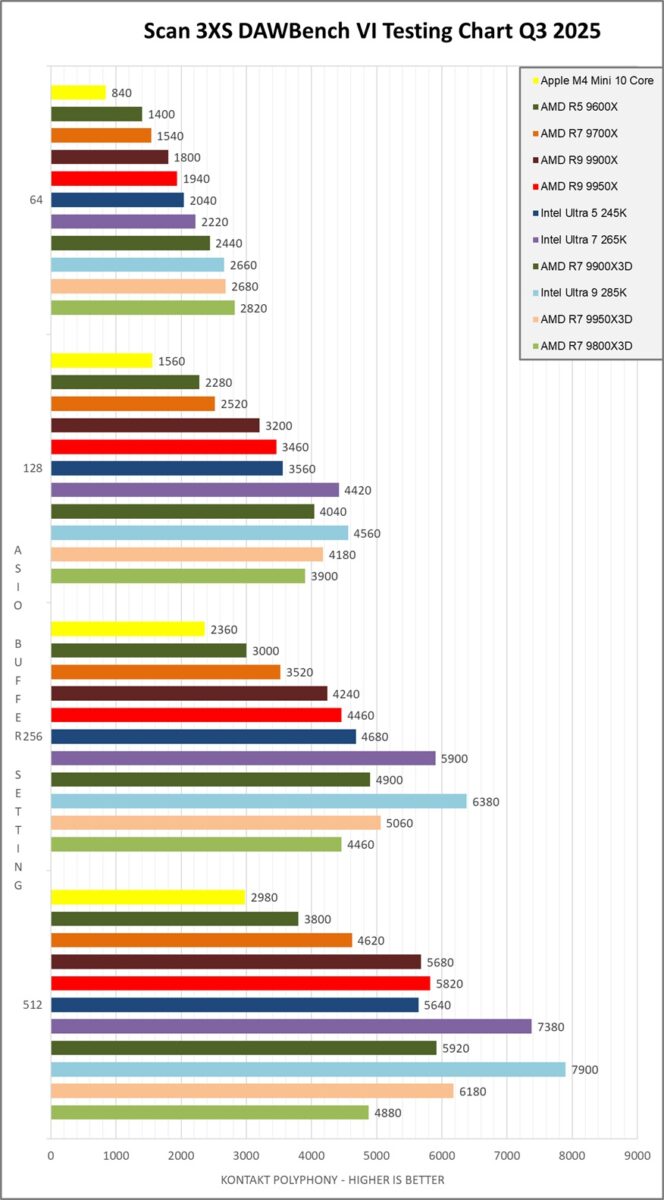
Geekbench single-core score: 4,060. Apple’s M4 Max just dethroned both Intel and AMD to claim the single-core crown. But here’s the thing — a music production CPU benchmark isn’t won on synthetic scores alone. Load up 200+ plugins in a real DAW session, and the rankings flip in ways that might surprise you.
It’s May 2025, roughly two months since the Mac Studio M4 Max hit shelves. Real-world benchmarks have had time to accumulate, Intel’s 14th-gen microcode stability patches have been deployed, and AMD’s Ryzen 9000 series hasn’t dropped yet — making the 7950X still AMD’s crown jewel. This is the perfect moment to settle the three-way CPU battle with hard data and hands-on studio context.
Music Production CPU Benchmark: Core Specs at a Glance
Before diving into DAW-specific tests, let’s establish the baseline. In music production, core quality matters more than core count — but both play a role depending on your workflow. Understanding the architecture behind each chip reveals why benchmark rankings shift so dramatically under different conditions.
Apple M4 Max (16-core): Geekbench 6 single-core 4,060, multi-core 26,180. Cinebench R23 multi-core 25,881. Twelve performance cores plus four efficiency cores. System peak power around 92W — a fraction of what the Intel and AMD competitors draw. Unified memory scales up to 128GB with a staggering 546GB/s bandwidth, which eliminates the traditional bottleneck between CPU and RAM that plagues discrete architectures. According to Logic Pro benchmarks, the M4 Max delivers a 30% single-core and 27% multi-core improvement over the M3 Max — and actually outpaces the M2 Ultra 24-core in multi-threaded workloads by 25%. The catch? Only 12 of those 16 cores are performance-class, the four efficiency cores rarely get utilized by DAW engines, and you’re locked into macOS with zero upgrade path.
Intel Core i9-14900K: Geekbench 6 single-core 3,100, multi-core 19,500. Twenty-four cores arranged in a hybrid architecture — 8 Performance cores (Raptor Cove) plus 16 Efficiency cores (Gracemont), boosting up to 6.0GHz. TDP of 253W (PBP 125W), which means serious thermal management is mandatory. That raw clock speed advantage translates directly to low-buffer real-time performance — exactly what live recording sessions demand. However, the 2024 stability saga looms large: widespread reports of 13th and 14th generation chips degrading under sustained high-voltage loads prompted Intel to release microcode patch 0x129, which throttles aggressive power profiles. The patch stabilized most systems, but the episode left a mark on pro audio confidence.
AMD Ryzen 9 7950X: Geekbench 6 single-core 2,950, multi-core 21,500. Sixteen cores — every single one a full performance-class Zen 4 core — with 32 threads. TDP of 170W, drawing roughly 52% less power than the i9-14900K under equivalent loads. The AM5 platform offers a clear upgrade path to the upcoming Ryzen 9 9950X without changing your motherboard, making it the most future-proof investment of the three. Community reports from production professionals consistently praise its stability under sustained 100% all-core loads — a critical factor for lengthy bounce and export sessions where thermal throttling means wasted studio time.
DAWBench Results: Buffer Size Changes Everything
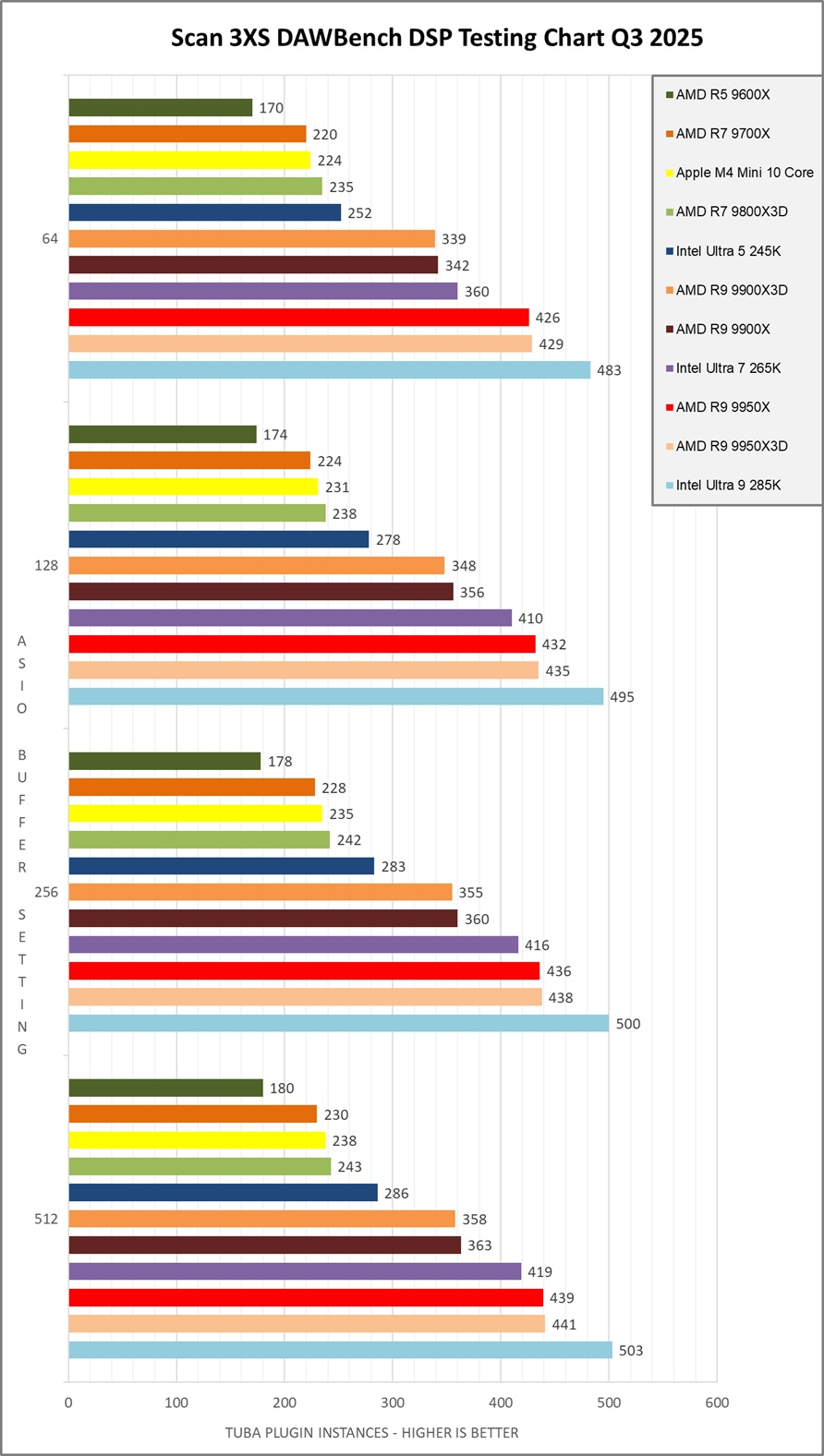
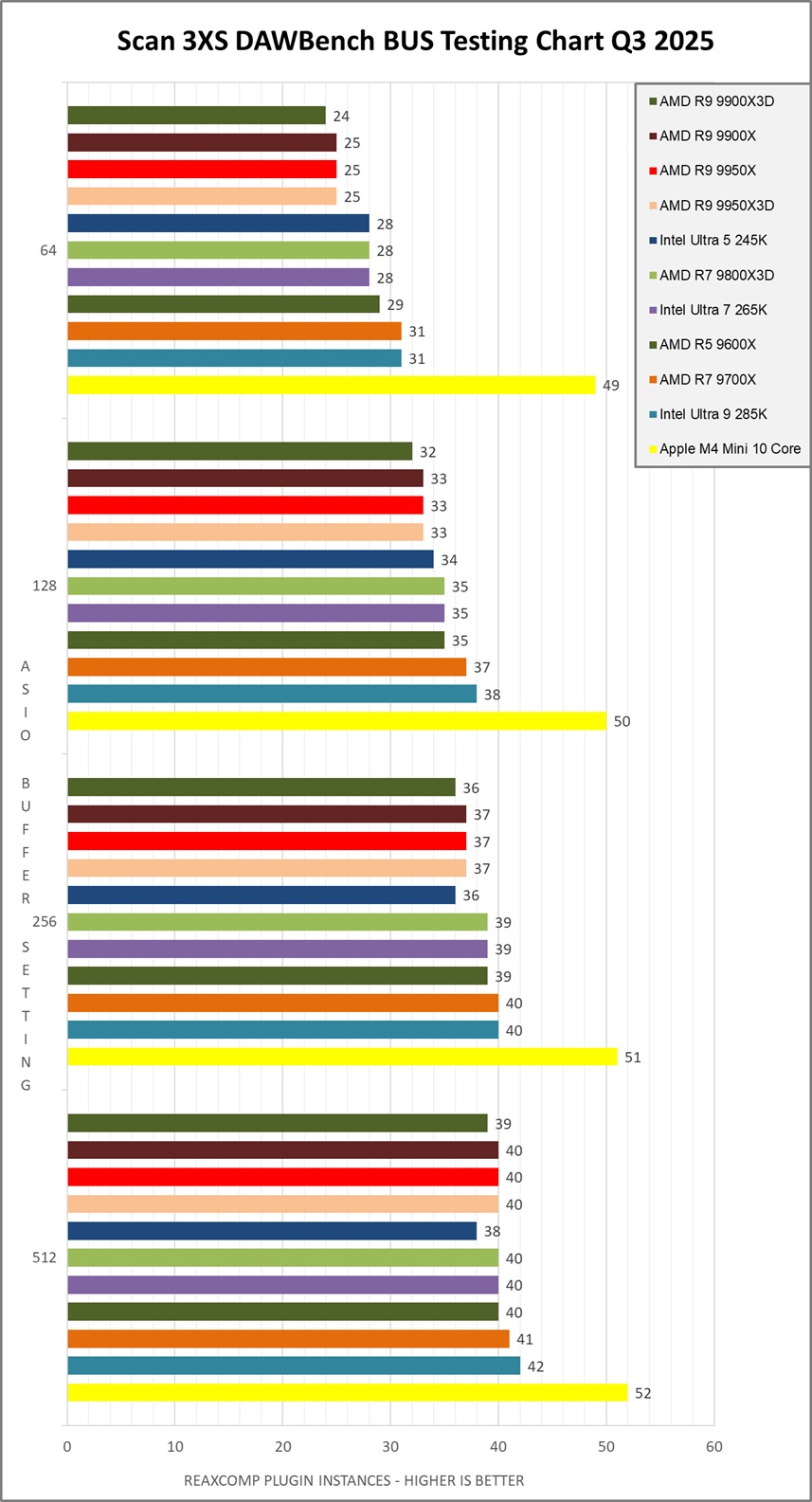
DAWBench is the industry-standard benchmark for measuring real DAW CPU performance. It tests plugin instance counts, bus chains, and performance at various buffer sizes. The Scan Pro Audio 2025 Edition DAWBench test was groundbreaking — it included M4 Apple Silicon in official benchmarks for the first time, confirming Apple’s strong showing in bus-heavy tests using Reaper with a Babyface Pro FS interface.
The critical insight from these tests? Buffer size completely reshuffles the rankings. The same CPU can go from first place to last depending on this single setting. This is why generic “best CPU for music production” advice is fundamentally misleading — the answer changes based on whether you’re tracking vocals at 64 samples or bouncing a final mix at 1024.
64-Sample Buffer — Live Recording
Winner: i9-14900K. When you need rock-bottom latency for real-time monitoring during tracking sessions, Intel’s 6.0GHz boost clock delivers. Pro audio workstation reviews consistently show Intel leading AMD in sub-128 sample buffer scenarios. At 64 samples with a 48kHz sample rate, you’re looking at roughly 1.3ms of buffer latency — and at that extreme, every microsecond of CPU processing speed matters. The i9-14900K’s raw single-thread throughput at these settings is exactly what keeps audio dropouts at bay when a vocalist needs zero-latency monitoring through plugin chains.
256-Sample Buffer — Everyday Mixing
Winner: Tie (M4 Max ≈ i9-14900K). At the buffer size most producers actually work at day-to-day, both chips perform nearly identically. The M4 Max’s advantage here is the near-silent thermal profile — in a treated studio environment, the difference between a whisper-quiet Mac Studio and a PC with an air cooler running at moderate RPM is immediately noticeable.
1024-Sample Buffer — Large Project Mixdown
Winner: Ryzen 9 7950X. When you’re bouncing a 200-track orchestral session or running offline exports with dozens of CPU-hungry plugins, all 16 performance cores of the 7950X shine. This is where AMD’s architecture philosophy pays off massively. Intel’s hybrid approach means DAWs often struggle to properly schedule work across P and E cores — some plugins get assigned to the weaker E-cores and create bottlenecks. The 7950X doesn’t have this problem: every core is equally capable, so the DAW’s thread scheduler can distribute load evenly. The result is more consistent performance and fewer unexpected spikes. Offline bounce ranking: Ryzen 9 7950X > M4 Max > i9-14900K.
Best CPU for Your Studio Workflow
Benchmarks tell one story. Your actual workflow tells another. Here’s how to match each chip to real-world use cases:
Live recording and real-time monitoring: Go with the i9-14900K. Its 64-sample buffer stability is unmatched, and the Windows ecosystem offers mature driver support for interfaces from RME, Universal Audio, and Antelope. Just budget for serious cooling — a Noctua NH-D15 class cooler is non-negotiable. The 2024 microcode stability concerns (13th/14th gen) have been largely addressed by the 0x129 patch, though some users in online forums still express caution for marathon sessions.
Large orchestral templates and sample libraries: The M4 Max is purpose-built for this. When streaming dozens of gigabytes from Kontakt, SINE, or Spitfire libraries simultaneously, the 546GB/s unified memory bandwidth is a game-changer that no discrete GPU + RAM setup can match. On a traditional PC, sample data has to travel from NVMe storage through system RAM to the CPU cache — each hop adding latency. The M4 Max’s unified architecture collapses these hops, keeping massive sample pools accessible with minimal overhead. Users in orchestral virtual instrument communities consistently highlight this advantage, with some reporting they can load templates that would require 128GB of DDR5 on PC into just 64GB of unified memory on the M4 Max.
Mixing, mastering, and plugin-heavy sessions: Ryzen 9 7950X. The raw multi-core throughput from 16 full performance cores is unbeatable for stacking EQs, compressors, and reverbs across hundreds of tracks. Power efficiency is 52% better than Intel, meaning lower electricity bills and less heat in your studio. The AM5 platform also future-proofs your investment with a clear upgrade path to the Ryzen 9 9950X.
Mobile production: M4 Max MacBook Pro. There’s simply no Windows laptop that combines this level of DAW performance with this battery life. It’s the only option in this category.
Budget-conscious builds: Ryzen 9 7950X again. The CPU itself is priced competitively, AM5 motherboard prices have stabilized, and cooling requirements are far more forgiving than the i9-14900K. Best performance per dollar in this comparison.
My Take: What 28 Years in Audio Taught Me About Choosing CPUs
I’ve lived through more CPU transitions than I care to count. PowerPC to Intel Mac. Intel Mac to Apple Silicon. On the PC side, from Athlon 64 through every Ryzen generation. Every single time, the benchmarks dominate the conversation — but in the studio, what actually matters is stability and workflow continuity.
Here’s the honest truth: all three of these CPUs are more than enough for 95% of professional music producers. We’ve reached a point where a 100-track session with dozens of plugins doesn’t make any of these chips break a sweat. That’s why I believe the decision framework needs to shift from raw performance to ecosystem.
If you’re already invested in the Mac ecosystem — Logic Pro is muscle memory, AirDrop is part of your client delivery workflow, and your entire plugin library is AU — the M4 Max is a no-brainer. The seamless integration between hardware and software that Apple provides simply doesn’t exist on the PC side, and in a professional environment, that frictionless experience has real dollar value in saved troubleshooting hours.
But if you’re running Pro Tools HDX hardware or depend on Windows-only VSTs, you’re in PC territory. In that case, my recommendation splits clearly: i9 for tracking studios where ultra-low latency is a daily necessity, Ryzen for mix rooms where plugin count and bounce speed drive productivity. The i9-14900K’s stability history does give me genuine pause for mission-critical sessions — the microcode patches helped significantly, but for 12-hour mixing marathons where a crash means re-doing an entire recall, the Ryzen’s rock-solid consistency under sustained all-core load gives me far more confidence. I’ve seen too many sessions derailed by unexpected system behavior to take stability lightly.
The Verdict: There’s No Best CPU — Only the Right One
The May 2025 music production CPU benchmark conclusion is clear. The M4 Max is the future-forward chip with unmatched single-core and unified memory architecture. The i9-14900K remains the low-latency king for live tracking. The Ryzen 9 7950X dominates multi-core efficiency and price-to-performance. Analyze your workflow first, then pick the chip that serves it — not the one with the highest number on a chart. Finding the CPU that’s optimal for your studio matters far more than chasing the one that tops a benchmark.
Building a studio workstation or optimizing your DAW setup? Get advice from a producer with 28 years of hands-on experience.
Get weekly AI, music, and tech trends delivered to your inbox.