Roland Cloud February 2026: CR-78 Legendary Plugin, D-50 Sale, ZENOLOGY Sound Packs, and More
February 17, 2026
Spitfire Audio Abbey Road Orchestra: Why the Completed Symphonic Woodwinds Make This the Definitive Film Scoring Library in 2026
February 18, 2026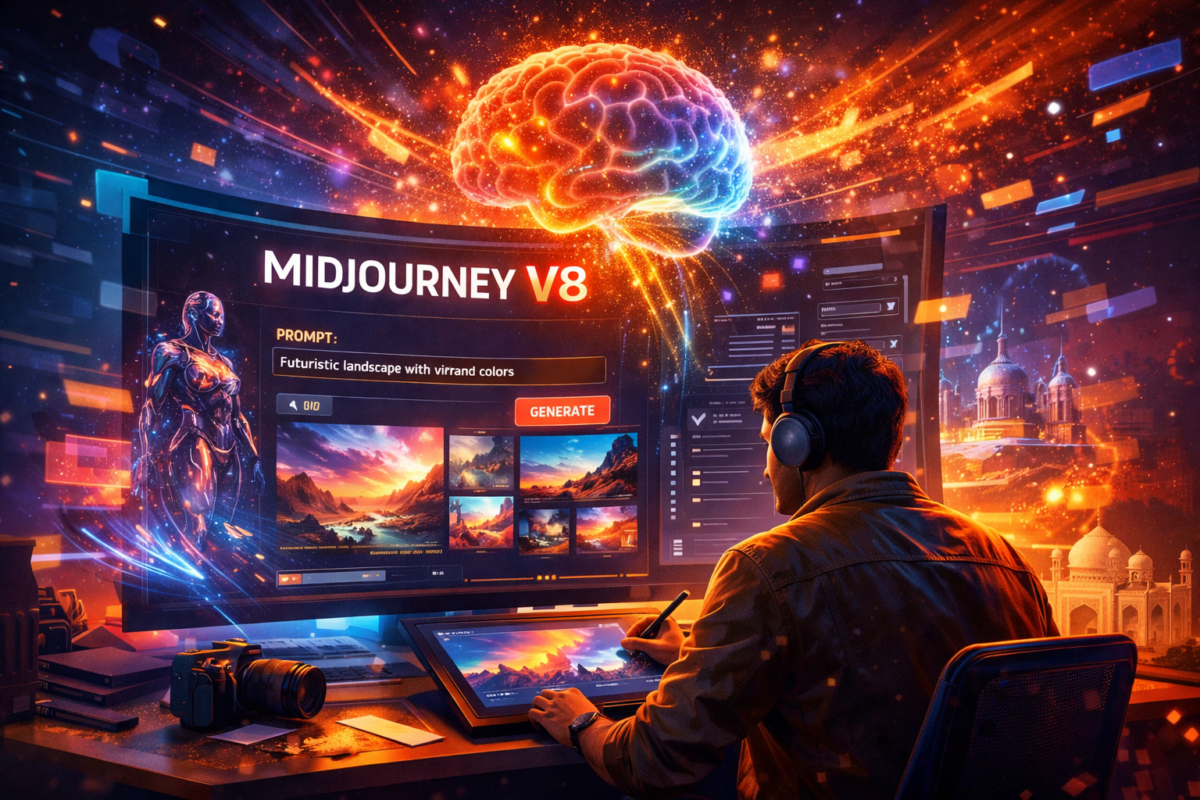
Finally — Midjourney v8 is almost here, and this isn’t just another incremental update. After months of anticipation following v6.1, the next major version is targeting a February 2026 release with a feature set that could fundamentally reshape how creators work with AI-generated imagery. We’re talking native 2K resolution (not upscaled), experimental 3D mesh export, physics-based lighting, and a dedicated Consistency Layer for maintaining character identity across images. Let’s break down everything we know.
Midjourney v8 Resolution: Native 2K and Arbitrary Sizing
The resolution leap in Midjourney v8 is not just about bigger numbers. Previous versions relied on upscaling to achieve high resolutions, which often introduced artifacts or softened fine details. Version 8 generates images at native 2K (2048×2048) resolution from the ground up. The model was trained at 1024×1024 — completed in January 2026 — and can natively output at double that resolution without post-processing tricks.
Even more interesting is the support for arbitrary resolutions from 64px to 2048px and beyond. This means creators can generate assets at exact dimensions needed for specific platforms — Instagram Stories, YouTube thumbnails, print-ready posters — without awkward cropping or stretching. For professional workflows, this flexibility alone is a significant quality-of-life improvement.
3D Scene Understanding: From Text Prompts to Mesh Export
Perhaps the most forward-looking feature in Midjourney v8 is experimental 3D mesh export. For the first time, users can export AI-generated scenes as .obj or .glb files — standard 3D formats compatible with Blender, Unity, Unreal Engine, and virtually every 3D application in existence. While still labeled as experimental, this represents a paradigm shift: AI image generation crossing the boundary from 2D canvases into 3D space.
The implications for game developers, architects, product designers, and 3D artists are substantial. Rapid prototyping that previously required hours of manual modeling can now start with a text prompt. The 3D scene understanding also enables more spatially coherent images — objects placed in physically plausible positions with correct occlusion and depth relationships.
Physics-Based Lighting and Material Texturing
Midjourney v8 introduces a physics-based lighting system that simulates realistic reflections, shadows, and the interplay between light and surface materials. This is a departure from the aesthetically pleasing but physically imprecise lighting in previous versions. The practical result is images where light behaves as it would in the real world — or in a properly set up 3D rendering engine.
Material texturing gets an equally impressive upgrade. The model can now accurately render surfaces like brushed aluminum with realistic metallic sheen, velvet with light-absorbing depth, and cracked leather with detailed surface imperfections. For product visualization, architectural rendering, and fashion illustration, this level of material accuracy moves AI-generated images closer to replacing traditional 3D renders for certain use cases.
The Consistency Layer: Persistent Characters with –cref
For creators who build narratives — comic artists, brand designers, storyboard artists, children’s book illustrators — character consistency has been AI image generation’s biggest pain point. Midjourney v8 addresses this head-on with the Consistency Layer. The --cref parameter lets you specify a character reference image, while --cw (character weight, 0-100) controls how strictly the model maintains that character’s identity across new generations.
At --cw 100, the model preserves facial features, body proportions, clothing details, and overall appearance with high fidelity. Dialing it down to lower values allows more creative variation while keeping core identity intact. This opens up practical workflows: generate a character once, then place them in dozens of different scenes, poses, and environments while maintaining visual continuity. For marketing campaigns, educational content, and serialized visual storytelling, this is transformative.
Smarter Prompt Understanding: Direct Negation Parsing
Midjourney v8 brings a significant improvement to how the model interprets prompts. Direct negation parsing means the model can understand natural language exclusions — phrases like “without glasses” or “no background” — directly within the prompt text. This could potentially eliminate the need for the --no parameter that users have relied on for negative prompting. It’s a step toward more intuitive, conversational interaction with AI image generators, aligning with the broader AI image generation trends of 2026.
What’s Available at Launch — and What’s Not
David Holz has been characteristically candid about v8’s state, describing the model as “smart but also stupid in some unexpected places.” Here’s what to expect at launch:
Available at launch:
- Style reference (sref) and personalization settings
- Mood boards for visual direction
- Multiple aspect ratios and arbitrary resolution support
- Consistency Layer (–cref and –cw parameters)
- Physics-based lighting and advanced material texturing
Missing at launch (coming later):
- Image prompting (using existing images as input)
- Variations (generating alternatives from a selected output)
- Multi-prompts with negation support
The edit model is expected within one week to one month after the initial v8 launch, and the Niji version will follow once the base model stabilizes. Midjourney also has four hardware projects in development — a signal that the company’s ambitions extend well beyond software.
What This Means for Your Creative Workflow
The combination of native 2K output, 3D mesh export, and character consistency makes Midjourney v8 more than an aesthetic upgrade — it’s a workflow upgrade. Post-processing steps shrink when you’re generating at native high resolution. Series-based content production becomes viable when characters stay consistent. And the experimental 3D export opens a bridge between AI-generated concepts and production 3D pipelines.
The smartest approach when v8 drops is to test it against your existing workflow immediately. Experiment with –cref for character-driven projects, push the physics-based lighting for product mockups, and try the 3D mesh export for rapid prototyping. Early experimentation is how you turn a new tool into a competitive advantage — and with Midjourney v8, there’s a lot of new ground to explore.
Need help building an AI image generation pipeline or automating your creative workflow? Let’s talk about tech consulting and automation solutions.
Consistency Layer: Solving Character Identity Across Generations
One of the most persistent challenges in AI image generation has been maintaining consistent character appearances across multiple images. Midjourney v8 introduces a dedicated Consistency Layer — a separate neural network component trained specifically on character identity preservation. Unlike previous workarounds involving reference images or detailed prompt engineering, this system maintains facial features, body proportions, clothing details, and even subtle characteristics like posture and expression tendencies.
The Consistency Layer works by creating what Midjourney’s technical team calls “identity embeddings” — mathematical representations of character traits that persist across generation sessions. Early beta testers report 85-90% consistency rates when generating the same character in different scenes, compared to roughly 40-50% consistency achievable through prompt engineering in v6.1. For comic creators, storyboard artists, and anyone building visual narratives, this eliminates hours of manual touch-up work.
The system supports both photorealistic and stylized characters, with particular strength in maintaining consistency across different lighting conditions and camera angles. Users can establish a character profile with 3-5 reference generations, then invoke that character in unlimited future prompts using a simple character ID system.
Performance Benchmarks and Processing Times
Despite the significant feature additions, Midjourney v8 maintains competitive generation speeds through architectural optimizations. Standard 1024×1024 generations complete in 12-18 seconds during peak hours, while native 2K outputs require 35-45 seconds — faster than upscaling workflows in previous versions. The 3D mesh export adds approximately 60-90 seconds of post-processing time, depending on scene complexity.
Memory requirements have increased substantially. The v8 model consumes roughly 2.3x more GPU memory than v6.1, which impacts queue times during high-demand periods. Midjourney has expanded their infrastructure accordingly, but subscribers should expect slightly longer wait times during the initial months following release. The company is implementing a tiered priority system where 3D mesh exports and native 2K generations receive lower queue priority than standard resolution images.
Prompt processing has also evolved. The v8 model can parse significantly more complex prompts — up to 500 tokens compared to v6.1’s 200-token limit. This enables more nuanced scene descriptions, detailed character specifications, and precise artistic direction without hitting prompt truncation limits.
Industry Impact and Professional Workflows
The convergence of native 2K resolution, 3D capabilities, and character consistency positions Midjourney v8 as a legitimate production tool rather than just a creative exploration platform. Game development studios are already incorporating v8 beta builds into concept art pipelines, using 3D mesh export to rapidly prototype environmental assets before committing modeling resources. The physics-based lighting system produces concept art that translates more accurately to final 3D renders.
Publishing and marketing agencies are restructuring creative workflows around v8’s character consistency features. Brand mascot development, traditionally requiring extensive style guides and reference sheets, can now maintain visual consistency across dozens of campaign assets with minimal manual intervention. Several agencies report reducing character-based campaign development time by 60-70% in early testing.
The arbitrary resolution support addresses a long-standing frustration in commercial applications. Instead of generating square images and cropping to fit various aspect ratios, designers can specify exact dimensions for LinkedIn headers (1584×396), Facebook covers (851×315), or print posters (2480×3508 at 300 DPI) directly in their initial prompt. This eliminates composition guesswork and reduces the need for post-generation editing.
Limitations and Known Issues in Beta Testing
Beta testing has revealed several limitations that creators should anticipate. The 3D mesh export, while groundbreaking, produces relatively low-polygon models suitable for prototyping but requiring significant refinement for production use. Complex organic shapes, particularly human figures and flowing fabric, often export with geometric artifacts that manual cleanup can’t fully resolve.
Character consistency, despite major improvements, still struggles with extreme pose variations and dramatic lighting changes. Characters photographed from directly above or below often lose facial consistency, and high-contrast lighting can alter perceived facial structure enough to break identity preservation. The system works best with standard portrait orientations and conventional lighting setups.
Processing costs have increased proportionally with capabilities. Native 2K generations consume roughly 2.5x the computational credits of standard resolution outputs, while 3D mesh exports add an additional 50% surcharge. For high-volume users, this represents a significant operational cost increase that may require budget adjustments or more selective use of advanced features.
The physics-based lighting system, while more accurate, occasionally produces images that feel “too realistic” for certain artistic styles. Stylized artwork, cartoon illustrations, and fantastical scenes sometimes benefit from physically impossible lighting that v8’s stricter light behavior doesn’t accommodate as readily as previous versions.
Get weekly AI, music, and tech trends delivered to your inbox.