NVIDIA Blackwell B300 Enters Volume Production: 288GB HBM3e Changes the AI Server Game
February 10, 2026
AI Coding Tools 2026: Claude Code vs Cursor vs GitHub Copilot — Which One Actually Wins?
February 11, 2026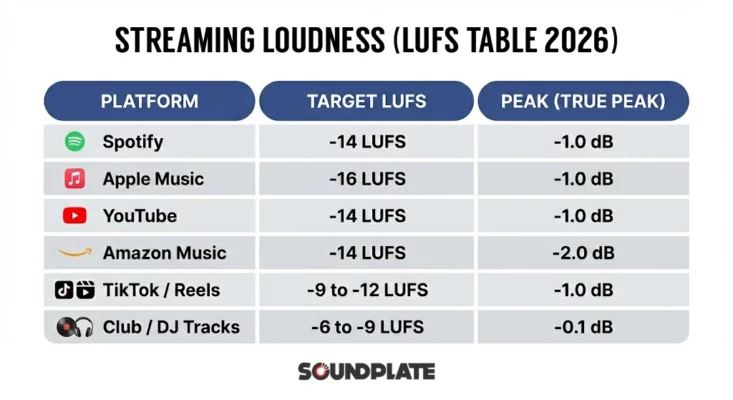
Here’s a number that should make every producer and mastering engineer pause: the top 25 tracks on Spotify average -8.4 LUFS. That’s nearly 6 dB louder than Spotify’s own -14 LUFS target. So what happens when these hyper-compressed tracks hit the platform? Spotify simply turns them down — and all that sacrificed dynamic range? Gone for nothing. If you’re still chasing loudness in 2026, you’re fighting a war that’s already been lost. Loudness mastering streaming platforms demand a completely different strategy today, and this guide breaks it all down.
Every major streaming platform now applies loudness normalization. Whether you deliver your master at -8 LUFS or -16 LUFS, the listener hears roughly the same volume. The difference? The quieter, more dynamic master actually sounds better because it retains punch, depth, and transient detail. Understanding loudness mastering streaming platforms in 2026 isn’t about hitting the loudest number — it’s about making smart decisions that translate across every service.
What Is LUFS and Why It Replaced the Loudness War
LUFS (Loudness Units Full Scale) measures perceived loudness using a frequency-weighting curve that mirrors how human ears actually process sound. Unlike peak meters or RMS readings, LUFS tells you how loud your track feels to a listener. There are two key measurements: Integrated LUFS (the average loudness across the entire track) and Short-term LUFS (a rolling 3-second window). Both matter for mastering decisions.
Then there’s True Peak — the actual maximum level your signal reaches after digital-to-analog conversion, accounting for inter-sample peaks that can exceed 0 dBFS. Most platforms recommend -1 dBTP as a ceiling, while Amazon Music demands a stricter -2 dBTP. Ignoring true peak can lead to audible distortion, especially after lossy codec encoding.
2026 Loudness Mastering Streaming Standards: Platform-by-Platform Breakdown
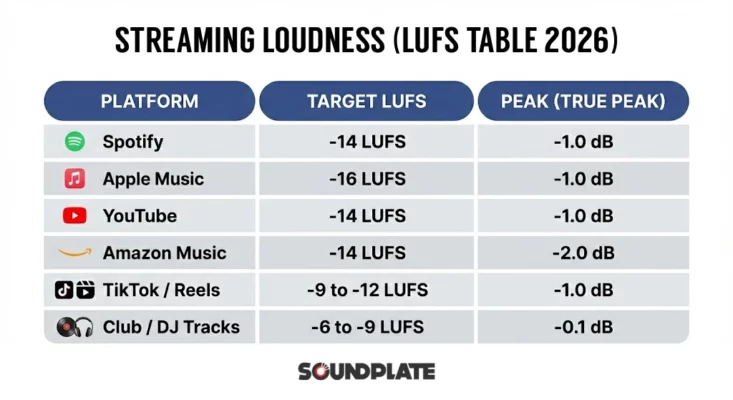
Each platform has its own LUFS target, codec pipeline, and normalization behavior. Here’s the complete comparison for 2026.
| Platform | Target LUFS | True Peak | Codec | Normalization |
|---|---|---|---|---|
| Spotify | -14 LUFS | -1 dBTP | Ogg Vorbis | Track-based; user preference (quiet/normal/loud) |
| Apple Music | -16 LUFS | -1 dBTP | AAC 256kbps | Sound Check (user toggle) |
| YouTube | -14 LUFS | -1 dBTP | AAC | Always on; no boost for quiet tracks |
| Tidal | -14 LUFS | -1 dBTP | FLAC (Premium) | Album-based |
| Amazon Music | -14 LUFS | -2 dBTP | FLAC HD | Track-based |
| Deezer | -15 LUFS | -1 dBTP | FLAC | Track-based |
| TikTok/Reels | -9 to -12 LUFS | -1 dBTP | AAC | Variable |
As Soundplate’s comprehensive LUFS table shows, most platforms converge around -14 LUFS. Apple Music remains the most conservative at -16 LUFS, while short-form platforms like TikTok and Reels allow significantly louder masters.
Spotify’s Normalization: What Actually Happens to Your Master
Spotify offers three loudness settings: “Quiet” (-23 LUFS), “Normal” (-14 LUFS), and “Loud” (-11 LUFS). When your track exceeds the target, Spotify reduces the playback volume. When it’s below, Spotify boosts it. This means a carefully mastered track at -14 LUFS plays back untouched, while a slammed -8 LUFS master gets pulled down by 6 dB.
Here’s the kicker: real-world measurements by Teknup reveal that top charting tracks average -8.4 LUFS. These tracks get turned down to match the -14 target. The result? All that aggressive limiting and compression accomplished nothing volume-wise — it only destroyed dynamic range. The tracks that actually stand out on Spotify are the ones with punch and breathing room, not the ones pushed to the wall.

Apple Music and Sound Check: The Most Conservative Target
Apple Music’s Sound Check targets -16 LUFS — 2 dB lower than most other platforms. But there’s a critical caveat: Sound Check is optional. Users can disable it in settings, which means your master plays back at its original loudness. This creates a dual challenge: your track needs to sound great normalized to -16 LUFS and also hold up well when played at full level without normalization.
Apple Music uses AAC 256kbps encoding, which can introduce inter-sample peaks during the encoding process. This is why true peak management matters even more on this platform. A master that sits at -0.5 dBTP might clip after AAC encoding. Playing it safe with -1 dBTP (or even -1.5 dBTP) gives your master room to survive the codec conversion cleanly.
YouTube, Tidal, and Amazon Music: Platform-Specific Quirks
YouTube’s normalization is always on and there’s no way for users to disable it. The unique aspect: YouTube only turns tracks down, never up. If your master sits at -18 LUFS, it plays at -18 LUFS — YouTube won’t boost it to -14. This is important for genres like classical or ambient where intentionally quieter masters are common. You won’t get a volume boost, so plan accordingly.
Tidal takes a different approach with album-based normalization. Instead of treating each track individually, Tidal normalizes at the album level, preserving the intended volume relationships between tracks. This is a win for concept albums, classical recordings, and any project where track-to-track dynamics are part of the artistic intent.
Amazon Music matches most platforms at -14 LUFS but enforces the strictest true peak requirement at -2 dBTP. If you’re distributing to Amazon Music HD (which streams in lossless FLAC), keeping your true peak at -2 dBTP ensures clean playback even on their high-resolution tier. This single requirement is actually a good reason to target -2 dBTP across the board — it satisfies every platform simultaneously.
One Master to Rule Them All: The Universal Approach
Despite the different standards, you don’t need separate masters for each platform. The streaming landscape in 2026 has converged enough that a single well-crafted master handles everything beautifully. Here’s the universal target that works everywhere.
- Integrated LUFS: -14 — sits at the sweet spot for Spotify, YouTube, Tidal, and Amazon. Apple Music and Deezer will apply minimal normalization
- True Peak: -2 dBTP — satisfies Amazon’s strict ceiling and provides ample codec headroom for AAC/Ogg Vorbis encoding on all platforms
- Preserve dynamic range — aim for at least 8-10 dB of dynamic range (difference between loudest and quietest sections). This is your competitive edge
- Test with codecs — encode your final master to Ogg Vorbis (Spotify) and AAC (Apple/YouTube) to verify true peak doesn’t exceed your ceiling post-encoding
Practical Loudness Mastering Streaming Workflow
Here’s a step-by-step mastering workflow designed for streaming distribution in 2026. Follow this process and your masters will translate across every platform.
- Step 1: Balance first, loudness last. Start with EQ, compression, and saturation to shape your tone and dynamics. Don’t touch the limiter until the mix sounds balanced and musical at a moderate level
- Step 2: Set your limiter ceiling to -2 dBTP. Industry tools like iZotope Ozone’s Maximizer, FabFilter Pro-L 2, or Sonnox Oxford Limiter all support true peak limiting. Enable true peak mode — don’t rely on sample peak readings alone
- Step 3: Monitor with a LUFS meter. Youlean Loudness Meter (free) or iZotope Insight give you real-time Integrated and Short-term LUFS readings. Aim for -14 Integrated LUFS across the full track
- Step 4: A/B at matched loudness. Pull up a reference track and match its loudness before comparing. This removes the psychoacoustic bias where “louder = better” and lets you evaluate tonal balance and dynamic impact honestly
- Step 5: Codec verification. As iZotope’s streaming mastering guide recommends, render your master through Ogg Vorbis and AAC encoders, then recheck true peak. If it exceeds -1 dBTP post-encoding, pull your limiter ceiling down by another 0.5 dB
- Step 6: Short-form version (optional). For TikTok and Reels distribution, create a separate render with additional limiting to reach -9 to -12 LUFS. Keep this as a derivative — your primary master stays at -14 LUFS
Short-Form Content: TikTok and Reels Need a Different Master
TikTok and Instagram Reels operate in a completely different loudness environment. With targets ranging from -9 to -12 LUFS, these platforms expect louder, more compressed audio. The reasoning makes sense: users scroll through content on phone speakers in noisy environments, and you have roughly 1-3 seconds to grab attention before they swipe away.
For short-form distribution, create a separate “social” master. Take your streaming master and apply additional parallel compression and limiting to bring the loudness up to around -10 LUFS while keeping the true peak at -1 dBTP. Many mastering engineers now deliver two versions as standard: a streaming master and a social master. If your distributor or label doesn’t request this yet, offering it proactively sets you apart.
Dynamic Range Is Your Real Competitive Advantage
The loudness war is over. Normalization won. Every track plays at roughly the same volume regardless of how loud you mastered it. In this environment, what separates a great master from a mediocre one isn’t loudness — it’s dynamic range.
Think about what makes a track exciting to listen to: the punch of a kick drum hitting through a verse, the swell of a chorus lifting above the bridge, the breath between vocal phrases, the explosive drop after a filtered build. All of these rely on dynamic contrast. When you slam a limiter to squeeze out every last fraction of a decibel, you flatten these moments. The kick doesn’t punch, the chorus doesn’t lift, and the drop doesn’t explode — everything sits at one flat, fatiguing level.
In 2026, the smartest mastering engineers are treating dynamic range as a creative tool, not a limitation. They’re delivering masters at -14 LUFS with 10+ dB of dynamic range that sound alive, exciting, and emotionally engaging. And on every streaming platform, after normalization, these masters consistently outperform the hyper-compressed competition.
Final Takeaway: Master Smarter, Not Louder
The loudness mastering streaming platforms playbook for 2026 fits on a single card: target -14 LUFS Integrated, keep true peak at -2 dBTP, preserve your dynamic range, and verify with codec encoding. One master serves every platform. Save your creative energy for the mix — for the tonal choices, the spatial depth, the emotional arc of the song. That’s what listeners actually hear. That’s what makes them save, share, and come back. Loudness? The algorithm handles that now. Your job is to make the music breathe.
Need your tracks mastered for streaming with precision LUFS targeting and true peak compliance? Greit Studios delivers broadcast-ready masters optimized for every platform.
Get weekly AI, music, and tech trends delivered to your inbox.