Gmail AI Subscription Manager: How to Auto-Organize and One-Click Unsubscribe in 2025
July 9, 2025
Best Budget Laptops July 2025: Under $600 Picks for Students and Work
July 9, 2025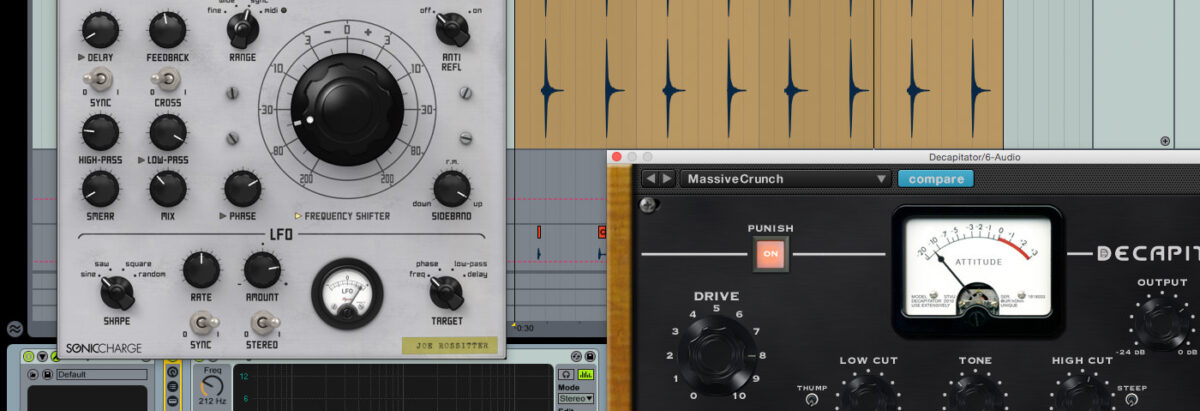
Every time I hear a perfectly quantized kick drum on a “lo-fi” house track, I die a little inside. The entire point of this genre is controlled imperfection — and yet producers keep making the same mistake: they slap RC-20 on the master bus and call it a day. That’s not lo-fi house production. That’s a filter preset.
After 28 years of producing and engineering music, I can tell you the difference between a track that sounds lo-fi and one that feels lo-fi comes down to three things: how you program your drums, how you degrade your signal, and how you resist the urge to clean everything up. Let’s break it all down — from the drum machines that defined the genre to the processing chains that give it soul.
Why Lo-Fi House Isn’t Just “Dirty House Music”
Lo-fi house emerged in the mid-2010s from bedrooms and basements, championed by artists like DJ Seinfeld, Mall Grab, and Ross From Friends. What separated their tracks from standard deep house wasn’t just the dusty texture — it was an entire production philosophy built on limitation. Cheap gear, cassette recorders, deliberately degraded samples, and drum patterns that swung so hard they felt like they might fall apart.
The genre sits comfortably between 115-125 BPM, with most tracks landing around 118-120. It borrows the four-on-the-floor kick pattern from classic house but filters everything through a lens of deliberate degradation. Think of it as house music recorded on equipment that your parents would have thrown away in the ’90s.
Lo-Fi House Production Starts with the Right Drum Machine Sounds
Your drum sound selection makes or breaks a lo-fi house track before you even touch an effect plugin. Here’s what works and why:
Roland TR-909: The Lo-Fi House Foundation
The TR-909 is the backbone of lo-fi house production. Its kick drum has that punchy, slightly overdriven quality that cuts through even heavily degraded mixes. The hi-hats have enough metallic bite to stay present after low-pass filtering, and the clap sits perfectly in the mid-range where lo-fi processing adds character rather than destroying definition.
But here’s what most tutorials won’t tell you: you don’t want clean 909 samples. You want 909 samples that have been bounced through analog hardware — old mixing desks, tape machines, even cheap guitar pedals. The imperfections in the signal path are what give lo-fi house its DNA.
TR-707 and TR-606: The Secret Weapons
While the 909 gets all the attention, the Roland TR-707’s hi-hats and ride cymbal are actually more common in lo-fi house than you’d expect. Their slightly thinner, more digital character degrades beautifully under bitcrushing. The TR-606’s cowbell and tom sounds, pitched down a semitone or two, create those ghostly percussion accents that float through the background of tracks by artists like DJ Boring and Sleep D.
The Arturia DrumBrute Impact Advantage
If you’re working with hardware, the Arturia DrumBrute Impact deserves special mention. Its built-in drive circuit can saturate hats and snares directly at the source, meaning you get that analog distortion character baked into the sound before it even hits your DAW. It’s one of the few modern drum machines that sounds authentically lo-fi without any post-processing.
Programming Lo-Fi House Drums: Swing Is Everything
The number one mistake in lo-fi house production is programming drums on a perfect grid. This genre lives and dies by its groove, and that groove comes from swing and deliberate timing imperfections.
The MPC Swing Secret
According to Attack Magazine’s lo-fi house breakdown, the sweet spot is “MPC 8 Swing 56” — a specific swing template that pushes every other 16th note slightly late, creating that head-nodding, slightly drunken groove. In Ableton Live, you can access this through the Groove Pool by loading MPC swing templates.
Another effective approach from the Studio Brootle method uses “Swing MPC Funker 16th 70” at 40% global amount, applied to every element in the session. This creates a cohesive feel where the entire track breathes together rather than just the drums swinging independently.
The J Dilla Influence
Lo-fi house owes a massive debt to J Dilla’s drum programming philosophy. His technique of leaving drums unquantized and deliberately playing hi-hat patterns behind the beat created the template that lo-fi house producers would later adapt. The key insight: you’re not making drums that sound programmed-but-swung. You’re making drums that sound like a human who has had exactly two drinks — loose but still in control.
Practical Pattern: A 2-Bar Lo-Fi House Beat
Here’s a concrete starting point at 118 BPM:
- Kick: Four-on-the-floor with one syncopated ghost kick on the “and” of beat 3 in bar 2. Remove sub-30Hz with a high-pass filter.
- Clap/Snare: Beats 2 and 4. Layer two clap samples — pitch the main one down 2 semitones. Add a noise clap on upbeats at -12dB.
- Hi-Hats: Offbeat 8th notes with shortened decay. Every other hit at slightly different velocity (85-110 range).
- Percussion: A filtered tom on the “e” of beat 2, pitched down 1 semitone. A shaker or tambourine loop playing 16ths, buried low in the mix.
- Texture Layer: Vinyl crackle or fire crackle sample running continuously, filtered below 150Hz and above 8kHz.
Apply your swing template after programming. Then manually nudge 2-3 hits off the grid by 10-20 milliseconds for additional human feel.
Vinyl Warmth Processing: The Signal Degradation Chain
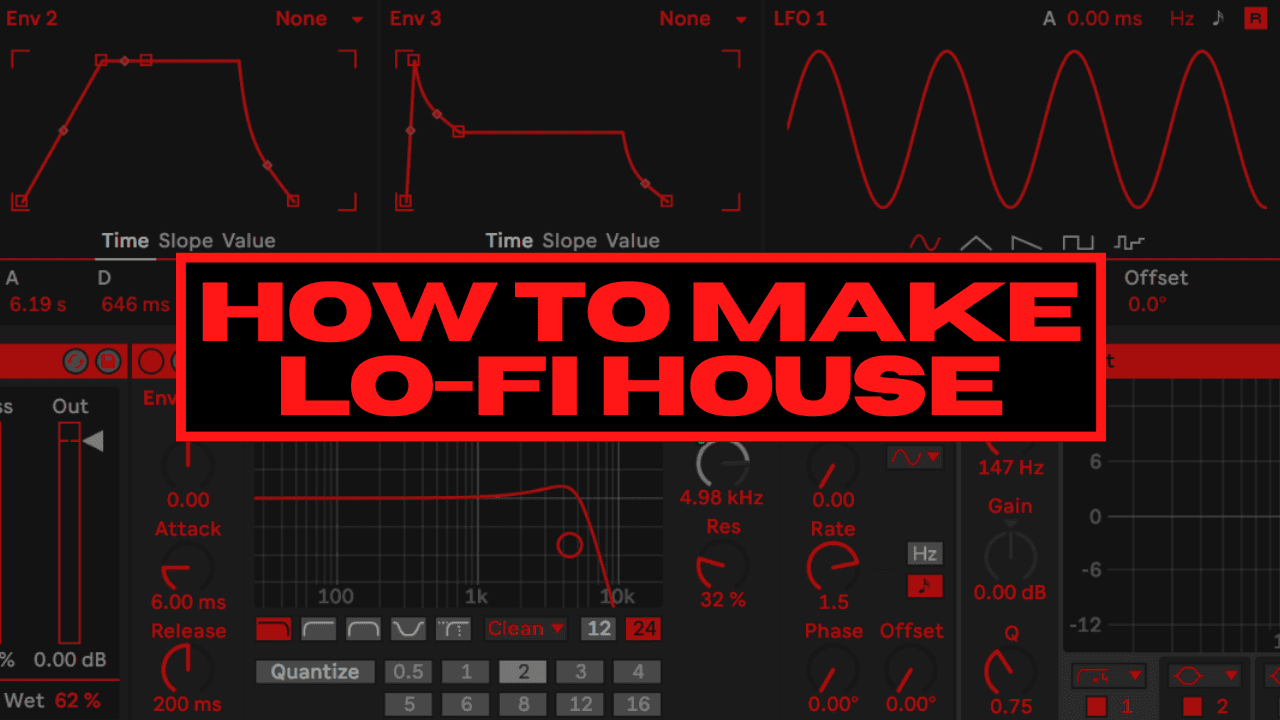
This is where most lo-fi house production falls apart. Producers either under-process (sounds clean with a crackle layer) or over-process (sounds like a broken radio). The trick is building a multi-stage degradation chain where each effect does a little, and the cumulative result feels organic.
Stage 1: Saturation (Warming the Source)
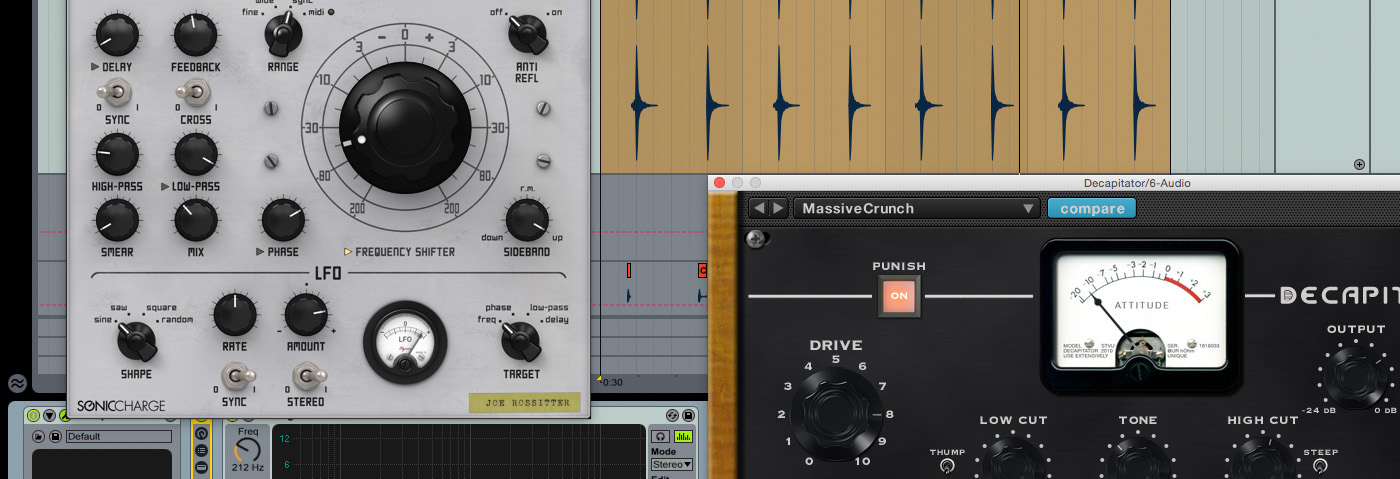
Start with saturation on individual drum sounds before grouping. In Ableton, the Saturator in Analog Clip mode at around 11dB drive adds warmth without destroying transients. For Ableton’s Amp effect, the Blues setting on kick drums — with tweaked frequency knobs and reduced Dry/Wet — gives that pushed-through-a-guitar-amp quality that defines classic lo-fi house kicks.
Stage 2: Bitcrushing (Controlled Digital Degradation)
Bitcrushing reduces the bit depth and sample rate of your audio, emulating early digital hardware. The key is subtlety on drums and aggression on melodic elements. On your drum bus, try reducing bit depth to 12 bits and sample rate to around 22kHz. On synth pads and chords, you can push harder — 8 bits at 16kHz creates that signature lo-fi house shimmer that sounds like a VHS tape of a rave.
Ableton’s Redux effect handles this well, but for more character, Ableton’s Erosion effect in Wide Noise mode adds noise-based artifacts while simultaneously widening the stereo image — a technique highlighted by ModeAudio’s vintage lo-fi house tutorial.
Stage 3: Tape Emulation (The Vinyl Warmth Core)
This is where the “vinyl warmth” truly lives. Two plugins dominate this space:
XLN Audio RC-20 Retro Color is the gold standard for lo-fi house producers. Its six modules — Noise, Wobble, Distortion, Digital, Space, and Magnetic — each address a specific flavor of degradation. The Noise module adds vinyl crackle and tape hiss. The Wobble module introduces pitch modulation mimicking warped tape. The Magnetic module creates volume fluctuations found in actual tape machines and vinyl players. The ability to dial each module independently means you can build exactly the amount of degradation you need.
iZotope Vinyl is free and surprisingly effective. Its decade selector lets you choose tonal characteristics from 1930s to 2000s, with each era shifting the EQ curve differently. For lo-fi house, the 1980 setting with mechanical noise and dust cranked up creates an instant vintage quality. As Attack Magazine’s tutorial demonstrates, setting the wear and dust parameters high transforms clean drums into something that sounds like it was sampled from a dusty record crate.
Stage 4: Low-Pass Filtering (Taming the Harshness)
After all that degradation, your track will likely be harsh. This is intentional — you want to distort too much, then soften with a low-pass filter. Roll off everything above 2.5-4kHz on your master bus or drum group. This removes the brittleness while keeping the warmth and character you’ve built. It’s the classic lo-fi move: push hard, then pull back gently.
Advanced Lo-Fi House Production Techniques
Hardware Resampling
The most authentic lo-fi house sound comes from actual hardware degradation. Route your drum bus out of your audio interface into a cassette deck with the input overdriven, then record it back. The physical tape saturation, head wobble, and frequency response limitations are impossible to fully replicate digitally. Even routing through a cheap second-hand mixer adds harmonic character that plugins can only approximate.
Sidechain Everything to the Kick
Lo-fi house gets that hypnotic, pumping quality from aggressive sidechain compression. Compress your pads, bass, and even background textures to your kick drum. Use a fast attack (0.1-1ms) and a medium release (100-200ms) so the entire mix ducks dramatically on every kick hit and slowly breathes back. This creates the signature “pumping” feel that makes lo-fi house so addictive on dance floors.
Guitar Pedals as Lo-Fi Processors
Don’t sleep on guitar pedals for lo-fi house processing. Running synth pads through a fuzz pedal, or sending your drum bus through an analog overdrive, adds harmonic complexity that’s different from digital plugins. As Attack Magazine’s lo-fi production secrets guide suggests, borrowing distortion, overdrive, and fuzz pedals from guitarists gives you character that no plugin can fully replicate.
Found Sound Integration
Layer field recordings underneath your drums — street noise, rain, mechanical hum, or even recordings of old equipment running. Process these with bitcrushing and heavy filtering, and they become textural beds that fill the gaps between drum hits. This technique is what separates bedroom lo-fi house from the genre’s most compelling tracks.
The Complete Lo-Fi House Drum Processing Chain
Here’s my recommended signal chain for a lo-fi house drum group, from first insert to last:
- 1. Drum Buss / Ableton Drum Buss: Crunch mode engaged, drive at 30-40%. This glues the kit together.
- 2. Saturator: Analog Clip mode, 8-12dB drive, Dry/Wet at 60-70%.
- 3. iZotope Vinyl or RC-20: Vinyl crackle, mechanical noise, and subtle pitch wobble.
- 4. EQ Eight: High-pass at 30Hz, low-pass at 3-5kHz (adjust to taste).
- 5. Compressor: Fast attack, slow release, 4-6dB gain reduction. Emulates hardware limiting.
- 6. Utility: Reduce width to 80-90% for a more mono-compatible, vinyl-like stereo image.
Run this chain on your drum group, then apply a separate, lighter version of stages 3 and 4 on your master bus for cohesion.
Common Lo-Fi House Production Mistakes to Avoid
- Over-relying on a single lo-fi plugin: RC-20 on the master bus is not a production technique. Build degradation in stages across multiple points in your signal chain.
- Ignoring swing: Perfectly quantized lo-fi house is an oxymoron. Always apply groove templates or manually offset timing.
- Too much vinyl crackle: Crackle should be felt, not heard. If your listener notices the crackle before the groove, you’ve gone too far.
- Cutting too many highs: Low-pass filtering is essential, but cutting below 2kHz kills the life out of your hats and percussion. Find the sweet spot between warmth and clarity.
- Clean bass: Even your sub bass should have some character. Light saturation on the bass keeps it present in the lo-fi aesthetic without muddying the low end.
The magic of lo-fi house production lies in understanding that every imperfection is intentional. From the swing in your drum patterns to the crackle on your master bus, each element of degradation serves the groove. Start with great drum machine sounds, program them with feel rather than precision, and build your vinyl warmth in stages. The genre rewards producers who embrace limitation — and the best lo-fi house tracks are the ones where you can’t tell where the music ends and the texture begins.
Need help dialing in your lo-fi house sound or building a production workflow that actually works? Sean Kim brings 28+ years of studio engineering to every session.
Get weekly AI, music, and tech trends delivered to your inbox.