Fender Studio Pro 8 Review: 57 Mustang Amp Models, AI Audio-to-MIDI, and a $199 DAW Built for Guitarists
March 17, 2026
DeepSeek V4: A Trillion-Parameter Multimodal AI Built on Huawei Chips, Not NVIDIA — What Developers Need to Know
March 17, 2026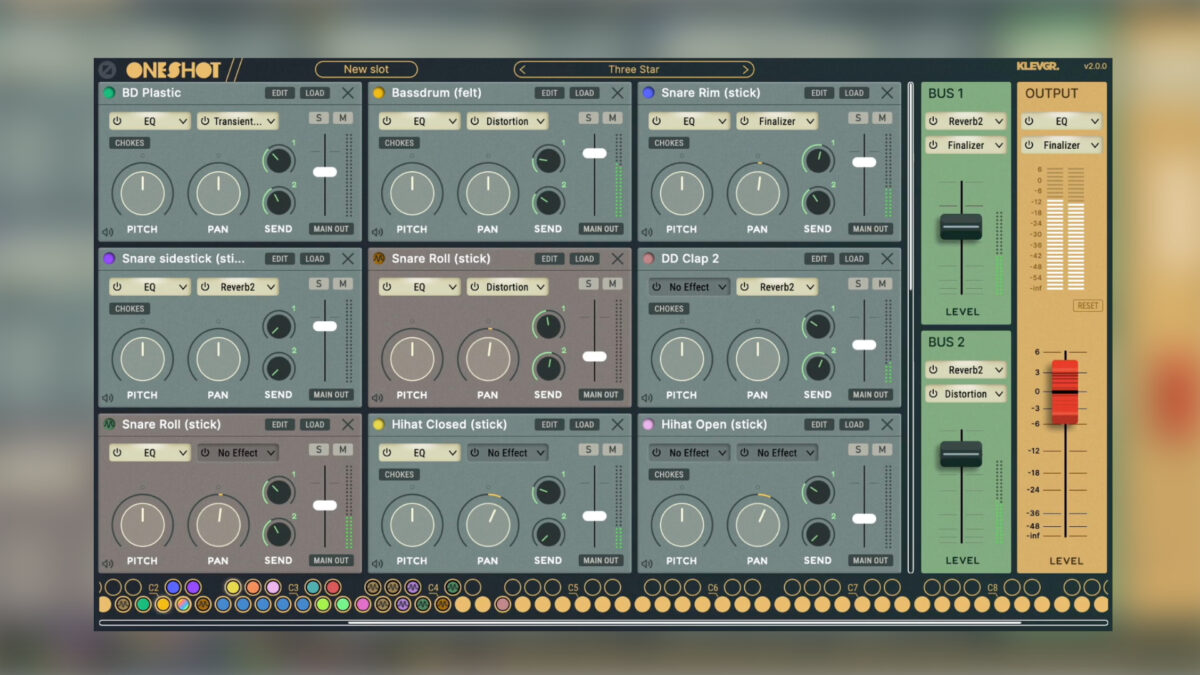
A drum sampler with 20,000 samples, an iPhone accelerometer as a controller, and an intro price of $120 — does that sound too good to be true? Klevgrand OneShot2 just dropped, and it’s making some bold promises. The successor to the original OneShot retains the beloved slot-based architecture while introducing something genuinely unprecedented: a Motion Engine that creates evolving rhythmic phrases, and a companion iPhone app that turns your phone’s accelerometer into a real-time performance controller. MusicRadar called it a plugin that redefines “what a drum sampler can be.” After digging deep into every feature, here’s whether that claim holds up.
The Motion Engine: Why Klevgrand OneShot2 Isn’t Just Another Drum Sampler
Traditional drum samplers operate on a simple premise: you hit a pad, a sample plays. Maybe you get some velocity layers, maybe round-robin variations. But the fundamental interaction hasn’t changed much in decades. Klevgrand OneShot2’s Motion Engine throws that entire paradigm out the window.
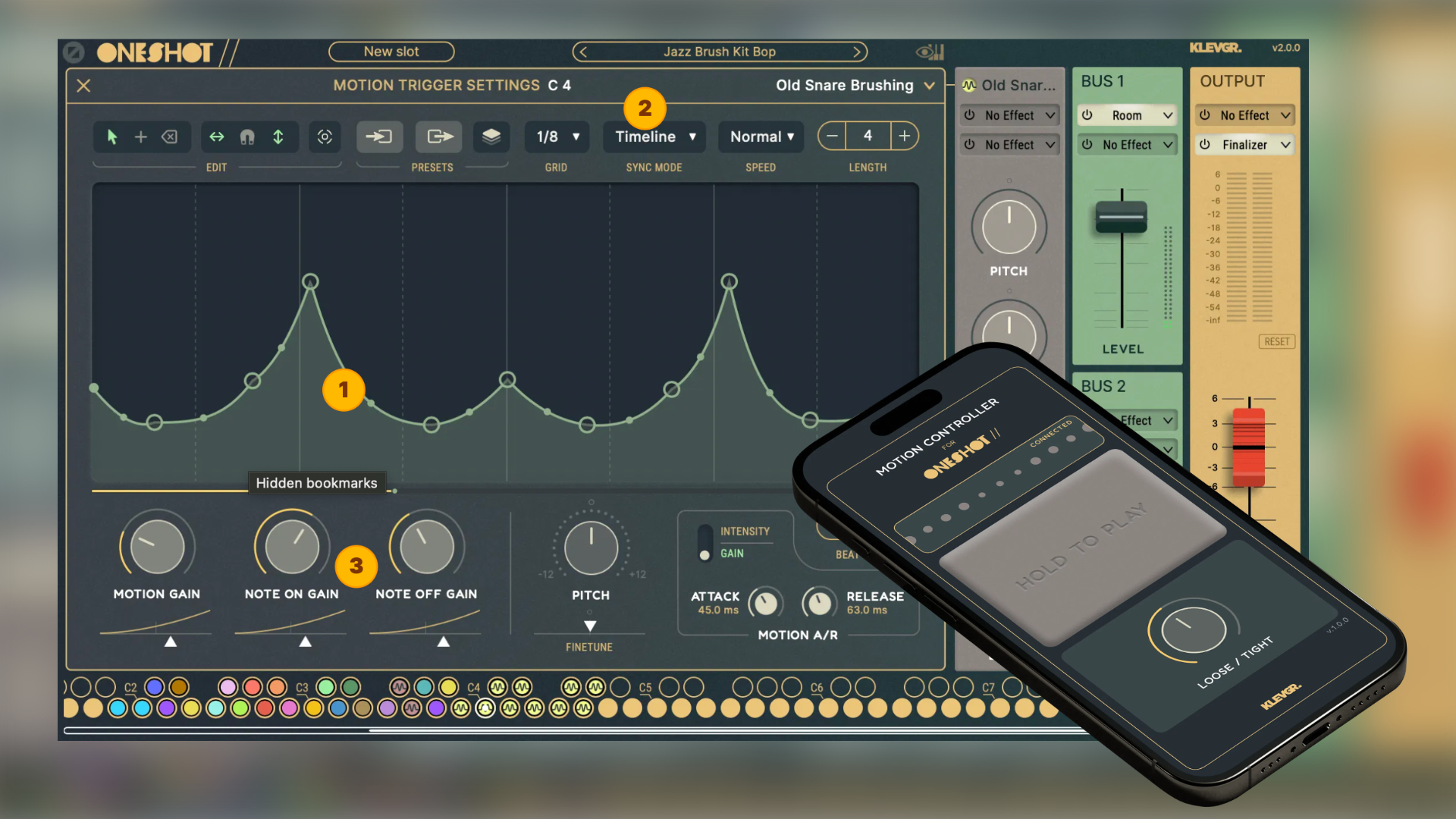
The Motion Engine generates evolving phrases that breathe and develop over time. Think timed cymbal swells that crescendo precisely where you need them, shaker figures that accelerate and decelerate organically, foley movements that add cinematic texture to your beats, and virtually any rhythmic sound that benefits from temporal evolution. This isn’t a step sequencer or an arpeggiator — it’s a fundamentally different approach to how drum sounds interact with time.
What makes this even more compelling is the iPhone companion app. Using your iPhone’s built-in accelerometer, you can control the Motion Engine parameters in real time with physical hand movements. Tilt the phone and the sound responds. Shake it and the parameters shift. The external sync mode keeps everything locked to your DAW’s timeline, so you’re not sacrificing precision for expressiveness — you get both simultaneously. It’s the kind of feature that sounds like a gimmick until you actually use it, and then you realize it adds a dimension of physical performance that no MIDI controller slider can replicate.
For live performers, this is a game-changer. Instead of hunching over a laptop clicking buttons, you can hold your phone and physically sculpt the rhythm in real time. For studio producers, it opens up happy accidents and organic variations that would take hours to program manually. The Motion Engine alone would justify attention, but OneShot2 brings much more to the table.
310+ Presets, 780+ Slots, and 20,000+ Samples: The Sound Library Deep Dive
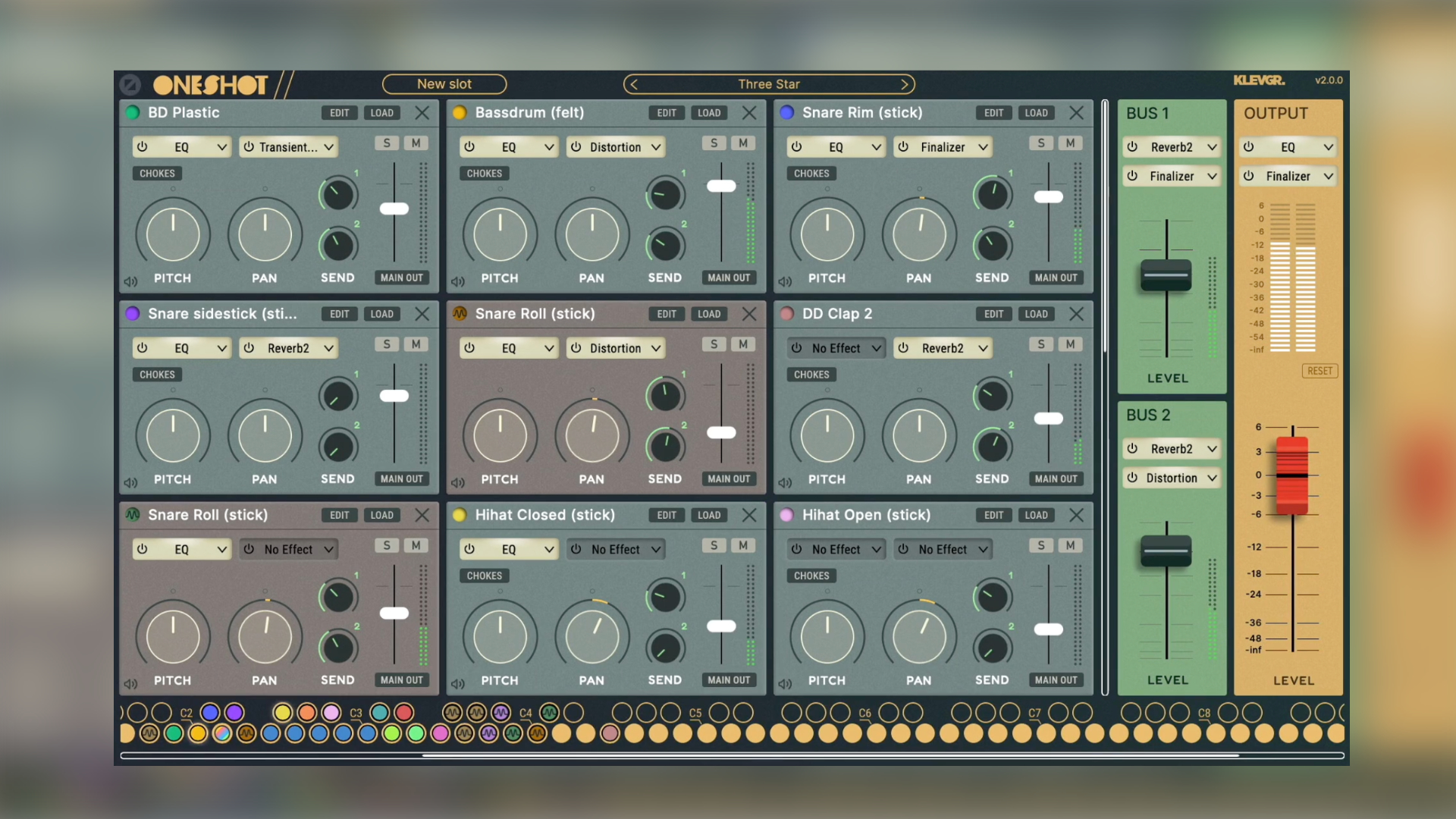
Numbers first: Klevgrand OneShot2 ships with over 310 presets, more than 780 slots, and a staggering 20,000+ individual samples. But raw numbers don’t tell you whether those samples are actually good, so let’s talk about what’s inside.
The brand-new Studio Kit is designed for modern acoustic drum sounds — the kind of tight, punchy, well-recorded kits you’d expect from a top-tier sample library dedicated solely to studio drums. This isn’t a collection of generic electronic hits; it’s a carefully curated set of acoustic drum recordings optimized for contemporary pop, rock, R&B, and hip-hop production. The equally new Jazz Brush Kit goes in a completely different direction, capturing the nuance and character of brush playing with a level of detail that’s often missing from multi-purpose drum plugins. Subtle ghost notes, delicate swirls, and the characteristic rasp of brushes on a snare head — these are the kinds of details that separate a usable sample set from an inspiring one.
Beyond the headline additions, Klevgrand has upgraded the percussion and nature sound categories significantly. Combined with the original OneShot’s electronic and synthetic content, you have a single plugin that can cover electronic beats, acoustic drum tracking, jazz sessions, ambient soundscapes, foley design, and experimental percussion — without ever loading a third-party sample.
The slot-based architecture inherited from the original OneShot remains the organizational backbone. Each slot independently loads and processes a sample, and trigger stacking lets you create flams and layered hits for more complex sounds. Batch import and export make managing large sample collections painless, while note-off duration control gives you precise handling of how samples decay. The copy/paste FX feature means you can design an effect chain on one slot and instantly replicate it across others — a small workflow enhancement that saves enormous time across a full session. Multi-output support lets you route individual slots to separate DAW tracks, giving you full mixing flexibility without any workarounds.
Reverb2, Transient Adder, and UnStereo: Built-in Effects That Actually Deliver
Drum sampler effects sections are often afterthoughts — basic reverb, maybe a filter, and you’re expected to handle everything else with external plugins. Klevgrand took a different approach with OneShot2, integrating three purpose-built tools that genuinely add value.
Reverb2 is based on Klevgrand’s proprietary Walls algorithm — the same technology from their standalone reverb plugin. This isn’t a generic algorithmic reverb bolted onto a drum machine. It’s a carefully designed spatial processor that creates convincing room, hall, and ambient spaces without the mud or metallic artifacts that plague budget reverb implementations. For drums specifically, good reverb is essential but bad reverb is catastrophic, so having a quality algorithm built in is a significant practical advantage.
The Transient Adder is borrowed from Klevgrand’s Fosfat plugin and does exactly what the name suggests — it shapes the attack transient of your drum hits. Need more snap on a snare? More click on a kick? More presence on a hi-hat? The Transient Adder handles it, and it can also add tonal character beyond simple transient shaping. In a mixing context, this means you can get your drums closer to mix-ready before they ever leave OneShot2, reducing the chain of external plugins you need to load.
The UnStereo tool rounds out the effects section by giving you control over stereo image width. You can widen stereo samples for a bigger soundstage or narrow them toward mono for tighter center placement. In drum mixing, kicks and snares typically sit dead center while hi-hats and percussion spread wide — being able to manage this imaging inside the sampler itself, per slot, eliminates the need for separate stereo width plugins on every drum bus. Combined with the copy/paste FX feature, you can design a complete effects template and deploy it across your entire kit in seconds.
Compatibility, Pricing, and Who Should Buy Klevgrand OneShot2
Klevgrand OneShot2 supports VST3, AU, and AAX formats, running natively on both macOS (Apple Silicon and Intel) and Windows. Whether you’re in Ableton Live, Logic Pro, Pro Tools, FL Studio, Cubase, or any other major DAW, compatibility isn’t an issue. The cross-platform support means you can use the same plugin across different studio setups without license juggling or performance compromises. Apple Silicon native support is particularly welcome — no Rosetta overhead means lower latency and better CPU efficiency on M-series Macs, which matters when you’re running multiple instances in a dense session.
Pricing is straightforward: $119.99 introductory price until April 30, 2026, after which it rises to the regular price of $199.99. Existing OneShot users can upgrade for $39.99 or $59.99 depending on their license tier. For context, $120 gets you 20,000+ samples, the Motion Engine, iPhone accelerometer control, Reverb2, Transient Adder, UnStereo, multi-output routing, trigger stacking, and batch import/export. Competing drum samplers in this price range rarely offer this combination of sample depth, innovative control options, and built-in processing quality. Even at the full $200 regular price, the feature-to-cost ratio remains competitive against established alternatives that charge similar amounts without the Motion Engine or mobile control integration.
As MusicRadar noted, OneShot2 promises to redefine what a drum sampler can be, and based on the feature set, that claim has real substance behind it. Whether you’re a beatmaker looking for fresh sounds, a producer who wants more expressive control over your drums, a sound designer exploring foley and texture, or a live performer who wants physical interaction with your rhythm programming, OneShot2 deserves a serious look. The upgrade pricing is especially attractive for existing OneShot users — at $40 to $60, getting access to the Motion Engine, new sample libraries, and the entire effects overhaul is a straightforward decision.
The Bottom Line: A New Standard for Drum Samplers
Klevgrand OneShot2 isn’t just a drum machine with a big sample count. It’s a rethinking of how drum samplers should work in 2026. The Motion Engine adds a temporal dimension that static one-shots can’t touch — creating evolving rhythmic textures that would require complex automation chains to achieve in any other sampler. The iPhone accelerometer control introduces physical expressiveness without requiring dedicated hardware, bridging the gap between electronic precision and human gesture in a way that feels genuinely intuitive rather than gimmicky.
Reverb2, Transient Adder, and UnStereo deliver mix-ready processing without leaving the plugin, which means fewer insert slots used on your mixer and a more streamlined session. And with 20,000+ samples spanning acoustic, electronic, jazz, percussion, and nature categories, you’re unlikely to run out of sonic material anytime soon — and if you do, batch import lets you fold your own sample collections into the same workflow seamlessly.
At $120 during the introductory period, the value proposition is hard to argue with. Major outlets like Synth Anatomy and MusicRadar have highlighted OneShot2 as a standout release, and it’s easy to see why. If you’ve been looking for a drum sampler that pushes beyond the conventional boundaries of trigger-and-play, the introductory pricing window closes April 30 — and this is one you don’t want to miss.
Looking for professional mixing, mastering, or studio workflow optimization? Sean Kim brings 28 years of music and audio experience to every project.
Get weekly AI, music, and tech trends delivered to your inbox.