Microsoft 365 Copilot Now Runs Claude Sonnet: How 400 Million Office Users Got Access to Anthropic’s AI — Enterprise Integration Deep Dive
March 18, 2026
Intel Clearwater Forest Xeon 6+: 288 Cores on 18A Process with Foveros Direct 3D — Inside Intel’s Make-or-Break Server CPU
March 18, 2026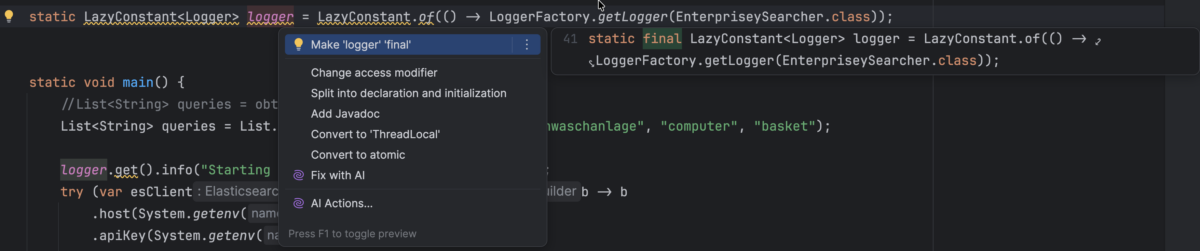
Java 26 just dropped yesterday — and this isn’t your typical “maintenance release with a couple of deprecation warnings.” Oracle shipped 10 JEPs on March 17, 2026, including the Vector API that finally brings hardware-accelerated AI inference to the JVM, post-quantum cryptography features that future-proof your JAR signing, and Structured Concurrency that’s been in preview since JDK 21. For the 35+ million Java developers worldwide, this is the most significant platform evolution since Records landed in Java 16.
Java 26 at a Glance: 10 JEPs, 5 Finalized, 5 Preview
Here’s what makes this release genuinely interesting: there are no new stable language features. Zero. Instead, Oracle focused on infrastructure that matters — performance, security, and the libraries that developers actually use every day. The 10 JEPs break down into five finalized features ready for production and five preview features progressing toward stability.
The finalized JEPs include JEP 516: Ahead-of-Time Object Caching with Any GC (part of Project Leyden), JEP 517: HTTP/3 for the HTTP Client API, JEP 522: G1 GC throughput improvements, JEP 500: Prepare to Make Final Mean Final, and JEP 504: Remove the Applet API. The preview side includes the Vector API (11th incubator), Structured Concurrency (6th preview), Lazy Constants (2nd preview), PEM Encodings (2nd preview), and Primitive Types in Patterns (4th preview).
Java 26 Vector API (JEP 529): Why AI Developers Should Pay Attention
The Vector API has been incubating since JDK 16, and its 11th iteration in Java 26 represents the most mature version yet. JEP 529 enables developers to express vector computations that compile directly to optimal SIMD (Single Instruction, Multiple Data) CPU instructions — think AVX-512 on x86 or NEON on ARM. The practical result? Hardware-accelerated math operations that run significantly faster than their scalar equivalents.
For AI and machine learning workloads, this is a game-changer. Instead of relying on native libraries like BLAS or custom JNI bridges to accelerate tensor operations, Java developers can now write pure Java code that achieves near-native performance for inference pipelines. Data analytics teams processing millions of records get the same benefit — dot products, matrix multiplications, and distance calculations that would normally bottleneck on scalar loops now execute in parallel across CPU vector lanes.
// Java 26 Vector API example — requires --add-modules jdk.incubator.vector
import jdk.incubator.vector.*;

static final VectorSpecies<Float> SPECIES = FloatVector.SPECIES_PREFERRED;

float[] dotProduct(float[] a, float[] b) {
    var sum = FloatVector.zero(SPECIES);
    int i = 0;
    for (; i < SPECIES.loopBound(a.length); i += SPECIES.length()) {
        var va = FloatVector.fromArray(SPECIES, a, i);
        var vb = FloatVector.fromArray(SPECIES, b, i);
        sum = va.fma(vb, sum);  // Fused multiply-add
    }
    float result = sum.reduceLanes(VectorOperators.ADD);
    for (; i < a.length; i++) result += a[i] * b[i]; // Scalar tail
    return new float[]{result};
}
To use the Vector API in Java 26, you still need the --add-modules jdk.incubator.vector flag. It remains in incubator status, but the API surface has been stable for several releases now — a strong signal that finalization is approaching, likely in JDK 27 or 28.
Java 26 Structured Concurrency (JEP 525): The End of Thread Leak Nightmares
Structured Concurrency has been in preview since JDK 21, and its sixth iteration in Java 26 brings meaningful refinements. The core idea is deceptively simple: treat groups of related concurrent tasks as a single unit of work. When a parent task is cancelled, all child tasks are automatically cancelled. When a child fails, the parent and siblings know immediately.
If you’ve ever debugged a production system where orphaned virtual threads kept running after their parent was garbage collected, you understand why this matters. Structured Concurrency eliminates an entire class of concurrency bugs — thread leaks, forgotten cancellation, and the “fire and forget” anti-pattern that causes resource exhaustion under load.
Combined with virtual threads (finalized in JDK 21), Structured Concurrency creates a programming model where writing correct concurrent code is actually easier than writing buggy concurrent code. IntelliJ IDEA 2026.1 already supports this with a debugger that groups virtual threads by their structured concurrency scope, making it trivial to see which tasks belong to which parent.
Java 26 Post-Quantum Cryptography: Future-Proofing Your Supply Chain
While the Vector API and Structured Concurrency grab headlines, Java 26’s security features deserve just as much attention. Oracle has introduced post-quantum ready JAR signing, which means your application’s supply chain can be cryptographically secured against future quantum computer attacks. This isn’t theoretical paranoia — NIST finalized its post-quantum cryptography standards in 2024, and enterprises are already being asked about their quantum-readiness timelines.
Java 26 also adds HPKE (Hybrid Public Key Encryption) support, an industry-standard encryption scheme that simplifies secure key exchange. Combined with JEP 524’s PEM encoding API for cryptographic objects, Java developers now have a modern, clean toolkit for handling encryption without reaching for third-party libraries like Bouncy Castle for basic operations.
Georges Saab, SVP of Oracle’s Java Platform, put it directly: “Java 26 reflects our commitment to helping customers leverage AI and cryptography for applications that accelerate business growth.”
Java 26 Ahead-of-Time Object Caching (JEP 516): Project Leyden Delivers
Project Leyden has been Oracle’s long-term initiative to improve Java startup time, and JEP 516 is its most impactful delivery yet. Ahead-of-Time Object Caching now works with any garbage collector — including ZGC, G1, and Shenandoah — not just the serial GC as in earlier implementations. This means pre-initialized Java objects are loaded sequentially at startup, dramatically reducing the cold-start penalty that has plagued Java applications in serverless and containerized environments.
For microservices teams deploying on Kubernetes, this is directly relevant. Faster JVM startup translates to faster pod scaling, lower cold-start latency, and reduced resource consumption during deployment spikes. Combined with JEP 522’s G1 GC throughput improvements (which reduce synchronization between application and GC threads), Java 26 applications should demonstrate measurably better performance characteristics out of the box.
Java 26 Additional JEPs Worth Knowing
JEP 517: HTTP/3 for the HTTP Client API — Nearly 40% of websites already support HTTP/3, and Java’s built-in HTTP client finally catches up. This isn’t just about speed; HTTP/3’s QUIC-based transport handles lossy networks and connection migration far better than HTTP/2, which matters for mobile backends and edge computing.
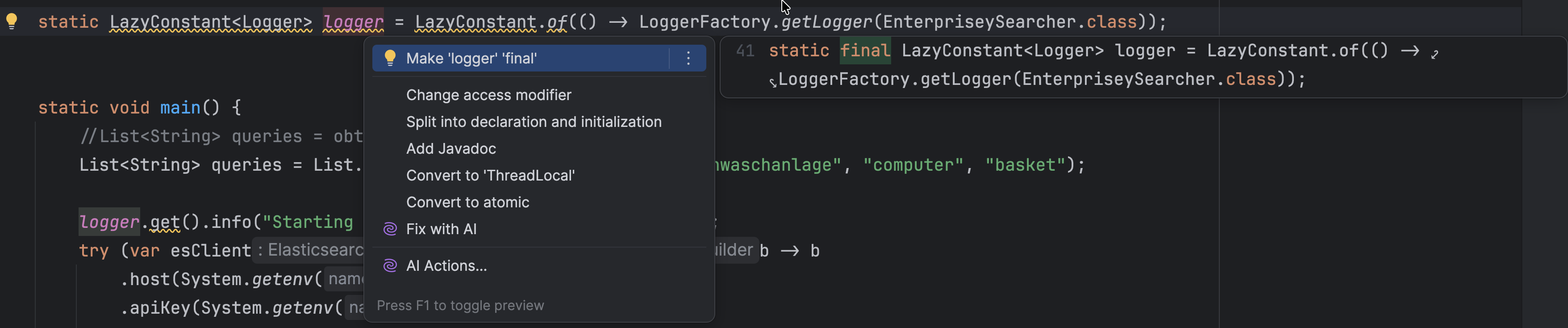
JEP 526: Lazy Constants (2nd Preview) — Introduces java.lang.LazyConstant for thread-safe deferred initialization. If you’ve ever written double-checked locking or used volatile fields for lazy singletons, this API eliminates that entire boilerplate pattern.
JEP 530: Primitive Types in Patterns (4th Preview) — Extends pattern matching to all primitive types in instanceof and switch expressions. No more manual range checks and unsafe casts when working with numeric types. This is heading toward finalization and will likely land as stable in JDK 27.
JEP 500: Prepare to Make Final Mean Final — Issues warnings when deep reflection mutates final fields. This is a preparation step: eventually, the JVM will enforce true finality, which means libraries that use reflection hacks to modify final fields (looking at you, serialization frameworks) need to update.
JEP 504: Remove the Applet API — The Applet API, deprecated since JDK 9 and disabled since JDK 17, is finally removed entirely. One less legacy artifact in the JDK.
Java 26 Oracle Java Verified Portfolio and IDE Support
Oracle also announced the Java Verified Portfolio, a new commercial support offering that bundles JavaFX, Helidon (Oracle’s cloud-native Java framework), and the Java Platform Extension for VS Code. This signals Oracle’s acknowledgment that the Java ecosystem extends well beyond the core JDK — and that developers expect first-party support for the tools they actually use.
On the IDE front, JetBrains shipped IntelliJ IDEA 2026.1 with day-one Java 26 support. Highlights include new inspections for LazyConstants, a virtual thread debugger that groups threads by structured concurrency scope, live templates for common concurrency patterns, and SDKMAN/.tool-versions auto-detection for seamless JDK management. The IDE even offers quick-fixes to migrate existing lazy initialization patterns to the new LazyConstant API.
Should You Upgrade to Java 26? The Pragmatic Take
Java 26 is not an LTS release — the next LTS will be JDK 25 (already GA) or JDK 29 (expected September 2027). If you’re on JDK 21 LTS or JDK 25 LTS in production, there’s no urgent reason to jump to 26 for production workloads. However, if you’re building AI inference pipelines, the Vector API’s maturity makes Java 26 worth evaluating in staging environments. If you’re concerned about quantum-readiness, the post-quantum JAR signing and HPKE support are compelling reasons to start testing.
For development teams, upgrading your local toolchain to JDK 26 is low-risk and gives you access to preview features that will become stable in future releases. The Structured Concurrency and Lazy Constants APIs are worth learning now — they represent the direction Java is heading, and early familiarity pays dividends when they finalize.
As IDC Research VP Arnal Dayaratna noted, Java 26’s “platform evolution enables organizations to incorporate transformative capabilities while preserving the reliability and security” that made Java the enterprise standard in the first place. Whether you upgrade today or wait for the next LTS, the features in Java 26 define the roadmap for Java’s next decade.
Need help building AI-powered automation systems or modernizing your Java infrastructure? Sean Kim brings 28+ years of engineering experience to tech consulting and pipeline architecture.
Get weekly AI, music, and tech trends delivered to your inbox.