Rode PodMic USB Review: The Hybrid Mic That Actually Delivers Broadcast Quality
October 14, 2025
Anthropic Claude API October 2025: Batch Processing, Prompt Caching, and 5 Cost Reduction Strategies That Save Up to 95%
October 15, 2025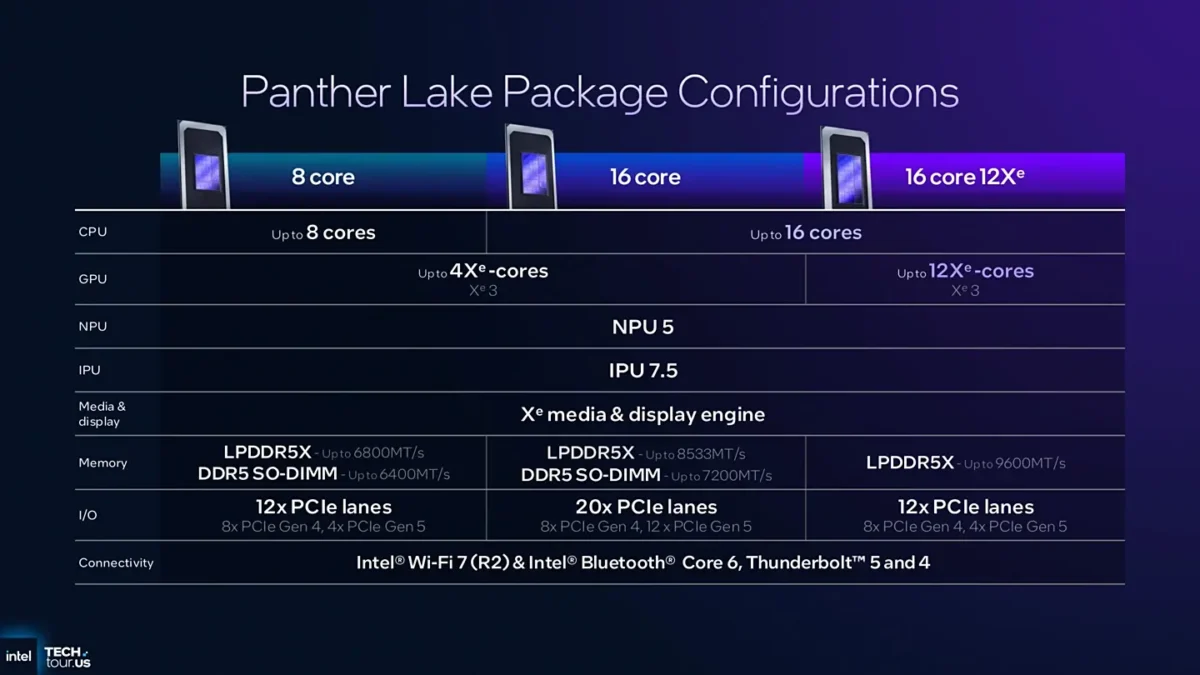
Intel just mass-produced a chip on a process node that doesn’t even exist at TSMC or Samsung yet — and it’s coming to laptops before the year ends. At the Intel Technology Tour 2025 in Chandler, Arizona on October 9, the company pulled the curtain back on Intel Core Ultra 300 Panther Lake, the Arrow Lake successor built on the brand-new Intel 18A node. After a year of watching Arrow Lake stumble in gaming benchmarks and cede ground to AMD’s Ryzen AI 300 series, this is Intel’s answer: a ground-up architecture redesign with 50% better multi-threaded efficiency, a next-generation Xe3 GPU, and an NPU that doubles AI throughput.
Here’s why this matters — and whether you should wait or build now.
Intel 18A: The Process Node That Could Save Intel
The Intel Core Ultra 300 Panther Lake is the first client processor manufactured on Intel 18A, and that alone makes it the most significant chip Intel has announced in years. Intel 18A combines two breakthrough technologies: RibbonFET (Intel’s implementation of gate-all-around transistors) and PowerVia (backside power delivery). Together, they deliver 15% better power efficiency and 30% higher transistor density compared to Intel 3.
Production is happening at Fab 52 in Chandler, Arizona — part of Intel’s $100 billion domestic manufacturing investment. This is the facility Intel calls home to “the most advanced logic chips manufactured in the United States.” For an industry that’s spent the last five years worried about TSMC concentration in Taiwan, Intel producing cutting-edge chips on American soil is a geopolitical story as much as a technical one.
Cougar Cove and Darkmont: Inside the New Core Architecture
Panther Lake introduces two new CPU microarchitectures. The Performance cores use Cougar Cove, a refined evolution of the Lion Cove cores found in Lunar Lake. The Efficiency cores run Darkmont, building on Skymont’s already impressive single-threaded performance. Both architectures benefit from the 18A process node’s density and power advantages.
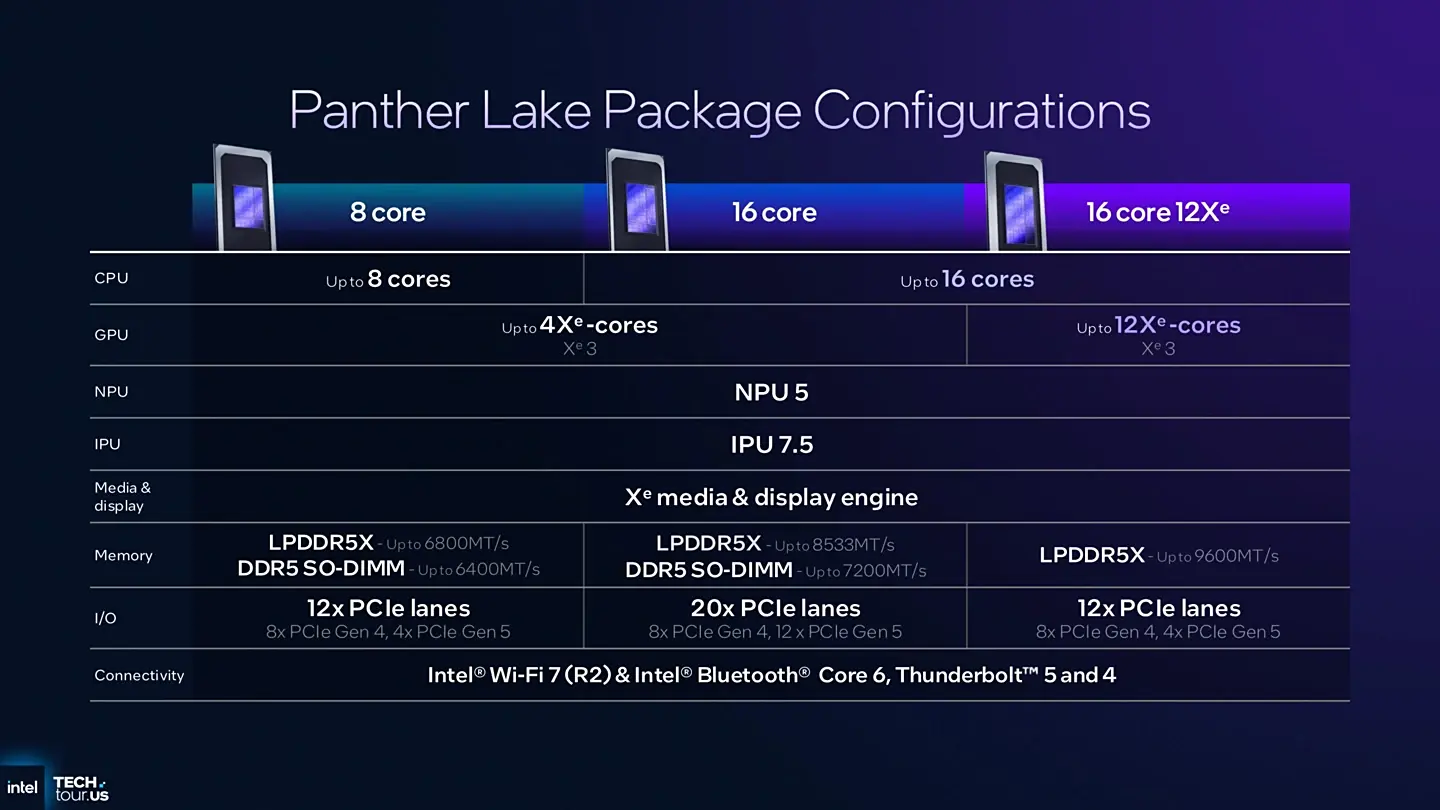
The core layout follows Intel’s increasingly modular approach with three distinct SKU configurations:
- 8-core model: 4 Cougar Cove P-cores + 4 LPE cores, with 4 Xe3 GPU cores
- 16-core variant A: 4 P-cores + 8 Darkmont E-cores + 4 LPE cores, with 4 Xe3 GPU cores
- 16-core variant B (Core Ultra X): 4 P-cores + 8 E-cores + 4 LPE cores, with 12 Xe3 GPU cores
The LPE (Low-Power Efficiency) cluster is a standout feature — four additional E-cores that operate without L3 cache access, handling background tasks at minimal power draw. This is Intel’s answer to always-on computing: email syncing, notifications, and light AI inference tasks can run on the LPE island while the main cores sleep. Boost clocks reach up to 5.1 GHz on the P-cores, putting Panther Lake in competitive territory with AMD’s Ryzen AI 300 Strix Point processors.
Intel Core Ultra 300 Panther Lake Performance: The Numbers That Matter
Intel’s performance claims for Panther Lake against Arrow Lake are significant — and if they hold up in independent reviews, they represent a genuine generational leap:
- Single-threaded: 10% performance increase at the same power envelope, or alternatively, 40% power reduction at equivalent performance
- Multi-threaded: 50% higher performance at the same power, or equivalent performance with 30% less energy consumption
- GPU (Xe3 Celestial): 50% better performance per watt compared to Xe2
- NPU5: 1.5x better efficiency with 2x the raw AI performance of the previous generation
That multi-threaded efficiency number is the headline. A 50% improvement at the same power envelope means Panther Lake laptops could deliver desktop-class multi-core performance in thin-and-light form factors. For content creators running Premiere Pro timelines, Blender renders, or compiling large codebases, this is the kind of jump that changes purchasing decisions.
Xe3 Celestial GPU and NPU5: Intel’s AI PC Strategy Takes Shape
The integrated GPU jumps to the Xe3 “Celestial” architecture, and it’s not just an incremental update. The top-tier Core Ultra X variants pack 12 Xe3 cores — enough to make discrete entry-level GPUs increasingly unnecessary for everyday gaming and creative workloads. Intel is positioning these as capable of running local AI models, handling light 1080p gaming, and accelerating video encoding simultaneously.
The new naming scheme introduces Core Ultra X as the premium tier. The flagship Core Ultra X9 388H gets the full 12 Xe3 GPU cores, while standard Core Ultra 300 models run with 4 Xe3 cores. This stratification means buyers will need to pay attention to the “X” designation if GPU performance matters to their workflow.
NPU5 doubles raw AI inference throughput compared to the previous generation while consuming 1.5x less power per operation. With Microsoft’s Copilot+ PC requirements demanding 40+ TOPS from on-device NPUs, Intel is clearly designing for a future where local AI processing is table stakes, not a differentiator. The race against Qualcomm’s Snapdragon X Elite and AMD’s XDNA 2 architecture is very much on.
5 Reasons This Launch Matters for PC Builders and Buyers
1. Intel 18A validates Intel’s manufacturing comeback. If Panther Lake ships on schedule in Q4 2025 with competitive yields, it proves Intel can execute on its process node roadmap — something the industry has questioned since the 10nm/Intel 7 delays.
2. The AI PC market gets a real three-way fight. With AMD’s Ryzen AI 300, Qualcomm’s Snapdragon X Elite, and now Intel’s Core Ultra 300, every laptop buyer in 2026 will have genuinely competitive options for on-device AI processing.
3. Arrow Lake desktop owners shouldn’t panic — yet. Panther Lake is a mobile-first launch. The desktop successor, codenamed Nova Lake, is expected in the second half of 2026 with the LGA 1954 socket. Current Arrow Lake-S desktop builds still have at least a year of relevance.
4. Integrated graphics are approaching a tipping point. With 12 Xe3 cores in the top-tier SKU delivering 50% better per-watt GPU performance, the argument for entry-level discrete GPUs continues to weaken. Budget builders should watch Panther Lake laptop benchmarks closely.
5. Power efficiency reshapes laptop battery life expectations. A 40% single-thread power reduction and 30% multi-thread energy savings translate directly to longer battery life in real-world usage. Expect Panther Lake ultrabooks to challenge Apple’s M-series efficiency claims.
Timeline: When Can You Actually Buy It?
Intel’s roadmap for Core Ultra 300 Panther Lake is aggressive but clear:
- Q4 2025: Mass manufacturing at Fab 52 begins
- Late 2025: First OEM shipments to laptop manufacturers
- January 2026 (CES): Official retail launch and laptop availability
- H2 2026: Nova Lake desktop variant expected
For anyone currently shopping for a new laptop, the calculus just got complicated. The current Arrow Lake and Lunar Lake machines are shipping now with known performance characteristics. Panther Lake promises significant improvements but won’t hit shelves until early next year. If your current machine handles your workload, waiting three months for Panther Lake reviews at CES 2026 seems like the smart play. If you need a machine today, Arrow Lake remains a solid choice — just know that its successor is right around the corner.
Intel’s Core Ultra 300 Panther Lake represents more than just a new chip — it’s proof that Intel’s multi-year, multi-billion-dollar manufacturing overhaul is actually producing results. Whether the benchmark claims survive contact with independent reviewers remains to be seen, but the architectural foundations are genuinely impressive. The AI PC era just got its most interesting contender yet.
Keeping up with CPU architecture changes, AI PC requirements, and the right time to upgrade? We break it down weekly.
Get weekly AI, music, and tech trends delivered to your inbox.