Back-to-School Laptop Guide August 2025: 6 Best Picks for Every Budget
August 4, 2025
Neural Amp Modeler 2.0: How a Free Open-Source Plugin Is Crushing $2,000 Amp Simulators in 2025
August 5, 2025
For the first time in ChatGPT’s history, GPT-5 free users can think. Not just chat — actually reason. OpenAI just dropped GPT-5 on August 7, 2025, and the move nobody expected is that the company’s most powerful reasoning model is available to every single user, including those who’ve never paid a cent. TechCrunch confirmed the launch, calling it OpenAI’s most significant release since GPT-4.
Sam Altman called it “the best model in the world.” Bold claim? Sure. But the benchmarks back it up — and the real story isn’t just the performance numbers. It’s what happens when you give 1.8 billion GPT-5 free users access to a reasoning engine that was previously locked behind a $20/month paywall.
GPT-5 Free Users Finally Get What They Deserve: A Unified Architecture
Here’s what makes GPT-5 fundamentally different from everything that came before: it’s not just a bigger model. It’s a completely new architecture that combines fast conversational responses with deep reasoning — all in one system. No more choosing between GPT-4o for quick answers and o1 for complex thinking. GPT-5 handles both through an intelligent real-time router that decides when to think hard and when to respond instantly.
For GPT-5 free users, this means you no longer need to manually select which model you want. The simplified interface just works. Ask it to write a quick email? Fast response. Ask it to debug a complex algorithm? The reasoning engine kicks in automatically. As Beebom reported, this is the first time a reasoning model has been made available to non-paying users — a seismic shift in AI democratization.
The Benchmarks Don’t Lie: GPT-5 Performance Breakdown
Numbers matter, and GPT-5 delivers across every major benchmark. Let’s break down what the scores actually mean for real-world usage:
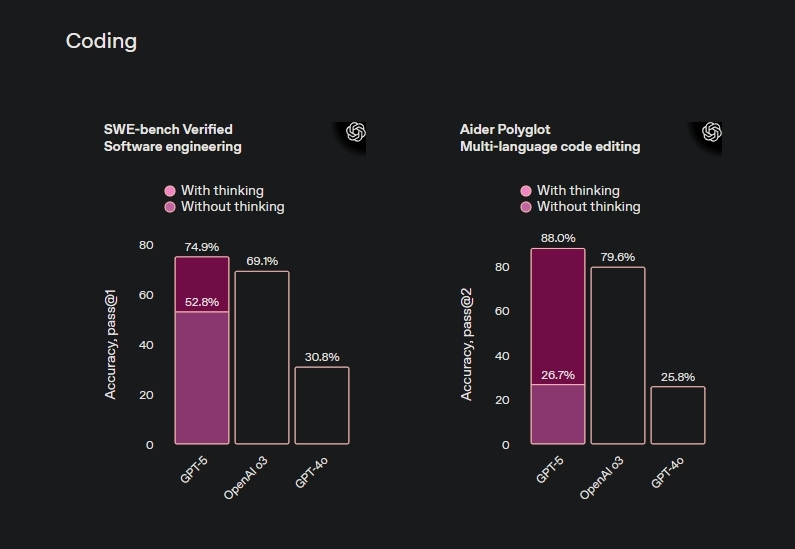
- SWE-bench: 74.9% — This is a software engineering benchmark where the model must fix real GitHub issues. GPT-5 scoring nearly 75% means it can genuinely debug and write production-grade code. For developers on the free tier, this alone is transformative.
- GPQA Diamond: 89.4% — Graduate-level science questions. GPT-5 outperforms most PhD candidates on physics, chemistry, and biology queries.
- MMMU: 84.2% — Multimodal understanding across diverse domains. This means GPT-5 doesn’t just process text — it understands images, charts, and diagrams with near-expert accuracy.
- Hallucination rate: 0.7% vs. 4.5% — This is the number that matters most for trust. GPT-5 hallucinates at roughly one-sixth the rate of its predecessors. When it gives you an answer, you can actually believe it.
To put the hallucination improvement in context: if you asked GPT-4o twenty questions, you’d statistically get one fabricated answer. With GPT-5, you’d need to ask roughly 143 questions before encountering a hallucination. That’s not incremental improvement — that’s a paradigm shift in reliability.
Free vs. Plus vs. Pro: What Each Tier Actually Gets
OpenAI structured GPT-5 access across three tiers, and understanding the differences matters if you’re deciding whether to upgrade:
Free Tier ($0/month)
GPT-5 free users get limited reasoning queries per day. When you hit the cap, you’re automatically downgraded to GPT-5 mini — a lighter, faster version that still outperforms GPT-4 on most tasks. This is clever design: you never lose access entirely, you just shift to a smaller model. For casual users who need occasional deep reasoning, this is more than enough.
Plus Tier ($20/month)
Higher rate limits for reasoning queries, priority access during peak hours, and faster response times. If you’re a developer, student, or professional using ChatGPT daily, the Plus tier is where the value proposition gets compelling. The reasoning query allocation is significantly higher than free, though OpenAI hasn’t published exact numbers.
Pro Tier ($200/month)
The flagship experience: GPT-5 Pro with extended reasoning capabilities. This isn’t just more queries — it’s a more powerful reasoning mode that can chain together longer thought processes for complex multi-step problems. Aimed at researchers, enterprise developers, and power users who need the absolute best.
The Usage Numbers Tell the Real Story
Here’s where it gets fascinating. Before GPT-5, less than 1% of free users ever touched reasoning models — because they simply didn’t have access. Within days of the launch, that number jumped to 7% of daily active free users engaging with reasoning capabilities. That’s not a small bump; that’s an entirely new behavior pattern emerging.
Plus subscribers saw an even more dramatic shift: reasoning usage jumped from 7% to 24% of daily sessions. When you remove the friction of model selection and make reasoning automatic, people use it. A lot.
Overall engagement among free-tier users increased by 40%. OpenAI effectively proved that the barrier to reasoning AI adoption wasn’t user interest — it was access. Remove the gate, and people walk through it.
Agent Capabilities: GPT-5 Does Things, Not Just Says Things
Beyond the reasoning improvements, GPT-5 introduces genuine agent capabilities. The model can now execute multi-step workflows — browsing the web, writing and running code, analyzing files, and chaining these actions together without constant user intervention.
For GPT-5 free users, this means the chatbot they’ve been using for simple Q&A can now function as a legitimate productivity tool. Need to research a topic, summarize findings, and draft an email? GPT-5 can chain those steps together in a single session. The agent functionality works within the same unified interface — no plugins, no special modes, no configuration required.
This is particularly significant for the AI democratization argument. Previously, agent-like capabilities required expensive API access or specialized tools. Now, anyone with a free ChatGPT account can leverage multi-step AI workflows.
The Rate Limit Boost: Altman Responds to Demand
Just three days after launch, on August 10, Sam Altman announced a temporary rate limit increase across all tiers. The demand was clearly exceeding OpenAI’s projections. This is a strong signal — when a company that charges $200/month for its top tier decides to give everyone more free queries, it means the growth metrics are too good to throttle.
The rate limit boost also suggests OpenAI is prioritizing user acquisition and engagement over short-term revenue optimization. Get people hooked on reasoning capabilities at the free tier, and a percentage will inevitably upgrade to Plus or Pro. It’s the classic freemium flywheel, but applied to the most advanced AI model on the planet.
What This Means for the AI Industry
GPT-5’s free-tier availability changes the competitive dynamics of the entire AI industry. Google’s Gemini, Anthropic’s Claude, and Meta’s Llama now face a reality where OpenAI’s best reasoning model is accessible to anyone. The race is no longer just about who builds the most capable model — it’s about who can distribute it most broadly.
For developers building on AI APIs, GPT-5’s improved hallucination rate (0.7%) makes it viable for applications that previously required expensive human verification layers. Healthcare, legal, and financial applications that couldn’t risk AI hallucinations now have a model that’s trustworthy enough for production deployment.
For everyday users, the message is simpler: the AI you’ve been using just got dramatically smarter, more reliable, and capable of actual reasoning — and you don’t have to pay for it. Whether you’re a student writing a thesis, a small business owner analyzing data, or a developer debugging code, GPT-5 represents a genuine leap in what free AI tools can do.
The question isn’t whether GPT-5 is impressive. The question is what happens to the entire AI ecosystem when reasoning becomes a commodity. OpenAI just fired the starting gun on that race — and the biggest winners are the 1.8 billion people who never had to pay a dime.
Want to leverage GPT-5 and AI reasoning models for your business workflows? Sean Kim helps companies build intelligent automation pipelines.
Get weekly AI, music, and tech trends delivered to your inbox.