Meta Quest 4: Eye Tracking and Mixed Reality Could Redefine Standalone VR in 2026
September 15, 2025
How to Create Future Bass: Synth Design and Arrangement Tutorial
September 16, 2025
The early-bird deadline is tomorrow. GitHub Universe 2025 early-bird registration — a $400 discount — closes on September 17. If you’re still on the fence, here’s why this year’s event is far more than just another developer conference.
Looking at what GitHub Universe 2025 has lined up, it’s clear that 2025 is shaping up to be the inflection point for AI-powered coding. The Copilot coding agent going GA, a CLI-based agent mode launching, and over 100 sessions — all converging at Fort Mason Center in San Francisco on October 28-29. This isn’t incremental improvement. This is the moment autonomous coding agents move from experimental curiosity to mainstream developer tooling.

GitHub Universe 2025: Why This Year Is Different
GitHub Universe has established itself as the developer community’s flagship event year after year, but 2025 demands special attention. Based on what GitHub has announced through its official blog, the core theme is unmistakable — agentic AI is moving to the center of the development workflow. Not as a side feature. Not as an experimental add-on. As the primary paradigm for how code gets written, tested, and shipped.
This year’s event is organized into three tracks: Build Faster, Automate and Scale, and Secure Every Commit. Over 100 sessions are structured around these pillars, with companies like Red Hat, HubSpot, CVS, and General Motors sharing real-world adoption stories. That’s not theoretical AI hype — it’s enterprise-grade implementation at scale. When General Motors is presenting on how they use AI coding agents in production, you know the technology has crossed the chasm from early adopter to mainstream enterprise tooling.
Several new additions stand out this year. The interactive Makerspace coding playground gives attendees hands-on time with unreleased tools in a guided environment — think of it as a sandbox where you can break things without consequences. The expanded Open Source Zone brings maintainers and contributors together for face-to-face collaboration that simply can’t happen over Issues and PRs. And live demo previews of unreleased features mean attendees get a first look at what’s coming to GitHub before anyone else.
Your ticket also includes access to GitHub certification exams, making attendance a tangible career investment beyond just networking and sessions. For developers looking to validate their skills formally, this alone can justify the cost of attendance.
Copilot Coding Agent: Autonomous Coding Goes Mainstream at GitHub Universe 2025
The biggest anticipated announcement at GitHub Universe 2025 is the Copilot coding agent’s GA (General Availability) transition. Currently operating in preview, once the coding agent goes GA, the workflow of assigning an agent to a GitHub Issue and having it autonomously write code, run tests, and create pull requests becomes available to every paid Copilot subscriber. That’s a fundamental shift in how software gets built.
Let’s break down what this actually means in practice. Today, when a bug report comes in, a developer reads the Issue, reproduces the problem, writes a fix, writes tests, creates a PR, and waits for review. With the coding agent at GA, you assign the Issue to Copilot, and it handles the entire cycle autonomously. The developer’s role shifts from writing every line to reviewing and approving the agent’s work. For routine bug fixes, dependency updates, and boilerplate tasks, this represents a 10x productivity multiplier.
The groundwork is already visible in recent releases. GitHub announced custom instructions for Agent mode in Eclipse IDE earlier this month, along with image and vision context support. That last one is particularly interesting — you can now generate code from hand-drawn layouts. Sketch a UI on paper, snap a photo, and Copilot generates the corresponding frontend code. This signals Copilot’s evolution from a code autocomplete tool into a genuine AI development partner that understands visual context, not just text.
The Eclipse integration also introduced folder and resource attachment for richer project context, plus reduced plugin size through platform-specific binary separation. These are the kinds of infrastructure improvements that indicate GitHub is preparing for a much larger rollout — you don’t optimize plugin size for a niche preview feature.
Azure Boards integration is also expected to enter public preview soon, which bridges the gap between project management and autonomous code generation. Teams will be able to assign work items directly to the Copilot coding agent and track the agent’s progress from within Azure Boards. For enterprise environments running on Azure DevOps, this creates a seamless pipeline from project planning to code delivery — a workflow that enterprise teams have been waiting for since AI coding assistants first appeared.
Copilot CLI: Agent Sessions Straight From Your Terminal
Another major feature expected to debut around GitHub Universe 2025 is GitHub Copilot CLI — a terminal-native coding agent that lets you spin up agentic sessions right from the command line. No IDE required. No GUI. Just your terminal and a coding agent ready to work.
The ability to run a full plan-execute-test-iterate cycle from the terminal is a game-changer for several use cases that IDEs simply don’t cover well. Server administration where you’re SSH’d into a remote box. CI/CD pipeline debugging where you need to iterate quickly on build scripts. Infrastructure-as-code work where your entire workflow lives in the terminal. Development on resource-constrained machines where running a full IDE isn’t practical. In all these scenarios, having an AI coding agent available directly in the terminal eliminates the friction of context-switching between tools.
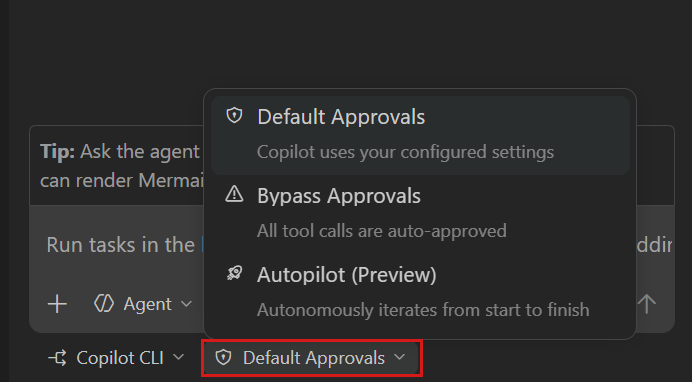
The standout capability here is Autopilot mode. In standard agent mode, the agent proposes a plan and waits for your approval at each step. Autopilot mode removes those approval stops entirely — it executes the full plan-execute-test-iterate loop automatically. Define the problem, and the agent handles the rest. For repetitive tasks like boilerplate generation, test writing, migration scripts, or dependency updates across multiple packages, this could save hours of developer time per week. The key question becomes not whether the agent can do the work, but whether you trust it enough to let it run unsupervised.
For developers already using CLI-based AI tools like Claude Code or Aider, Copilot CLI represents GitHub’s native entry into this space. The advantage of a GitHub-native solution is obvious: deep integration with Issues, PRs, Actions, and the entire GitHub ecosystem without third-party bridges or API wrappers.
Visual Studio Integration: From Profiler Agent to .NET Modernization
GitHub has been aggressively expanding Copilot’s Visual Studio integration throughout September, and the updates reveal a clear strategic direction. The Profiler Agent automates AI-powered performance analysis and bottleneck detection — feed it a slow endpoint, and it identifies the performance culprit and suggests optimized code. The .NET Modernization Agent assists with legacy project upgrades and Azure migration, tackling one of the most painful tasks in enterprise development: moving aging codebases to modern frameworks without breaking everything.
Enhanced MCP (Model Context Protocol) interactions mean Copilot can now pull in richer context from external tools and services when generating suggestions. Smarter code reviews provide more nuanced feedback that goes beyond syntax checking into architectural and pattern-level analysis. These aren’t flashy features, but they represent the kind of deep integration that makes a tool indispensable in daily workflows.
The emergence of these specialized agents sends a significant signal: Copilot is evolving from a general-purpose coding assistant into a platform of domain-specific expert agents. Performance optimization, legacy migration, security review — each area gets a dedicated agent that operates like a specialist on your development team. Instead of one AI that’s mediocre at everything, you get multiple AIs that are excellent at their specific domains. This is the direction the entire industry is headed, and GitHub is leading the charge.
5 Things Developers Should Watch at GitHub Universe 2025
- Copilot coding agent GA — From preview to production, democratizing autonomous coding workflows for every paid subscriber
- Copilot CLI launch — Terminal-based agent sessions with Autopilot mode for zero-approval iteration loops
- Agentic AI sessions — Real enterprise adoption stories from Red Hat, HubSpot, CVS, and General Motors in the Build Faster track
- Security track — Code security strategies for the AI era in the Secure Every Commit track, addressing the unique challenges of AI-generated code
- Unreleased feature demos — Live previews at Makerspace revealing GitHub’s next moves before they ship to production
The Bigger Picture: What This Means for the Developer Ecosystem
GitHub Universe 2025 isn’t just a product launch event — it’s a preview of how software development will work for the next decade. The shift from AI-assisted coding (autocomplete, suggestions) to AI-agentic coding (autonomous task execution) is comparable to the shift from manual deployment to CI/CD. Once teams experience an agent that can close an Issue end-to-end, going back to writing every line manually will feel like going back to FTP deployments.
The competitive landscape is also worth watching. Microsoft-backed GitHub is pushing Copilot agents aggressively, while competitors like Cursor, Windsurf, and various open-source alternatives are innovating rapidly. Universe will likely set the benchmark for what enterprise-grade AI coding agents look like, and every other player in the space will need to respond. For developers, this competition is excellent news — it means better tools, faster iteration, and more options.
From Someone Building Automation Systems Daily
I build and operate multi-agent orchestration systems, blog pipelines, and Telegram bots on a daily basis. So the Copilot coding agent going GA hits differently for me. I’m already using Claude Code as a CLI-based agent for autonomous code generation tasks — and once GitHub’s native coding agent ships to GA, building an Issues-driven automated code generation pipeline that’s fully integrated with GitHub’s ecosystem becomes a reality rather than a hack.
The Azure Boards integration, in particular, opens up massive possibilities for enterprise environments. Picture this workflow: a project manager creates a work item in Azure Boards, the coding agent automatically picks it up, writes the implementation with tests, creates a PR with a detailed description, and auto-assigns it to the appropriate reviewer based on code ownership. That end-to-end pipeline — from ticket to deployable code — without a human writing a single line is no longer science fiction. It’s what GitHub is actively building.
What excites me most is the specialization angle. Having a Profiler Agent for performance work and a Modernization Agent for migrations means I can compose workflows where different agents handle different aspects of a complex project. One agent refactors the codebase, another optimizes performance, a third handles security review. That’s not a single AI assistant — that’s an AI development team. 2025 is definitively the year agents write code, and GitHub Universe 2025 is where that future gets its official debut.
Registration Details and Practical Guide
Dates: October 28-29, 2025 (GitHub HQ Experience Day: October 30)
Venue: Fort Mason Center, San Francisco
Early Bird: $400 discount — deadline September 17 (tomorrow!)
Includes: 100+ sessions, GitHub certification exams, Makerspace, Open Source Zone
Tracks: Build Faster, Automate and Scale, Secure Every Commit
Even if you can’t attend in person, GitHub Universe’s major announcements are typically available through livestreams and recorded sessions. The Copilot coding agent GA, CLI launch, and various specialized agent features expected at this year’s event will impact every developer the moment they ship. Head over to the GitHub Universe official site to check the full schedule and bookmark the sessions that matter to your workflow. And if you’re within reach of San Francisco, that early-bird deadline really is tomorrow — September 17.
Interested in building AI agent-powered automation systems or development pipelines? Check out Sean Kim’s tech consulting services.
Get weekly AI, music, and tech trends delivered to your inbox.