AWS Bedrock AI Agents for Healthcare: 5 Use Cases Actually Working in Production (2026)
March 12, 2026
Music Composition Methods That Actually Work: 7 Practical Techniques Every Producer Should Master in 2026
March 12, 2026
$91 billion. That’s the generative AI market in 2026. Two years ago, it was barely $20 billion. The number quadrupled. But here’s the question nobody’s answering properly — where is all that money actually going?
After 28 years in the music and audio industry, I’ve watched technology trends come and go. But nothing has reshaped the landscape as fast and as broadly as generative AI. According to DemandSage’s 2026 statistics, this market is on track to exceed $1 trillion by 2034, growing at a staggering 44.2% compound annual growth rate. These aren’t projections from optimists — they’re consensus estimates backed by real spending data.
The Generative AI Market 2026: Where We Stand
The global generative AI market grew from $37.89 billion in 2025 to an estimated $69.85–$91 billion in 2026, depending on which research firm you ask. The direction is unanimous — explosive growth. North America commands 41% of total revenue, followed by Europe at 28% and Asia Pacific at 22%. Asia Pacific is the fastest-expanding region with a 27.6% CAGR, driven by aggressive enterprise adoption in South Korea, Japan, and India.
At the enterprise level, the numbers are even more telling. Deloitte’s 2026 State of AI report shows the average enterprise AI investment has hit $110 million, with 86% of organizations planning to increase their AI budgets this year. The return? For every $1 invested, companies are seeing an average return of $3.70.

4 Sectors Driving the Generative AI Market 2026 Growth
1. Media & Entertainment — 34% of Revenue
The biggest slice of the pie belongs to media and entertainment. Content generation, personalized recommendations, automated dubbing, and AI-powered editing tools are all fueling this sector’s dominance. As a music producer, I see this shift every day. AI now handles reference track analysis, stem separation, lyric generation, and even mastering chain suggestions. The creative industry isn’t being replaced — it’s being amplified.
2. Automotive & Transportation — 22%
Autonomous driving, in-vehicle AI assistants, and supply chain optimization are the core growth drivers here. Tesla, Waymo, and Hyundai are pouring billions into AI R&D. Notably, generative AI-powered simulation for autonomous driving training is cutting real-world road testing costs by over 90%. This sector’s growth trajectory shows no signs of slowing as Level 4 autonomy inches closer to mass deployment.
3. Financial Services (BFSI) — 14%, Fastest Growth Rate
While BFSI holds 14% market share, it’s growing at a blistering 36.4% CAGR — the fastest of any sector. Fraud detection, risk modeling, customer service automation, and regulatory document analysis are expanding rapidly. JPMorgan’s AI-powered contract analysis system famously processes what took lawyers 360,000 hours in mere seconds. That’s not incremental improvement — it’s a paradigm shift.
4. Healthcare — 13%, 36.8% Adoption Growth
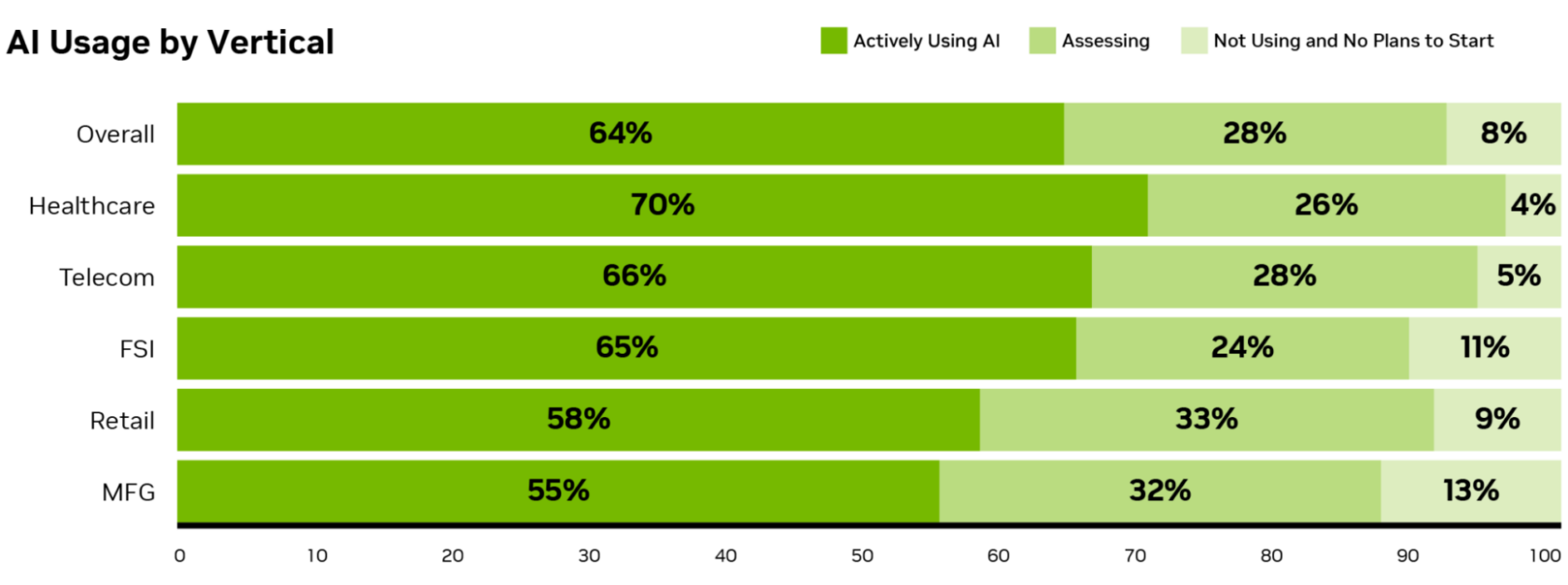
Healthcare leads all sectors in AI adoption growth rate at 36.8% CAGR. Drug discovery, clinical trial optimization, medical imaging diagnostics, and personalized medicine are the battlegrounds. Healthcare vertical AI spending hit $1.5 billion in 2025, tripling from $450 million the year before. But here’s the sobering reality: only 1% of healthcare organizations describe their AI adoption as “fully mature.” The opportunity is massive, but so is the implementation gap.
The $527B Infrastructure Play: Where the Money Actually Goes
Goldman Sachs reports that hyperscaler capital spending for 2026 has a consensus estimate of $527 billion — up from $465 billion. Microsoft, Google, Amazon, and Meta are pouring astronomical sums into data centers, GPU clusters, and AI-specific chips.
At the application layer, $19 billion was deployed in 2025, with an interesting breakdown:
- Horizontal AI (general-purpose tools): $8.4B — Think ChatGPT, Claude, and GitHub Copilot
- Departmental AI (function-specific): $7.3B — Marketing, HR, and legal-focused AI tools
- Vertical AI (industry-specific): $3.5B — Healthcare, finance, and manufacturing AI
42% of enterprises named “optimizing AI workflows” as their top spending priority for 2026, while 31% said they’d focus on “finding new use cases.” This signals a critical market maturation — we’ve moved past the “should we adopt AI?” phase into “how do we make AI actually deliver ROI?”
71% Adoption, Yet 80% See No Bottom-Line Impact — What’s Going Wrong?
Here’s the uncomfortable truth. 71% of organizations now use generative AI regularly in at least one business function. Yet more than 80% report no measurable impact on enterprise-level EBIT. There’s a gaping chasm between adoption rates and actual financial returns.
The reason is clear: most companies added AI to existing workflows rather than redesigning workflows around AI. They changed the tool but not the process. It’s like putting a jet engine on a horse cart — the power is there, but the vehicle wasn’t built for it.
My own blog pipeline is a case in point. Simply using “AI to write articles” didn’t move the needle. What made a real difference was redesigning the entire workflow — from topic discovery and research to writing, image sourcing, publishing, and quality review — as an AI agent pipeline. The productivity gains only materialized when the workflow itself was reimagined, not just the tools within it.
3 Signals to Watch in H2 2026
- Agentic AI Goes Enterprise: AWS Bedrock AI Agents, Microsoft Copilot Studio, and similar platforms are bringing multi-step autonomous workflows to the enterprise. We’re moving from single prompts to self-orchestrating agent pipelines that can handle complex business processes end-to-end.
- Asia Pacific Acceleration: With a 27.6% CAGR, APAC is the fastest-growing region. As AI regulatory frameworks in South Korea, Japan, and India mature, enterprise adoption is accelerating rapidly.
- Vertical AI Breakout: The shift from general-purpose AI tools to industry-specific solutions is accelerating. Healthcare vertical AI spending tripling in a single year is the leading indicator of this trend — and every major sector will follow.
The generative AI market’s explosive growth is beyond question. But the real winners won’t be the companies that adopt the most AI tools — they’ll be the ones that redesign their workflows around AI. The answer to the $91 billion question isn’t “what tools to use” but “how to use them.”
Interested in building an AI-powered content pipeline or automating enterprise workflows? With 28 years of hands-on industry experience, I offer practical guidance that goes beyond the hype.