Convolution Reverb Showdown: Space Designer vs Altiverb vs Free IR Loaders in 2025
August 18, 2025
Hot Chips 2025: Intel Lunar Lake NPU Delivers 48 TOPS — 11 Months of Real-World AI Performance Data
August 19, 2025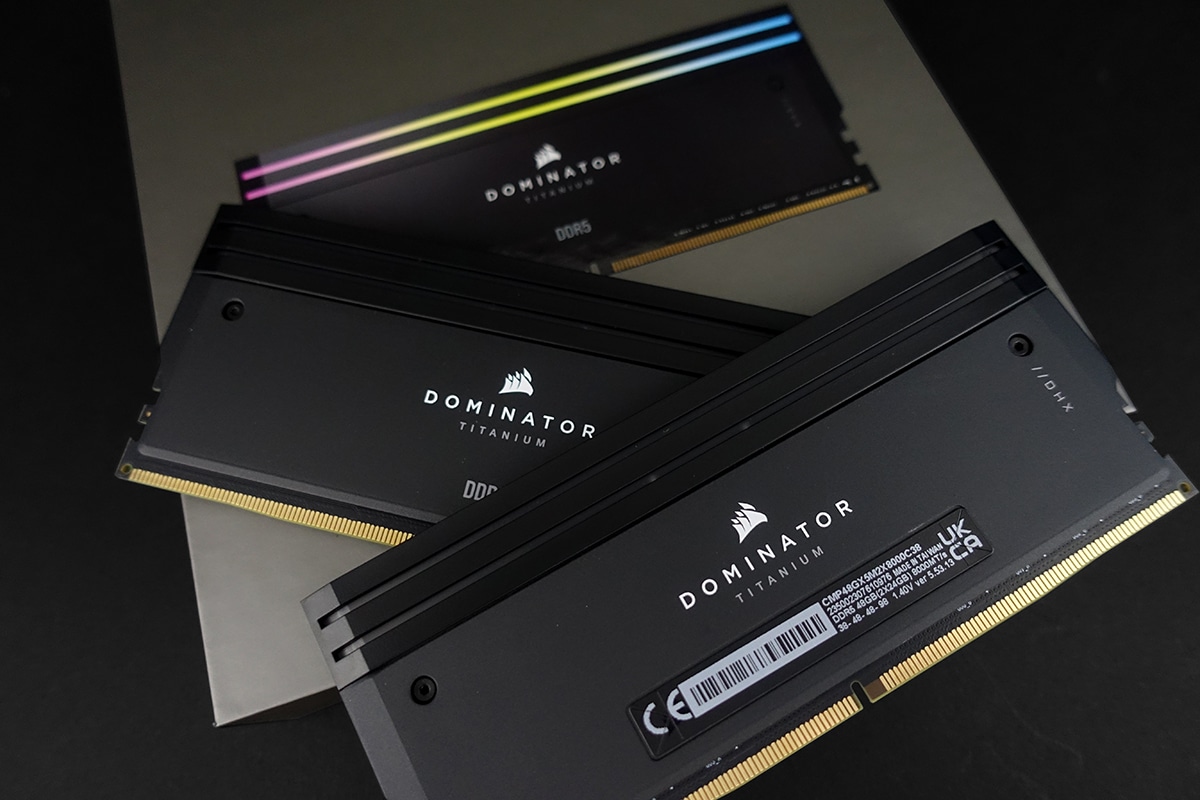
120,633 MB/s write speed. 55.8 nanosecond latency. DDR5-8400 on air cooling. If those numbers don’t make your pulse quicken, you’re probably not the target audience for Corsair’s most extreme memory kit — and that’s perfectly fine. But if you just leaned forward in your chair, the Corsair Dominator Titanium DDR5-8000 CL38 might be exactly what your next build demands.
Corsair Dominator Titanium DDR5-8000: What You’re Actually Getting for $834
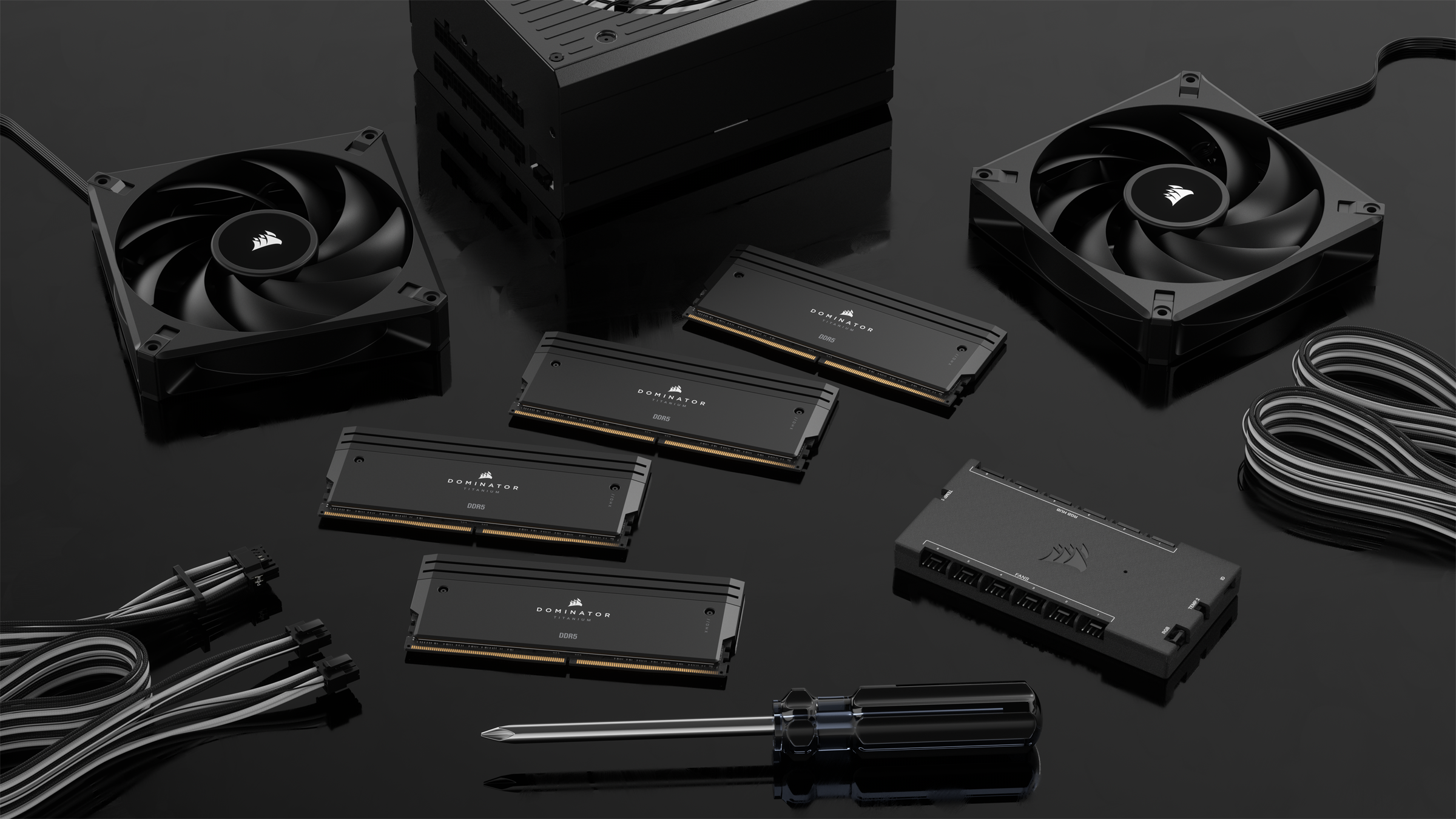
Let’s address the elephant in the room first. At $833.99 for 48GB (2x24GB), this kit costs more than many people’s entire system. But Corsair isn’t selling you commodity RAM here — they’re selling a precision-engineered overclocking instrument built around cherry-picked SK Hynix 24Gbit M-Die ICs, an Extreme OC PMIC, and their patented DHX cooling system.
The XMP 3.0 profile targets DDR5-8000 at CL38-48-48-98 with 1.40V — numbers that would have been unthinkable just two years ago. The SPD fallback sits at a conservative 4800MHz CL40 at 1.1V, giving you a massive frequency range to play with. Each 24GB module runs single-rank, which is crucial for hitting these speeds — dual-rank sticks at 8000MT/s would be fighting physics.
SK Hynix M-Die Under the Hood: Why It Matters
Corsair hand-sorts every IC that goes into the Dominator Titanium DDR5-8000 kit, and for good reason. The SK Hynix 24Gbit M-Die is currently the gold standard for high-frequency DDR5 — but not all M-Die chips are created equal. The binning process separates chips that can reliably hit 8000MT/s at reasonable voltages from those that top out at 7200 or 7600.
What makes M-Die particularly interesting for overclockers is its scaling characteristics. According to testing from Igor’s Lab and Overclocking.com, these ICs scale significantly better with frequency increases than with tighter timings. That means pushing from 8000 to 8200 or even 8400MT/s yields more tangible performance gains than trying to squeeze CL38 down to CL36 at the same speed. This is critical knowledge for anyone planning to manually tune these sticks.
Benchmark Reality: The Numbers That Matter
Running at the rated XMP profile (DDR5-8000 CL38), the Corsair Dominator Titanium DDR5-8000 delivers write speeds of 120,633 MB/s — comfortably past the 120K barrier that separates premium DDR5 kits from the rest. Average throughput at 7800MT/s hits 123,333 MB/s across read, write, and copy operations. Latency settles at 55.8 nanoseconds — competitive for this frequency class, though still trailing DDR4-3200 CL16’s legendary 50.3ns figure.
But here’s where things get exciting for tuners. With manual voltage and timing adjustments, reviewers pushed bandwidth past 130 GB/s while approaching the mythical 50ns latency barrier. That’s DDR4-level responsiveness with DDR5-level throughput — the best of both worlds, if you’re willing to invest the hours in BIOS tuning.
Overclocking Headroom: DDR5-8400 and Beyond
The Corsair Dominator Titanium DDR5-8000 isn’t just fast at stock — it’s designed to go further. On a 2-DIMM motherboard like the ASUS Z790 APEX, reaching DDR5-8200 was described as “quite easy” by Igor’s Lab, requiring minimal voltage adjustments beyond the XMP baseline. Pushing to DDR5-8400 at CL38-48-48-98 demanded around 1.55V — still within safe daily operating range for most enthusiasts, though I’d personally recommend enhanced airflow over the DIMMs at that voltage.
The key caveat, flagged prominently in every review, is the IMC (Integrated Memory Controller) lottery. Your CPU’s memory controller determines the ceiling just as much as the RAM itself. Intel’s 13th and 14th Gen processors vary significantly in IMC quality — some hit 8000+ without drama, others struggle past 7600. This isn’t a Corsair problem; it’s a silicon lottery issue that affects every high-frequency DDR5 kit on the market.
Build Quality and Design: Premium Meets Practical
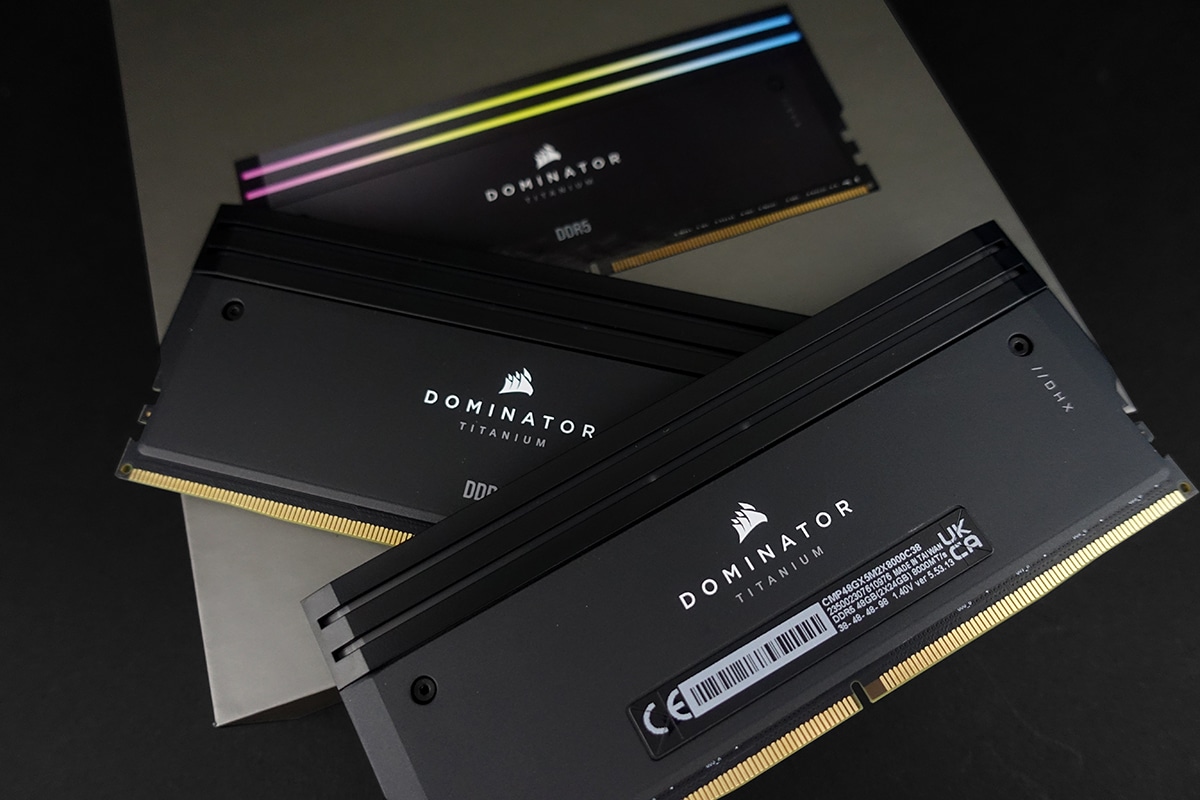
The Dominator Titanium series lives up to its name with die-cast aluminum heat spreaders that feel genuinely premium in hand. The 11 individually addressable RGB LEDs integrate with Corsair’s iCUE ecosystem for full lighting control — tasteful or outrageous, your call. But the standout design feature is the swappable top bar system. You can pop off the default bar and replace it with custom designs, including 3D-printed options. It’s a small touch that shows Corsair understands their enthusiast audience wants personalization, not just performance.
The patented DHX cooling technology pulls heat through the PCB itself via internal cooling planes, transferring it to thermal pads and then to the aluminum heat spreader. It’s not just marketing — at 1.40-1.55V under sustained load, effective cooling directly impacts stability and overclocking headroom.
The Hot Chips Context: Why DDR5-8000 Matters in August 2025
With Hot Chips 2025 spotlighting next-generation memory technologies and CXMT demonstrating DDR5-8000 capability from the manufacturing side, the timing of this review feels particularly relevant. The DDR5 ecosystem is maturing rapidly — what was exotic overclocking territory 18 months ago is now an XMP profile you can enable with a single BIOS toggle. Memory bandwidth demands from AI workloads, content creation, and modern gaming are pushing the mainstream toward speeds that were once exclusive to competitive overclockers.
The global DDR5 market, valued at $12.4 billion in 2024 and projected to hit $34.7 billion by 2032, reflects this acceleration. Kits like the Dominator Titanium DDR5-8000 sit at the bleeding edge today, but they preview where the mainstream will be in 12-18 months.
Corsair Dominator Titanium DDR5-8000 Compatibility Checklist
Before pulling the trigger on this kit, there are several compatibility factors worth checking. First, motherboard topology matters enormously — 2-DIMM boards (like the ASUS Z790 APEX or MSI MEG Z790 ACE) give you the cleanest signal path and the best chance of hitting rated speeds. 4-DIMM boards with daisy-chain topology can work, but you’ll likely sacrifice 200-400MT/s of headroom.
Second, BIOS maturity is critical. Board partners have been steadily improving DDR5-8000 support through firmware updates — running the latest BIOS is non-negotiable. Third, consider your power delivery: the Extreme OC PMIC in these modules can handle aggressive voltages, but your board’s memory VRM also needs to keep up. Finally, cooling isn’t optional at these speeds. Even with Corsair’s DHX system doing heavy lifting, case airflow over the DIMMs makes a measurable difference in stability testing. A small fan pointed at your RAM sticks might look inelegant, but it can be the difference between a stable 8200 and an unstable 8000.
Who Should Buy the Corsair Dominator Titanium DDR5-8000?
This kit makes sense for a specific audience: enthusiast builders who treat memory tuning as part of the hobby, content creators running memory-bandwidth-sensitive workloads (4K+ video editing, large AI model inference, complex DAW sessions with massive sample libraries), and competitive overclockers looking for a high-quality starting point. If you’re gaming at 1080p and running Chrome with 30 tabs — respectfully, a DDR5-6000 kit at half the price will serve you just as well.
For those who do need the absolute fastest DDR5 available today, the Dominator Titanium DDR5-8000 delivers. The SK Hynix M-Die binning is excellent, the overclocking headroom is genuine, and the build quality justifies the premium positioning. Just make sure your motherboard has only 2 DIMM slots and your CPU won the IMC lottery — otherwise, you’ll be leaving performance on the table.
Final Verdict
The Corsair Dominator Titanium DDR5-8000 CL38 is unquestionably one of the fastest consumer DDR5 kits you can buy. With 120K+ MB/s write speeds at stock, overclocking headroom to DDR5-8400+, and premium build quality, it earns its place at the top of the DDR5 hierarchy. The $834 price tag will filter out casual buyers — and that’s by design. This is memory for people who understand exactly why they need it. In the age of accelerating DDR5 adoption and increasingly bandwidth-hungry workloads, the Dominator Titanium DDR5-8000 isn’t just fast today — it’s an investment in staying ahead of the curve.
Want weekly deep dives on the latest hardware, AI tools, and tech trends? Subscribe to Sean’s newsletter — no fluff, just actionable insights for builders and creators.
Get weekly AI, music, and tech trends delivered to your inbox.