GitHub Copilot Agent Mode: The AI That Autonomously Writes Your Pull Requests
October 16, 2025
Sony WF-1000XM6 vs Apple AirPods Pro 3: Should You Wait or Buy Now?
October 16, 2025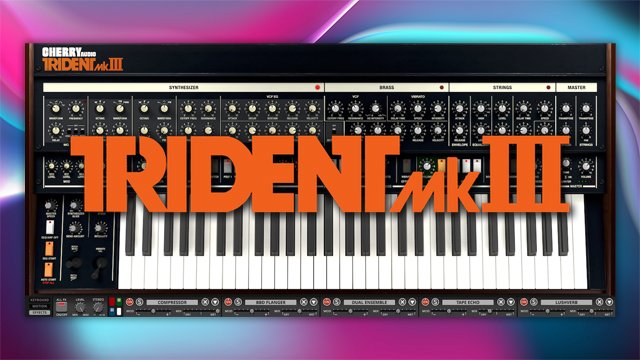
Cherry Audio vintage synth plugins have been on an absolute tear in 2025. Three legendary analog synthesizers — the Korg Trident, the Crumar Spirit, and the ARP Odyssey — have been meticulously recreated as software instruments, and the combined price of all three is just $187. That is less than what most producers spend on a single Eurorack module, and each one has earned a perfect 5-star rating from MusicRadar.
Between April and October 2025, Cherry Audio shipped four vintage synth emulations: Yellowjacket, ODC 2800, Crumar Spirit, and Trident Mk III. The pace is remarkable, but what stands out even more is the quality. These are not rough approximations of classic hardware. They are deep, faithful, and sonically stunning recreations built with award-winning DSP — and they all come loaded with hundreds of expertly crafted presets ready for immediate production use.
Trident Mk III — Three Instruments in One Plugin for $69
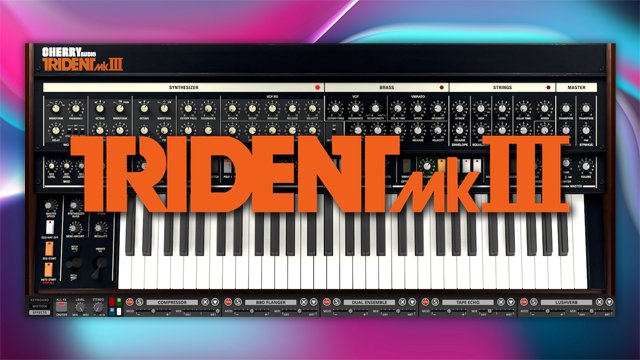
Released on October 7, the Trident Mk III is Cherry Audio’s latest vintage synth plugin, and it might be their most ambitious release yet. Priced at $69, it faithfully emulates the 1981 Korg Trident — a synthesizer that was essentially three instruments packed into one massive keyboard.
The original Trident featured separate Synth, Brass, and Strings sections, and Cherry Audio has preserved this architecture while expanding it significantly. Each section offers 16 voices of polyphony, meaning you can theoretically run 48 simultaneous voices across the three engines. The Synth section excels at sweeping pads and evolving textures, the Brass section delivers bold, punchy leads, and the Strings section produces lush orchestral tones that sit beautifully in any mix.
Cherry Audio did not stop at recreating the original sound engine. They added 380 presets designed by their in-house team, a 32-step polyphonic sequencer, dual arpeggiators, and a Motion panel with Quick Split functionality for live performance. The effects section is equally generous, with 17 effects organized across 4 processing chains, including Cherry Audio’s signature Lushverb reverb. An optional Momentum Pack ($9.99) adds 100 additional presets designed by James Dyson for producers who want even more starting points.
The Quick Split feature in the Motion panel deserves special attention. It allows you to divide your keyboard into zones and assign different sections to different ranges in seconds, turning the Trident Mk III into a multi-timbral performance instrument. Combined with the dual arpeggiators, you can create complex, evolving arrangements from a single plugin instance that would normally require loading multiple instruments and configuring MIDI routing.
For film composers and ambient producers, the Trident Mk III is a goldmine. The ability to layer three distinct sound sections within a single plugin instance — without the CPU overhead of loading three separate instruments — makes it one of the most efficient and inspiring Cherry Audio vintage synth plugins to date. The original 1981 Korg Trident was a rare instrument even in its own era, and finding a working unit today is both difficult and expensive. Cherry Audio has made that sound accessible to everyone for the price of a decent dinner.
Crumar Spirit — Bob Moog’s Italian Synth Gets the Plugin Treatment
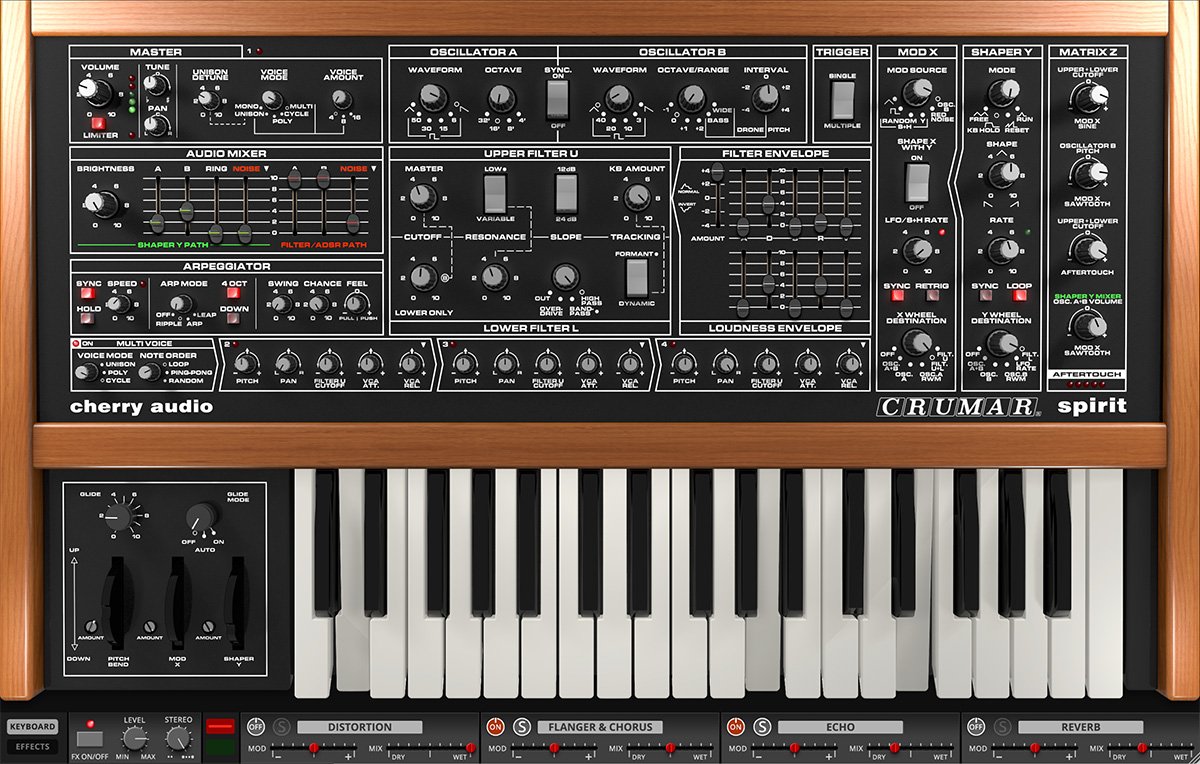
Two months before the Trident, Cherry Audio dropped the Crumar Spirit on August 19. At $59, it recreates the 1983 Crumar Spirit — a synthesizer with a remarkable pedigree. The original hardware was designed by none other than Robert A. Moog and Tom Rhea, with contributions from Jim Scott and Sante Crucianelli. As Synth Anatomy noted in their review, it is quite literally “Bob Moog’s Italian synth in a plugin.”
The sound architecture centers on two CEM3340 oscillators feeding into a CEM3350 dual VCF configuration — an upper low-pass filter paired with a multimode lower filter. This dual-filter design gives the Crumar Spirit a tonal range that most single-filter synths simply cannot match. Cherry Audio expanded the voice count to 16 polyphonic voices and loaded the plugin with over 430 presets.
The standout feature here is the Matrix Z modulation matrix. With 25 modulation sources and 45 destinations, the sound design possibilities are staggering. You can route LFOs, envelopes, velocity, aftertouch, and a host of other sources to virtually any parameter in the synth. Cherry Audio themselves describe the Crumar Spirit’s character as “not polite” — it produces colorful, experimental sounds that push well beyond typical vintage territory.
The arpeggiator offers three distinct modes — Ripple, Arp, and Leap — each with its own rhythmic character. Ripple creates cascading patterns that feel organic and unpredictable, while Leap introduces wider intervallic jumps that can spark entirely new melodic ideas. These are not afterthought features — they are integral to the Crumar Spirit’s identity as a performance-oriented instrument.
MusicRadar awarded it a perfect 5-star review, and for good reason. The Crumar Spirit occupies a unique space in the Cherry Audio vintage synth plugins lineup: it has the warmth and character of a classic analog instrument with the sound design depth of a modern modular system. The dual VCF configuration alone sets it apart from most virtual analog synths on the market, giving you tonal sculpting capabilities that go far beyond what a single filter can achieve.
ODC 2800 — Three Decades of ARP Odyssey in a Single Plugin
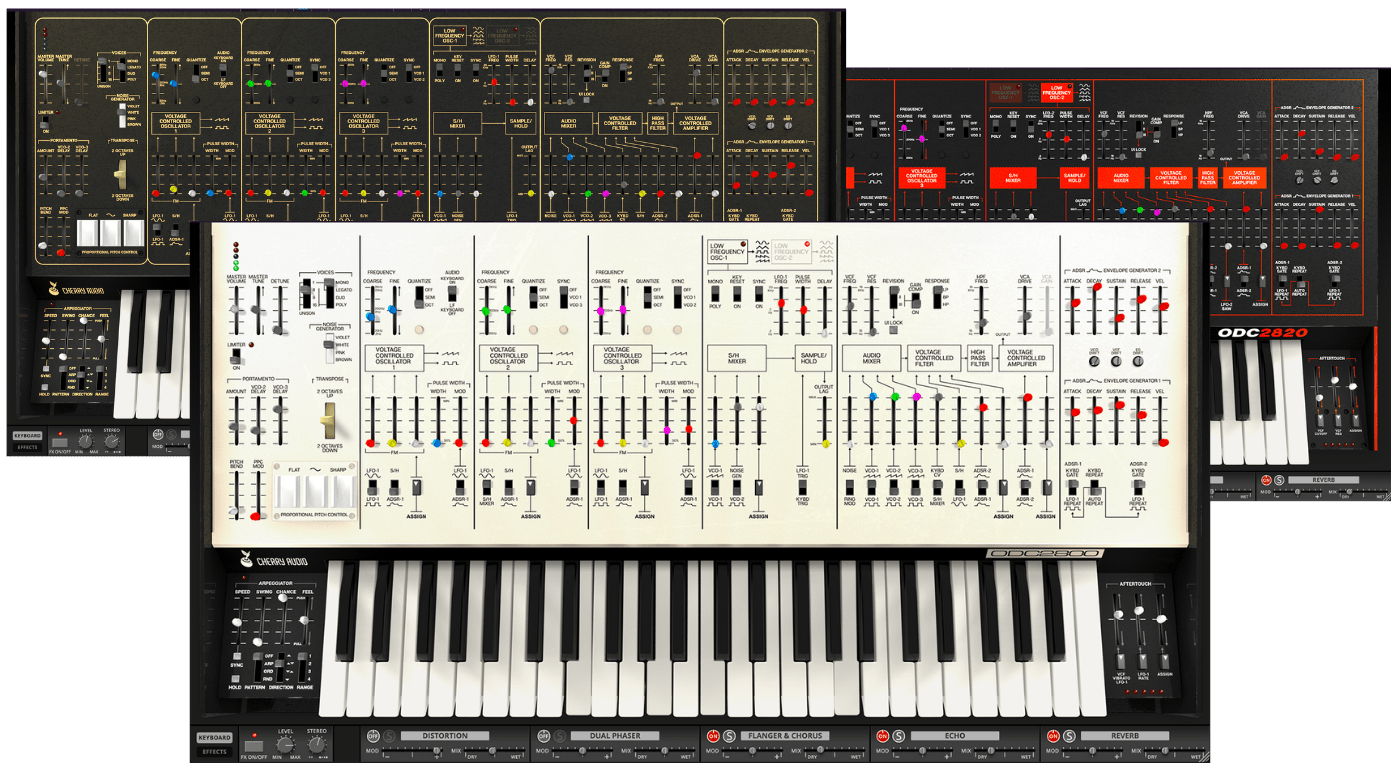
The ODC 2800, released on June 18 at $59, takes on one of the most iconic synthesizers ever made: the ARP Odyssey. But Cherry Audio did not simply emulate one version. The ODC 2800 faithfully recreates all three major revisions — the Mk I (1972), Mk II (1975), and Mk III (1978) — each with its distinct filter character and sonic personality.
The plugin was designed by Mark Barton, an award-winning DSP engineer whose work has earned widespread acclaim in the virtual analog space. It features three oscillators and three separate filter emulations corresponding to each Odyssey generation. The voice architecture goes far beyond the original monophonic design, supporting Monophonic, Mono Legato, Duophonic, and Polyphonic modes with 1, 4, 8, or 16 voices. This means you can play lush polyphonic pads and chords using the ARP Odyssey sound — something the original hardware could never do.
The ODC 2800 was released as a tribute to Alan R. Pearlman, ARP’s founder, on what would have been his 100th birthday. It is a fitting tribute: 330 expertly designed presets, ring modulation capabilities, and a sound engine that MusicRadar called “one of the finest-sounding synths around” in their 5-star review. Whether you are chasing the aggressive leads of early Herbie Hancock recordings or exploring the lush drones of modern ambient music, the ODC 2800 delivers.
The Value Proposition — 1,140 Presets and 50 Years of Analog History for $187
Step back and consider what Cherry Audio has assembled here. Three vintage synth plugins, each earning perfect review scores, collectively offering over 1,140 presets. The combined price of $187 is less than a single decent reverb pedal, less than many sample libraries, and a fraction of what even one of the original hardware units would cost on the used market — if you could even find one in working condition.
The 2025 release timeline tells its own story. Cherry Audio started the year with Yellowjacket in April, followed by the ODC 2800 in June, Crumar Spirit in August, and Trident Mk III in October. Four vintage synth emulations in seven months, each one critically acclaimed. That pace of development, combined with the consistent quality, suggests that Cherry Audio has built an exceptionally efficient pipeline for translating classic analog circuits into software.
All three plugins support AU, VST, VST3, AAX, and Standalone formats, making them compatible with virtually every major DAW on the market. Whether you work in Logic Pro, Ableton Live, Pro Tools, FL Studio, Cubase, Studio One, or any other host, these Cherry Audio vintage synth plugins will slot right into your existing workflow without any compatibility headaches.
The standalone mode is worth highlighting separately. It means you can fire up any of these synths without opening a DAW at all — perfect for sound design sessions, live performance setups, or simply exploring presets when inspiration strikes. Cherry Audio has clearly designed these plugins with both studio producers and performing musicians in mind.
Which Cherry Audio Vintage Synth Plugin Should You Buy First?
If you produce cinematic scores, ambient music, or any genre that benefits from layered, evolving textures, start with the Trident Mk III. Its three-section architecture lets you build complex, multi-layered sounds within a single plugin instance, saving CPU and streamlining your creative workflow.
If sound design is your primary focus — if you want a synth that rewards experimentation and offers seemingly endless routing possibilities — the Crumar Spirit and its Matrix Z modulation matrix should be at the top of your list. The 25 sources and 45 destinations give you modular-level flexibility in a straightforward plugin interface.
If you want the raw, aggressive character of one of the most legendary monophonic synths ever made — but with the added versatility of polyphonic voicing — the ODC 2800 is the clear choice. Having all three ARP Odyssey generations in one plugin is a sound designer’s dream.
Of course, all three together cost just $187. With over 1,140 presets spanning five decades of analog synthesis history, the real question is not which one to buy — it is whether you can justify not getting all three. Cherry Audio frequently runs sales and bundle deals as well, so keeping an eye on their website could save you even more. At these price points, building a world-class vintage synth collection has never been more accessible.
Need help optimizing your production workflow, setting up plugins, or studio consulting? Greit Studios can help.
Get weekly AI, music, and tech trends delivered to your inbox.