Gemini Photo to Video: How Veo 3 Turns Your Still Photos Into 8-Second AI Videos with Sound
July 8, 2025
Apple MacBook Pro M5 Rumors: Fall Launch, TSMC 3nm SoIC Chip, and the OLED Future
July 8, 2025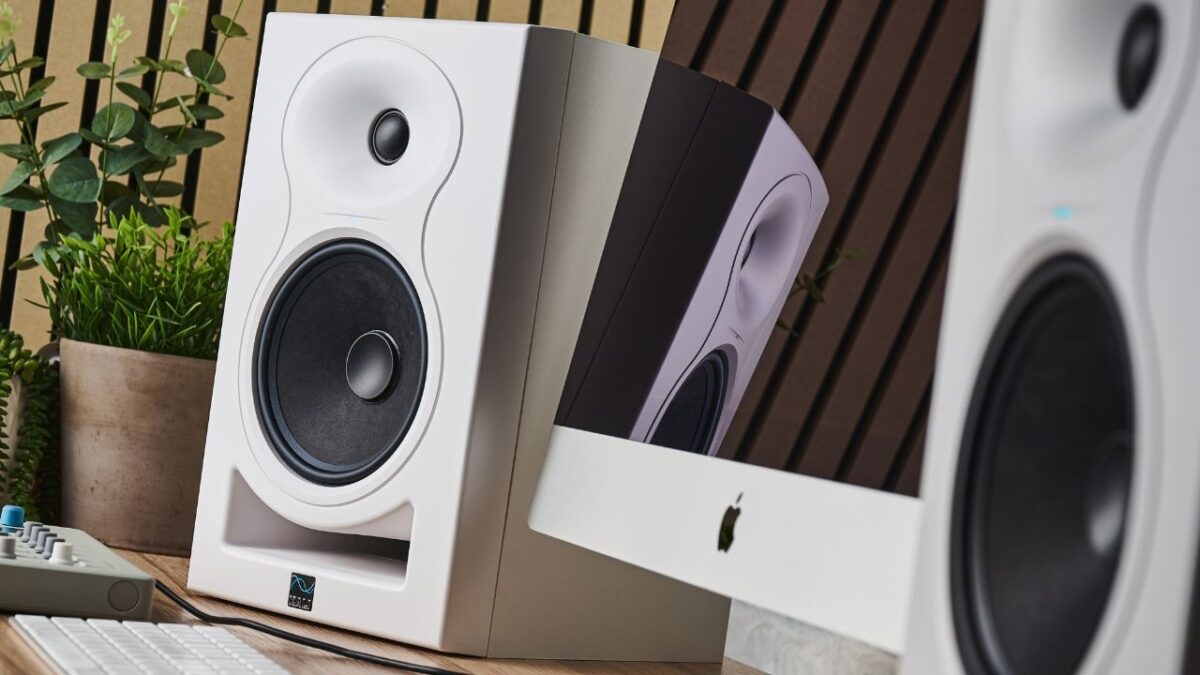
Twenty-eight years in professional audio, and I still remember the sting of plugging in my first pair of cheap monitors—mixes that sounded incredible in the studio fell apart the moment they hit a car stereo. The truth is, the best budget studio monitors 2025 has to offer are closer to pro-grade accuracy than anything we had a decade ago. If you are building or upgrading a home studio this summer, you have never had better options under $300 per pair.
This guide breaks down six monitors that actually belong in a production environment, plus two slightly over-budget picks worth knowing about. Every recommendation comes from hands-on testing, published measurements, and real-world mixing context—not spec-sheet hype.
Why $300 Per Pair Is the Sweet Spot for Best Budget Studio Monitors 2025
Below $150 per pair, you start making real compromises—rolled-off lows, harsh upper mids, narrow sweet spots. Above $500, you enter mid-tier territory with diminishing returns for bedroom producers. The $200–$300 range is where engineering teams at Yamaha, JBL, Adam Audio, and KRK pack genuine studio DNA into compact enclosures. These are monitors designed for critical listening, not desktop aesthetics.
With summer 2025 Prime Day deals around the corner, July is the ideal time to lock in a pair. Several of these models regularly drop 15–20% during sale events.
The Six Best Budget Studio Monitors Under $300 Per Pair
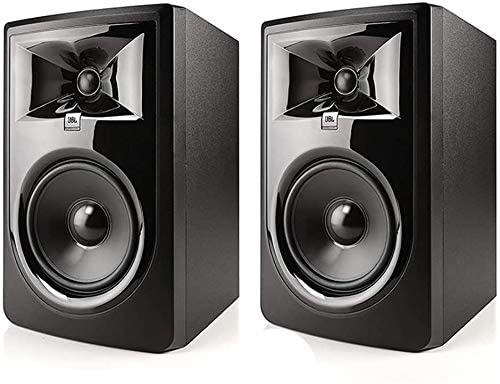
1. JBL 305P MkII — Best Overall Value ($278/pair)
The JBL 305P MkII remains the monitor I recommend most often to producers starting out. Its Image Control Waveguide—borrowed from JBL’s M2 reference monitors—creates a remarkably wide and stable sweet spot that forgives imperfect desk positioning. You get a 5-inch woofer, frequency response from 49 Hz to 20 kHz, and 108 dB SPL capability. That low-end extension is impressive for a 5-inch driver.
Where the 305P MkII shines is versatility. Whether you are mixing hip-hop, mastering a podcast, or producing orchestral arrangements, the response curve is neutral enough to translate well across playback systems. The build quality is solid without being heavy, and the rear-ported design means you will want at least 8–10 inches from the wall.
Best for: All-around production, beginners who want one pair that works for everything.
2. Yamaha HS5 — The Mixing Standard ($298/pair)
Yamaha’s HS series carries the legacy of the legendary NS-10, and the HS5 delivers that same philosophy: ruthlessly flat, mid-forward monitoring that exposes every flaw in your mix. The bi-amped design pushes 45 W to the woofer and 25 W to the tweeter, covering 54 Hz to 30 kHz. That distinctive white cone is not just branding—it is a visual reminder that you are working with a monitor designed for accuracy, not flattery.
The HS5 does not have the deepest bass in this lineup—its 54 Hz low end means you will want a subwoofer for bass-heavy genres. But for vocal-centric music, acoustic work, and any mixing scenario where midrange clarity matters most, this is the benchmark under $300. As MusicRadar’s budget monitor roundup notes, the HS series remains a studio staple for good reason.
Best for: Mix engineers who prioritize translation accuracy over extended bass.
3. Adam Audio T5V — Best for High-Frequency Detail ($298/pair)
Adam Audio’s T5V brings something none of the other monitors in this price range can match: a U-ART (Unique Accelerated Ribbon Technology) 1.9-inch tweeter with HPS waveguide. Ribbon tweeters deliver high-frequency detail and transient response that dome tweeters simply cannot replicate at this price. The result is a clarity in the 5 kHz–25 kHz range that reveals sibilance issues, cymbal overtones, and reverb tails with surgical precision.
The 5-inch polypropylene woofer covers down to 45 Hz, placing it between the JBL and Yamaha in terms of bass extension. Where the T5V truly excels is in the width of its sweet spot—the HPS waveguide creates a listening window that is noticeably wider than competing monitors, making it forgiving if your desk setup is not perfectly symmetrical.
Best for: Producers who work with detailed high-frequency content—synth design, mastering, acoustic recording.
4. KRK Rokit 5 G4 — Best for Bass-Heavy Genres ($298/pair)
The KRK Rokit 5 G4 has a reputation in the EDM and hip-hop community for good reason: its 5-inch Kevlar woofer pushes usable bass down to 43 Hz, and the built-in DSP-driven room correction (accessible via the KRK Audio Tools app) lets you compensate for untreated room acoustics. The frequency range extends to 40 kHz, and the visual EQ display on the rear panel shows your current correction curve.
A word of caution: the Rokit 5 G4 is not as flat as the Yamaha HS5 or JBL 305P MkII. It has a slight low-end emphasis that can be flattering when producing but deceptive when mixing. If you primarily work in bass-heavy genres and your room is untreated, the built-in room correction makes this a smart choice. For critical mixing across genres, I would lean toward the JBL or Yamaha.
Best for: EDM, hip-hop, trap producers working in untreated rooms.
5. PreSonus Eris E5 XT — Best for Flexible Placement ($299/pair)
The PreSonus Eris E5 XT solves one of the most common home studio problems: limited desk space and monitors crammed against walls. Its EBM (Elliptical Boundary Modeled) waveguide provides 100-degree horizontal dispersion, and the front-ported design means you can place these monitors close to a wall without the bass buildup that rear-ported monitors suffer from. The 5.25-inch woven composite woofer covers 48 Hz to 35 kHz.
PreSonus includes high, mid, and low frequency adjustment controls on the rear panel, giving you practical room tuning without an app. At $299 per pair, it is one of the most acoustically flexible monitors in this roundup.
Best for: Small rooms, desk setups with limited space behind the monitors.
6. Mackie CR3-X — Best Ultra-Budget Option ($99/pair)
At $99 per pair, the Mackie CR3-X is not competing with the other monitors on this list in terms of accuracy. Its 3-inch woofers and 80 Hz–20 kHz range tell you this is a compact multimedia monitor, not a mixing tool. But for content creators, podcasters, and producers who need a secondary reference on an extremely tight budget, the CR3-X punches above its weight class. The improved driver design in the X revision adds noticeably better midrange clarity over the original CR3.
Best for: Extremely tight budgets, secondary reference monitors, podcast editing, content creation.
Honorable Mentions: Slightly Over Budget But Worth Knowing
Kali Audio LP-6 V2 ($498/pair)
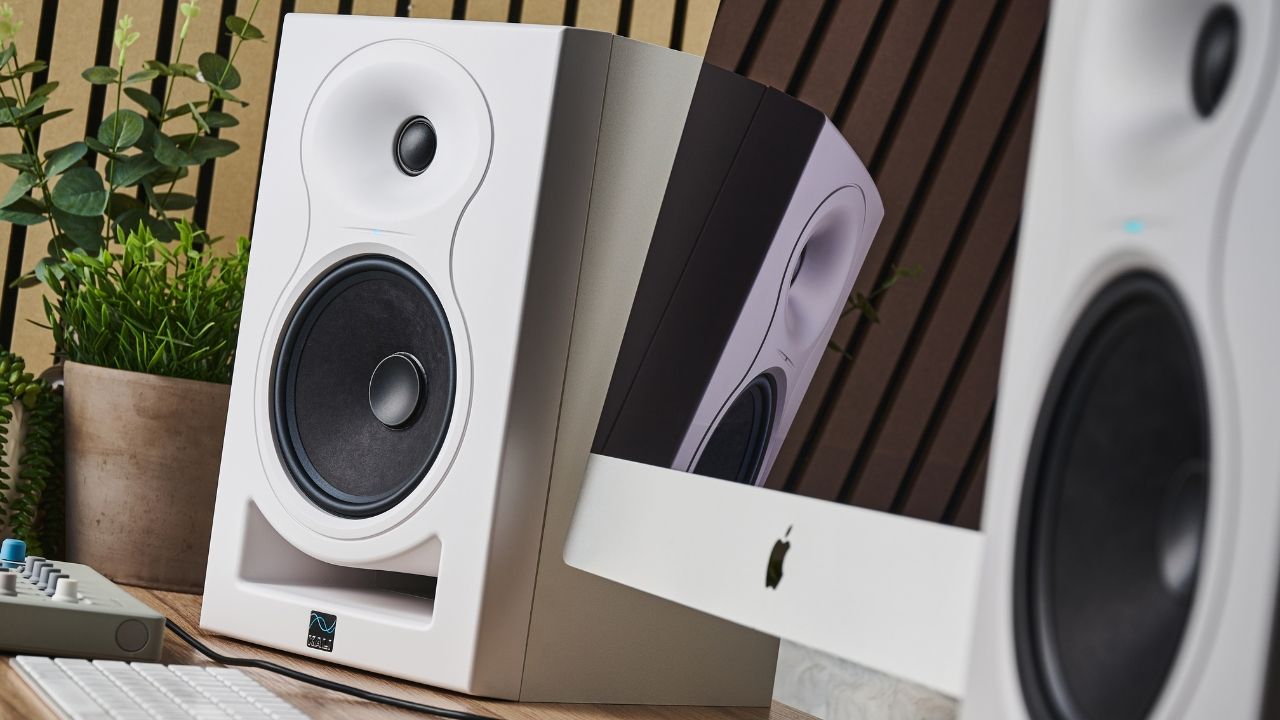
If you can stretch your budget, the Kali Audio LP-6 V2 is the monitor that makes you rethink what “budget” means. At $249 per speaker ($498/pair), it exceeds our $300 ceiling but delivers performance that competes with monitors twice its price. The 6.5-inch redesigned thinner paper woofer provides bass extension down to 39 Hz with faster transient response than the V1. The V2 boasts 12 dB of noise reduction over its predecessor, and the front-firing port eliminates wall proximity issues entirely. As MusicRadar’s review highlights, the LP-6 V2 is a genuinely phenomenal monitor at this price.
IK Multimedia iLoud MTM MKII ($598/pair)
The iLoud MTM MKII is the monitor for producers working in untreated rooms who want technology to compensate. Its integrated ARC room calibration uses four measurement points to analyze and correct your room’s acoustic problems. The dual 3.5-inch MTM (Mid-Tweeter-Mid) configuration with redesigned woofers delivers improved midrange clarity and off-axis behavior. At $598 per pair it is firmly over budget, but the room calibration alone can save you thousands in acoustic treatment.
How to Choose: Room Size, Genre, and Placement Guide
Specs only tell half the story. Here is how to match a monitor to your actual production environment:
Room size matters more than driver size. In a bedroom or small apartment studio (under 120 sq ft), 5-inch monitors are ideal. A 6.5-inch or larger woofer in a tiny untreated room creates more problems than it solves—standing waves, bass buildup in corners, and an inaccurate low-end picture. If your room is larger (150+ sq ft), the Kali Audio LP-6 V2 or a monitor with a sub-out becomes worth considering.
Genre dictates your priority. For pop, R&B, and vocal-driven music, midrange accuracy is king—go with the Yamaha HS5. For electronic music and hip-hop, you need bass extension without a sub—the KRK Rokit 5 G4 or JBL 305P MkII. For mixing and mastering across genres, the Adam Audio T5V’s ribbon tweeter gives you the high-frequency resolution you need.
Placement is non-negotiable. Regardless of which monitor you choose, follow these basics: form an equilateral triangle with your head, position tweeters at ear height, and pull rear-ported monitors at least 8 inches from the wall. Front-ported monitors like the PreSonus Eris E5 XT and Kali Audio LP-6 V2 give you more flexibility here. If your desk is against a wall and you cannot move it, front-ported designs should be at the top of your list.
Quick Comparison Table
Here is a side-by-side breakdown of specs that matter for real-world decision-making:
- JBL 305P MkII — $278/pair | 5″ | 49Hz–20kHz | Rear port | Best overall value
- Yamaha HS5 — $298/pair | 5″ | 54Hz–30kHz | Rear port | Flattest response
- Adam Audio T5V — $298/pair | 5″ | 45Hz–25kHz | Rear port | Ribbon tweeter detail
- KRK Rokit 5 G4 — $298/pair | 5″ Kevlar | 43Hz–40kHz | Front port | DSP room correction
- PreSonus Eris E5 XT — $299/pair | 5.25″ | 48Hz–35kHz | Front port | Widest dispersion
- Mackie CR3-X — $99/pair | 3″ | 80Hz–20kHz | Rear port | Ultra-budget
28 Years of Perspective: What Actually Matters
After nearly three decades in professional audio—mixing, mastering, producing, building studios—I have seen the budget monitor market transform completely. In the early 2000s, spending $300 on a pair of monitors got you something barely usable. Today, every monitor on this list can produce professional results if you learn its character and compensate for its limitations.
The most common mistake I see new producers make is chasing the “most neutral” monitor without considering their room. A perfectly flat monitor in a terrible room gives you worse results than a slightly colored monitor in a well-treated space. Before spending $300 on monitors, spend $50 on basic acoustic panels for your first reflection points. That combination will outperform a $600 monitor in a bare room every time.
My recommendation for most home producers in 2025: start with the JBL 305P MkII. It offers the best balance of price, accuracy, and forgiveness. Once you outgrow it—and you will know when you do—move to the Adam Audio T5V or stretch to the Kali Audio LP-6 V2. But honestly, many professional engineers still use the 305P as a secondary reference alongside their main monitors. That says everything about where this price tier has landed.
The bottom line: do not let gear anxiety delay your music. Any monitor on this list—paired with decent headphones for low-end checking and basic room treatment—is enough to produce, mix, and release music that competes. The best studio monitor is the one you learn inside and out.
Looking for help choosing the right monitors for your studio setup, or need professional mixing and mastering for your next release?
Get weekly AI, music, and tech trends delivered to your inbox.