AI Year in Review 2025: 10 Developments That Shaped the Industry
December 8, 2025
Best Smart Home Devices of 2025: 8 Products That Actually Made Our Homes Smarter
December 8, 2025
After testing, recommending, and tracking every major audio interface release this year, I can say with confidence: 2025 was the year multichannel interfaces finally became affordable — and the year 32-bit conversion stopped being a luxury. Whether you’re building your first home studio or upgrading a room that’s seen better converters, here’s every interface worth your money right now.
Best Audio Interfaces 2025: The Budget Tier (Under $300)
The best audio interfaces of 2025 at the entry level prove that great recordings don’t demand a second mortgage. Three models dominated this space throughout the year, each targeting a slightly different workflow.
Focusrite Scarlett 2i2 4th Gen — $200
Still the best-selling audio interface on the planet, and for good reason. The 4th generation Scarlett 2i2 bumped preamp gain from 56dB to a much more useful 69dB — enough to comfortably drive a Shure SM7B without a CloudLifter. Add Auto Gain (which nails input levels for you), Clip Safe (a second A/D converter running 12dB lower as a safety net), and the switchable Air mode that adds a Focusrite ISA transformer sheen to vocals, and you’ve got a $200 interface that eliminates most beginner mistakes before they happen.
Best for: First-time buyers, singer-songwriters, podcasters. If you’ve never owned an interface, start here.
Audient EVO 4 — $130
Audient’s EVO 4 continues to punch above its weight with the same console-class preamp topology found in their $5,000+ ASP8024 Heritage console. The Smartgain feature auto-sets levels (yell into the mic, it figures out the rest), and the converter quality at this price point is genuinely class-leading. At $130, there’s nothing that sounds this clean.
Best for: Budget-conscious producers who prioritize raw sound quality over features.
PreSonus AudioBox 96 — $100
The true entry-level champion. At $100, the AudioBox 96 gets you 24-bit/96kHz recording, two combo inputs, and — crucially — a full copy of Studio One Artist. It’s not going to win any converter shootouts, but the included DAW alone would cost more than the interface. For students and absolute beginners, this is the lowest barrier to entry in 2025.
Best for: Students, absolute beginners, anyone who needs a complete recording setup under $100.
Best Audio Interfaces 2025: The Mid-Range Sweet Spot ($250–$500)
This is where 2025 got genuinely exciting. Three interfaces at mid-range prices delivered features that would have cost $1,000+ just two years ago.
MOTU M4 — $250
The MOTU M4 remains the best-kept secret in audio interfaces — or at least it was, until word got out. ESS Sabre32 DAC technology delivering 120dB of dynamic range at $250 is borderline absurd. The full-color LCD meters are the best visual feedback on any interface under $1,000, and the loopback routing makes it a podcaster’s dream. MOTU writes their own drivers in-house, which means rock-solid stability and consistently low latency across macOS and Windows.
Best for: Producers who want reference-grade monitoring and don’t need onboard DSP effects.
SSL 2+ MK2 — $350
Solid State Logic brought their legendary console DNA to the desktop with the SSL 2+ MK2. The headline feature is still the 4K button — engage it and you get the harmonic saturation and high-frequency lift inspired by SSL’s 4000 series consoles, the same boards that shaped decades of hit records. The MK2 upgrade pushed converters to 32-bit/192kHz and refined the preamp stage for even lower noise. For mix engineers who want that SSL glue without buying a channel strip, this is a remarkable value at $350.
Best for: Mix-focused producers who want console-inspired character baked into their signal chain.
Antelope Audio Zenith 2 — $299
The late-2025 surprise. Antelope Audio — a brand typically associated with $2,000+ mastering converters — launched the Zenith 2 at $299 in December 2025. It brings FPGA-based real-time effects processing (think hardware-accelerated reverbs and EQs with near-zero latency) to a price point that competes with the Scarlett. Pre-orders shipped in December, and early reports suggest the conversion quality punches well above the $299 tag. This could be the interface to watch heading into 2026.
Best for: Producers who want Antelope’s conversion pedigree and onboard effects at a fraction of the usual cost.
Best Audio Interfaces 2025: Professional Tier ($800–$1,900)
For commercial studios, touring engineers, and producers who need serious I/O count with uncompromising quality, 2025 delivered several standout options.
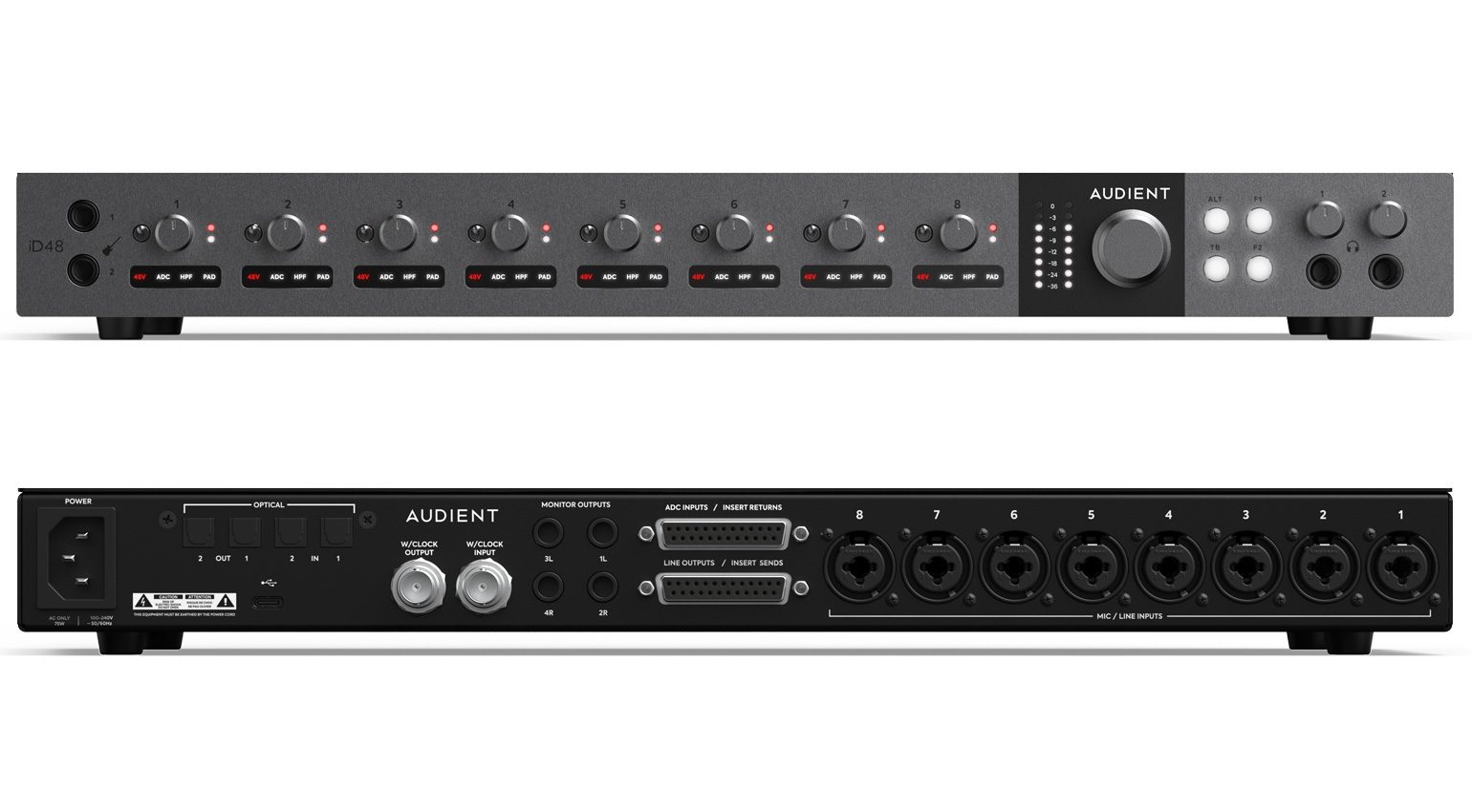
Audient iD48 — $859
Audient’s iD48 is one of the most impressive multichannel interfaces in its class. Eight console-grade preamps with 68dB of gain, 16 channels of digital I/O via ADAT, standalone operation for live recording, and dual headphone outputs that can drive up to 600-ohm headphones. The D-Sub connectivity with eight insert channels means you can patch in outboard gear without rerouting your whole studio. At $859 for 24 channels of I/O, the per-channel cost is hard to beat.
Best for: Small commercial studios recording live bands, engineers who need standalone operation.
SSL 18 — $899
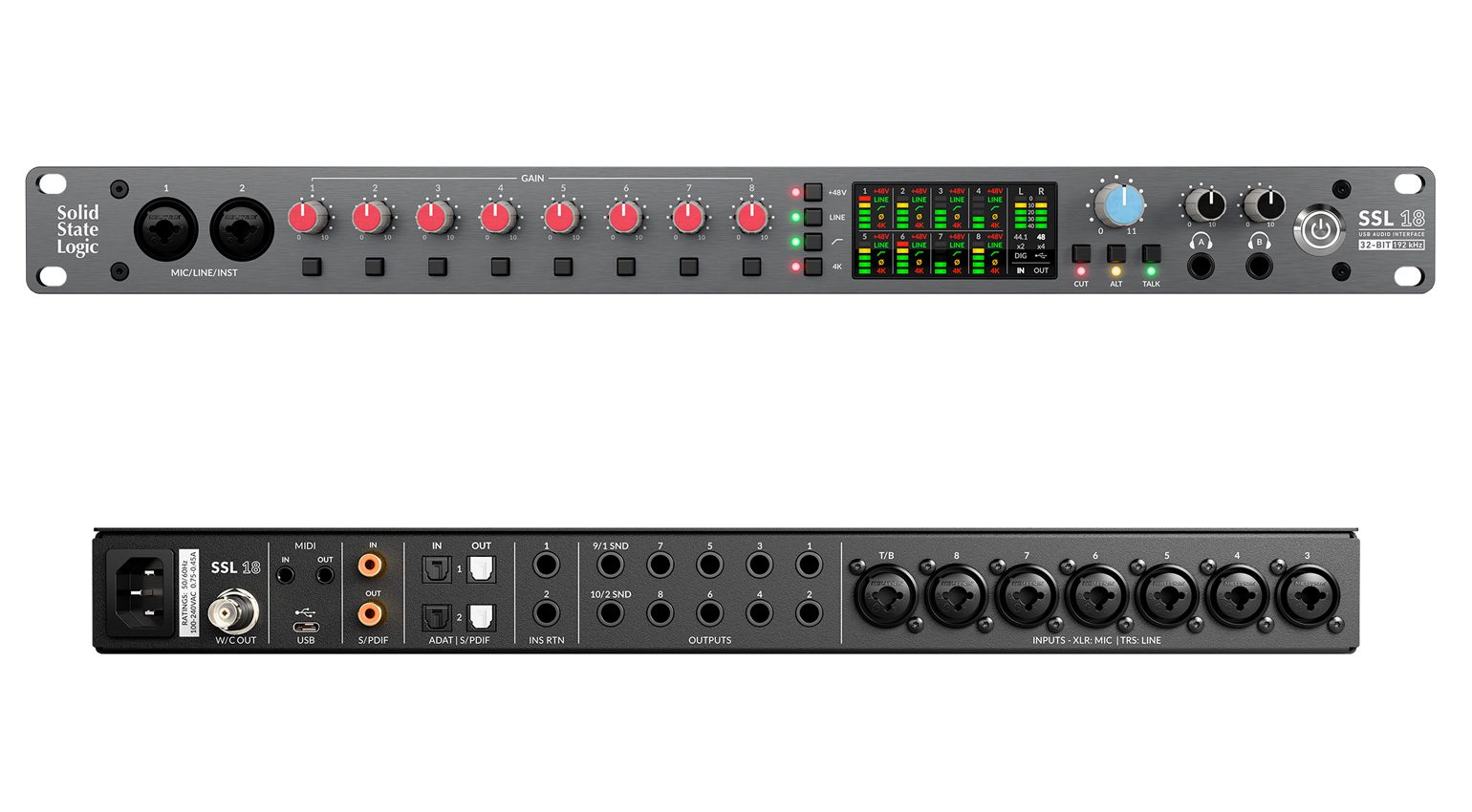
SSL’s first-ever rackmount audio interface made waves at NAMM 2025. The SSL 18 packs eight SSL-designed preamps with the signature 4K function, 32-bit/192kHz conversion, 26×28 I/O, ADAT expansion (up to 16 channels at 48kHz), and a dedicated talkback input with a listen mic compressor — a feature borrowed from SSL’s broadcast consoles. At $899, it undercuts the competition significantly while carrying the SSL name and the engineering chops to back it up.
Best for: Project studios wanting rackmount reliability with SSL’s preamp character and massive I/O.
Universal Audio Apollo Twin X Gen 2 — $1,500
The Apollo Twin X Gen 2 remains the gold standard for producers who live inside their plugins. The onboard SHARC DSP runs UA’s entire plugin library — 1176 compressor, LA-2A, Neve 1073, API 2500, Capitol Chambers reverb — with near-zero latency while tracking. That means you can record through a vintage Neve channel strip emulation without any perceptible delay, something no native plugin can match. The Gen 2 update brought lower self-noise, integrated Sonarworks room correction, and a cleaner signal path. At $1,500, it’s not cheap — but for producers who depend on UA’s ecosystem, nothing else comes close.
Best for: Producers invested in UAD plugins who need near-zero-latency processing while tracking.
MOTU 848 — $1,899
MOTU’s 848 targets the professional tier with its ESS Sabre32 conversion, Thunderbolt and USB connectivity, 28×32 I/O, and two Gigabit Ethernet ports supporting 128 audio channels via AVB networking. The CueMix Pro software provides a 64-channel mixer with 26 aux buses — essentially a full digital console inside your computer. For studios that need to scale beyond a single unit, the AVB networking lets you chain multiple 848s for massive channel counts without additional hardware.
Best for: Professional studios needing scalable, high-channel-count solutions with network audio.
The Reference Standard: RME Fireface UFX III — $3,500
If money is no object and you need the absolute best stability, driver performance, and conversion quality available in 2025, the RME Fireface UFX III stands alone. A 188-channel architecture at 24-bit/192kHz, TotalMix FX with its legendary routing flexibility, and the lowest-latency drivers in the industry — all built in Germany to standards that make other manufacturers’ QC look casual. RME interfaces don’t crash. They don’t introduce artifacts. They just work, session after session, year after year. The $3,500 price tag is steep, but for mastering studios and post-production houses where downtime costs real money, it’s an insurance policy that pays for itself.
Best for: Mastering studios, post-production, broadcast — anywhere reliability is non-negotiable.
2025 Audio Interface Comparison: Quick-Reference Table
Here’s every interface in this roundup at a glance. Note that “best for” is subjective — your ideal choice depends on your specific workflow, I/O needs, and whether you value features like onboard DSP or raw converter quality.
| Interface | Price | I/O | Bit/Rate | Connection | Standout Feature |
|---|---|---|---|---|---|
| PreSonus AudioBox 96 | $100 | 2×2 | 24/96 | USB-C | Studio One Artist included |
| Audient EVO 4 | $130 | 2×2 | 24/96 | USB-C | Console-class preamps |
| Focusrite Scarlett 2i2 4th Gen | $200 | 2×2 | 24/192 | USB-C | Auto Gain + Clip Safe |
| MOTU M4 | $250 | 4×4 | 24/192 | USB-C | ESS Sabre32 DAC (120dB DR) |
| Antelope Zenith 2 | $299 | 2×2 | 32/192 | USB-C | FPGA real-time effects |
| SSL 2+ MK2 | $350 | 2×4 | 32/192 | USB-C | 4K button (console harmonics) |
| Audient iD48 | $859 | 24×24 | 24/96 | USB-C | 8 preamps + standalone |
| SSL 18 | $899 | 26×28 | 32/192 | USB-C | SSL’s first rackmount |
| UA Apollo Twin X Gen 2 | $1,500 | 10×6 | 24/192 | Thunderbolt 3 | Onboard UAD DSP plugins |
| MOTU 848 | $1,899 | 28×32 | 24/192 | TB/USB | AVB networking (128ch) |
| RME Fireface UFX III | $3,500 | 188ch | 24/192 | USB/TB | Industry-best drivers |
What Defined the Best Audio Interfaces in 2025
Three trends shaped the audio interface market this year. First, 32-bit conversion went mainstream — SSL’s MK2 lineup and the Antelope Zenith 2 brought 32-bit/192kHz specs to interfaces under $400, a threshold that seemed impossible even in 2023. Second, multichannel interfaces became dramatically more affordable — the SSL 18 delivered 26×28 I/O with eight SSL preamps for under $900, a price point that would have seemed absurd for a product with the SSL logo two years ago. Third, auto-gain and intelligent features — from Focusrite’s Clip Safe to Audient’s Smartgain — continued to lower the technical barrier to getting a clean recording.
For producers who have been waiting for prices to come down before upgrading, the wait is over. The gap between budget and professional converters has never been narrower, and the feature sets at every price tier are more generous than ever. Whether you’re tracking vocals in a bedroom or mixing a full band in a treated room, there’s an interface on this list that fits your workflow and your budget — and it probably sounds better than what you paid twice as much for five years ago.
My personal picks? The Focusrite Scarlett 2i2 4th Gen for beginners who want the safest recommendation, the SSL 2+ MK2 for anyone who wants console character at a desktop price, and the Universal Audio Apollo Twin X Gen 2 for serious producers who’ve committed to the UAD ecosystem. But honestly, there are no bad choices on this list — only different priorities.
Need help choosing the right interface for your studio setup, or looking for professional mixing and mastering to make the most of your recordings?
Get weekly AI, music, and tech trends delivered to your inbox.