Google Chrome AI Features September 2025: Tab Organizer and Writing Assistant Transform Your Browser
September 5, 2025
Google Pixel 10 Pro September Update: Camera Fixes, Material 3 Expressive, and 12 Key Changes You Need to Know
September 5, 2025
Thirty-nine vintage instruments for $599. That works out to roughly $15 per instrument — and Sound On Sound called it “ridiculously cheap.” Arturia V Collection 10 (X) compresses half a century of synthesizer history into a single bundle, from the Minimoog to the TB-303 and everything in between. But is the quantity matched by quality? After spending considerable time exploring every new addition and rebuilt engine, here is the complete breakdown of what V Collection X brings to the table — and whether it deserves a spot in your production setup.
” alt=”Arturia V Collection 10 virtual instrument interface overview”/>
What’s New in Arturia V Collection 10 (X)
Released on December 12, 2023, V Collection X (using the Roman numeral branding) brings six new instruments to push the total count to 39. But this is not simply about inflating numbers on the roster. The update includes two genuinely new instruments built from the ground up (CP-70 V and Augmented Woodwinds), four instruments joining the collection for the first time (MiniFreak V, Acid V, Augmented Brass, and Augmented Grand Piano), and two completely rebuilt audio engines (Mini V4 and Wurli V3). Three exclusive expansion packs with curated presets round out the package.
The distinction between “new to V Collection” and “genuinely new” matters here. MiniFreak V and Acid V already existed as standalone Arturia products before joining the bundle. Meanwhile, CP-70 V and Augmented Woodwinds are instruments that did not exist in any form before this release. Understanding that difference is key to evaluating whether the upgrade makes sense for your situation.
Pricing sits at $599 (€599) for the full bundle, or $199 (€199) for upgrades from V Collection 9. MusicRadar awarded it 4.5 out of 5 stars, praising the MiniFreak V addition and Acid V’s TB-303 recreation, though noting that having only two genuinely new instruments might disappoint vintage purists expecting a larger haul of fresh content.
The Standout New Instruments: Acid V, CP-70 V, and Mini V4
Acid V — The TB-303 Reborn With Modern Muscle
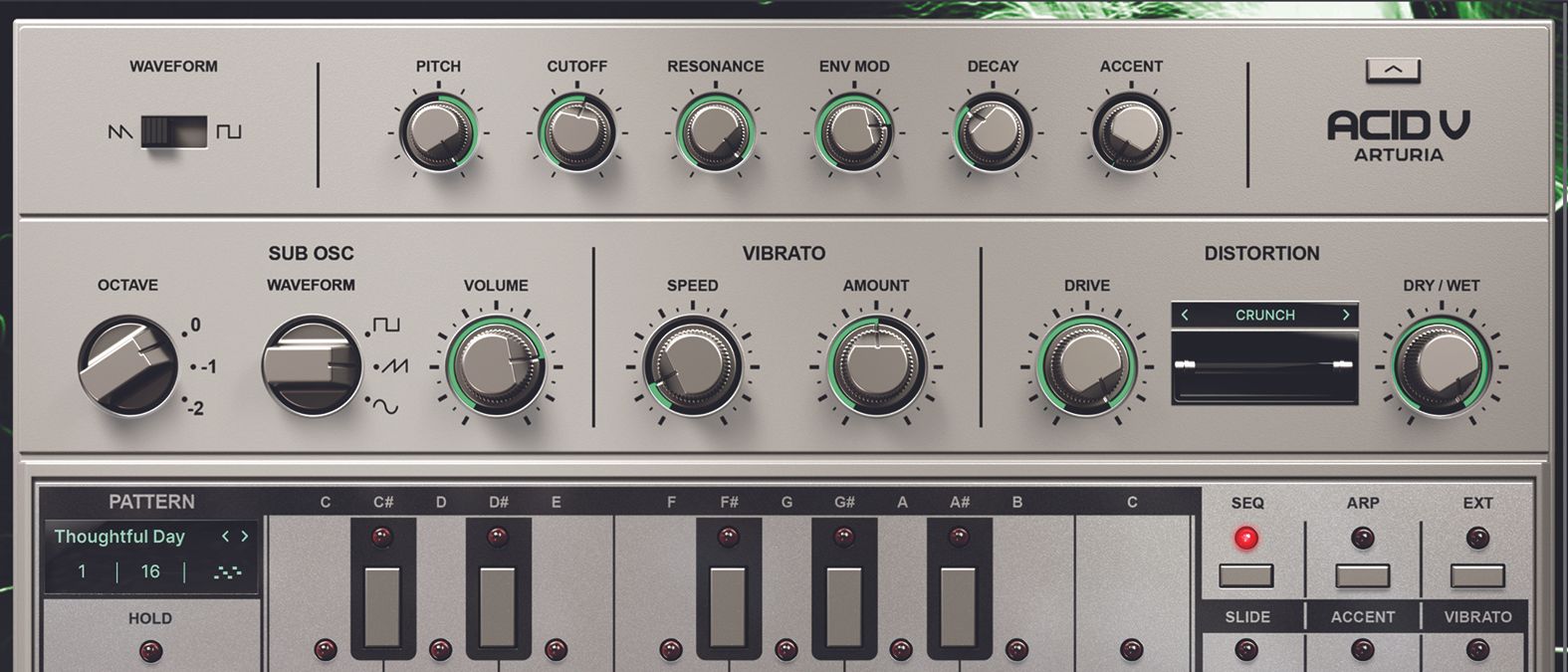
If you have ever chased that iconic acid house squelch, Acid V delivers it with remarkable authenticity — and then goes far beyond what the original hardware could dream of. Built around multi-algorithm distortion, a modern step sequencer, three modulators, and a four-slot multi-FX chain packing 17 different effects, it takes the TB-303’s DNA and supercharges it for contemporary production workflows.
MusicRadar specifically highlighted the way Acid V nails those signature “TB-303 squeals” that defined an entire genre of electronic music. But what makes it more than just another 303 clone is the depth of sound design possibilities. The multi-algorithm distortion alone offers tonal variety that would require multiple hardware units to replicate. The sequencer feels genuinely playful and encourages experimentation — something the original hardware was always celebrated for. Whether you are producing acid techno, adding gritty bass lines to hip-hop tracks, or exploring experimental sound design, Acid V covers all of it without requiring a second plugin.
CP-70 V — The Electric Grand Piano Returns
The Yamaha CP-70 was the electric grand piano that defined live performance in the late 1970s and 1980s. Artists from Genesis to Toto relied on its distinctive tone — warm and resonant like an acoustic grand, yet amplified and road-ready in a way that traditional grands could never be. Arturia’s CP-70 V uses a hybrid approach, combining deep multi-sample recordings with circuit modeling to recreate that warm, instantly recognizable character with impressive fidelity.
Five built-in effect slots let you shape everything from the original’s mellow, slightly metallic tone to heavily processed modern textures suitable for ambient and electronic production. Dedicated CP-70 emulations are surprisingly rare in the plugin market — most piano plugins focus on acoustic grands or the ubiquitous Rhodes and Wurlitzer. That gap in the market makes this addition genuinely valuable for keyboard-focused producers, session musicians, and anyone working on productions that need that specific late-70s/early-80s sonic signature.
Mini V4 — A Ground-Up Minimoog Rebuild
Mini V has been a flagship instrument of the V Collection since the very first version, and version 4 represents its most significant transformation yet. The audio engine has been completely redesigned from scratch — not tweaked, not updated, but rebuilt from the ground up using new modeling techniques that Arturia has developed over the past several years.
According to Sound On Sound’s detailed review, polyphony was actually reduced to six voices in this version. That might sound like a downgrade on paper, but the new vintage and dispersion controls more than compensate by delivering a sound character that feels dramatically closer to the analog original. Each voice now exhibits subtle variations in tuning, filter behavior, and oscillator character — the kind of organic imperfections that made real Minimoogs sound so alive. It is a deliberate trade-off that prioritizes sonic authenticity over feature counts. For Minimoog purists who felt previous versions were too clean or too digital, Mini V4 is the version that finally captures the magic of the original hardware.
The Augmented Series and Wurli V3 — Supporting Cast That Punches Above Its Weight
Beyond the headline additions, V Collection X also brings three new entries to Arturia’s Augmented series: Augmented Brass, Augmented Grand Piano, and Augmented Woodwinds. These hybrid instruments blend deeply sampled acoustic sources with synthesis engines, creating textures that sit somewhere between organic and electronic. They are particularly useful for film scoring, ambient production, and any project where you need sounds that feel natural but carry an otherworldly edge.
Wurli V3, the rebuilt Wurlitzer emulation, also deserves mention. Like Mini V4, it received a complete audio engine overhaul rather than incremental improvements. The result is a warmer, more responsive instrument that better captures the Wurlitzer’s characteristic bark and sustain behavior. If the Wurlitzer is a staple in your productions — and for genres ranging from neo-soul to indie rock, it often is — the V3 rebuild represents a meaningful sonic upgrade.
The Complete 39-Instrument Lineup at a Glance
V Collection X’s 39 instruments span four major categories that together cover virtually every vintage keyboard and synthesizer type ever made. First, classic synthesizer emulations make up the largest group: ARP 2600 V, Buchla Easel V, CS-80 V, DX7 V, Jup-8 V, Jun-6 V, KORG MS-20 V, Matrix-12 V, Mini V4, Modular V, OP-Xa V, Prophet-5 V, Prophet-VS V, SEM V, SQ80 V, Synclavier V, Synthi V, CZ V, MiniFreak V, and Acid V. That is effectively a who’s-who of synthesizer history spanning from the 1960s modular era through to modern digital hybrids — all in one package.
Second, keyboard instruments include B-3 V (Hammond organ), Clavinet V, CP-70 V, Farfisa V, Mellotron V, Piano V, Solina V, Stage-73 V (Fender Rhodes), VOX Continental V, and the rebuilt Wurli V3 (Wurlitzer). This category alone would cost well over $599 if purchased individually from competing developers. Third, the Augmented series (five instruments total) blends acoustic samples with synthesis engines for hybrid textures that are difficult to achieve with conventional plugins. Fourth, specialty instruments like Vocoder V, CMI V (Fairlight), and Emulator II V round things out, alongside Analog Lab Pro as the unified browsing and preset management interface.
According to Arturia’s official product page, the total preset count exceeds 14,000 across all instruments. Each instrument features an intuitive, resizable interface with in-app tutorials that explain the original hardware’s history and controls, making vintage synthesis genuinely accessible even if you have never touched a real Moog or Prophet. Format support covers VST, VST3, AU, AAX, and standalone mode on both macOS (Apple Silicon and Intel native) and Windows — so regardless of your DAW or operating system, compatibility is not a concern.
” alt=”Arturia V Collection 10 complete instrument lineup”/>
Who Should Buy Arturia V Collection 10 — And Who Should Wait
The biggest strength of V Collection X is its sheer comprehensiveness. Synthesizers, organs, electric pianos, string machines, samplers, vocoders — nearly every vintage keyboard and synth category a producer could need, bundled together at a per-instrument cost that borders on absurd. That breadth and value proposition is exactly why MusicRadar gave it 4.5 stars and why the bundle consistently appears in “best plugin deals” roundups across the industry.
However, existing V Collection 9 owners should weigh the upgrade path carefully. Only two instruments are genuinely brand new (CP-70 V and Augmented Woodwinds). The rest are either migrated from standalone products you may already own separately, or rebuilt versions of instruments already in your V Collection 9 library. Whether the $199 upgrade price is justified comes down to specifics: Do you need the CP-70 V’s electric grand sound? Will the Mini V4 and Wurli V3 audio engine rebuilds make a noticeable difference in your productions? Are the three new Augmented instruments relevant to your genre? If you answer yes to two or more of those questions, the upgrade is easy to justify. If not, you may want to wait for the next version.
For first-time buyers, though, V Collection X is arguably the most complete and cost-effective virtual instrument bundle available today. At roughly $15 per instrument, with over 14,000 presets, full cross-platform compatibility, and a track record of regular updates, it is what MusicTech aptly described as a “39-strong lineup” that covers virtually every sonic territory from the dawn of electronic music to the present day. No other single bundle offers this range at this price point.
Final Verdict: Why V Collection X Belongs in Your Studio
Arturia V Collection 10 (X) bridges the gap between vintage nostalgia and modern production pragmatism in a way that very few bundles manage to achieve. Acid V’s searing 303 acid lines, CP-70 V’s warm and resonant electric grand character, Mini V4’s newly authentic analog feel — each of these could stand on its own as a worthwhile individual purchase. Together, 39 instruments deep with over 14,000 presets and comprehensive format support, they create something genuinely greater than the sum of their parts.
The real question is not whether V Collection X sounds good — it does, and both Sound On Sound and MusicRadar have confirmed as much in their detailed reviews. The real question is whether you need this breadth of vintage sound in your toolkit. For most producers working across multiple genres, the answer is a clear yes. If you want vintage sounds that actually sit well in modern mixes without hours of processing, this bundle is both the starting point and the destination.
Looking for professional mixing, mastering, or production help to get the most out of your vintage plugin sounds? Let’s talk.
Get weekly AI, music, and tech trends delivered to your inbox.