Valhalla Supermassive 3.0 Update: Why Leo and Virgo Modes Change Everything for Free Reverb
May 12, 2025
Model Context Protocol: How Anthropic’s MCP Became the USB-C of AI Tool Integration
May 13, 2025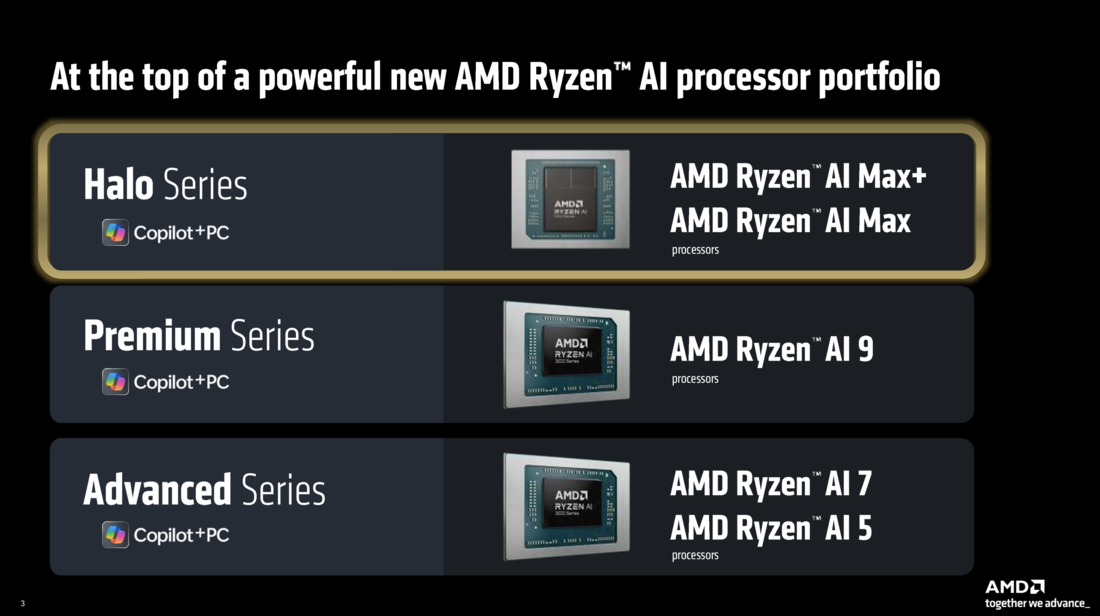
Running a 70-billion parameter LLM on a laptop without an external GPU — sounds impossible, right? The AMD Strix Halo laptop review starts with this verdict: it outperforms a desktop RTX 4090 by 2.2x in AI inference. No dedicated GPU. No eGPU dock. Just an APU with 128GB of unified memory that rewrites the rules of what portable computing can do.
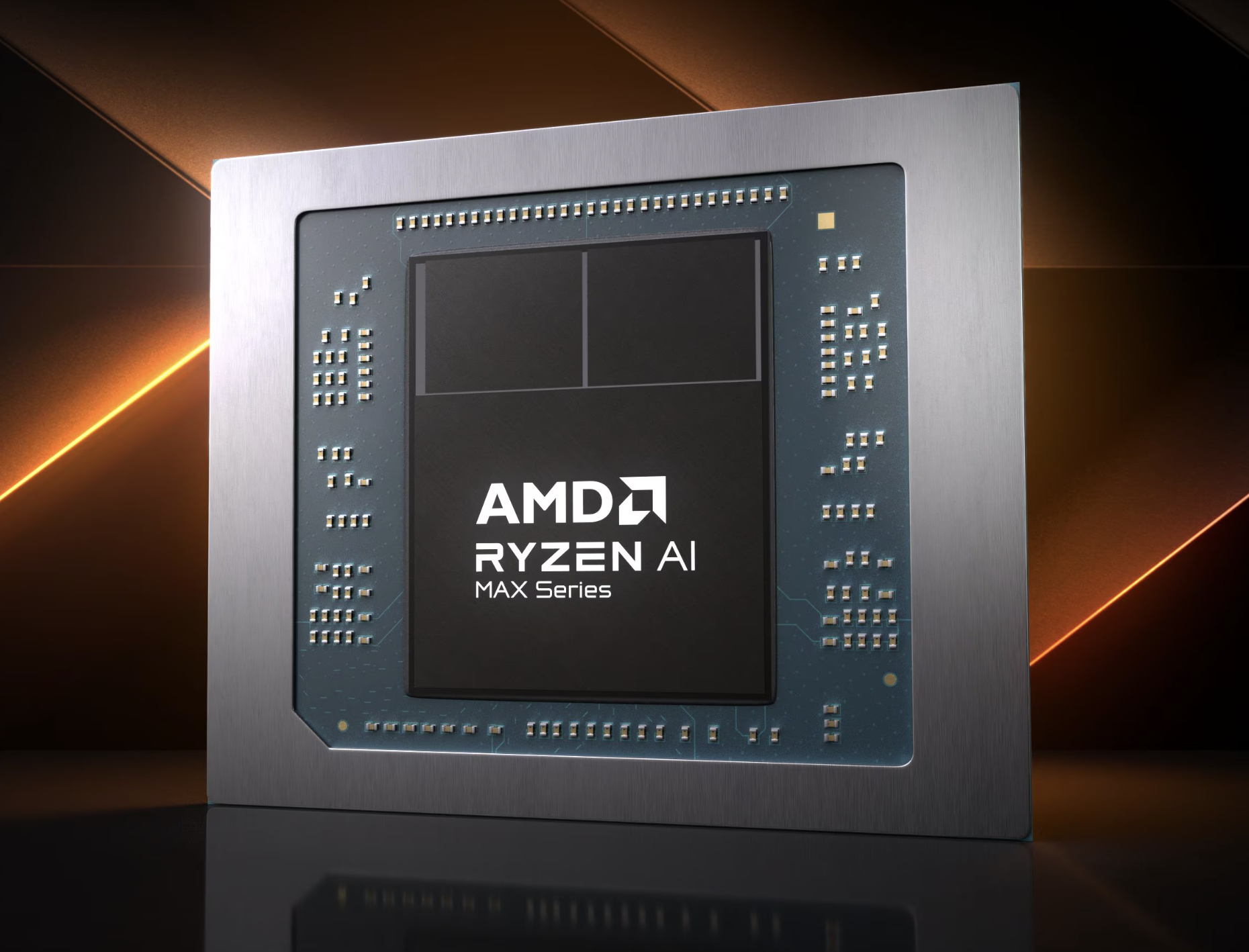
What Is AMD Strix Halo: The First x86 Unified Memory Revolution
AMD Strix Halo (marketed as the Ryzen AI Max series) is a chiplet-based APU that combines Zen 5 CPU cores, an RDNA 3.5 integrated GPU, and an XDNA 2 NPU into a single package. The defining innovation is its unified coherent memory architecture — up to 128GB of LPDDR5x-8533 memory shared between CPU and GPU, with Variable Graphics Memory technology enabling dynamic allocation of up to 96GB as VRAM.
Here’s why that matters. Until now, workloads demanding large VRAM pools on x86 laptops — local LLM inference, large-scale 3D scene rendering, AI image generation — were strictly the domain of discrete GPUs. Even the NVIDIA RTX 4090 Laptop tops out at 16GB VRAM. Strix Halo is the first x86 APU to shatter this barrier with coherent unified memory that eliminates costly memory copies between CPU and GPU address spaces.
The SKU Lineup: Which AMD Strix Halo Laptop Should You Pick?
Strix Halo ships in four SKUs, each targeting different use cases.
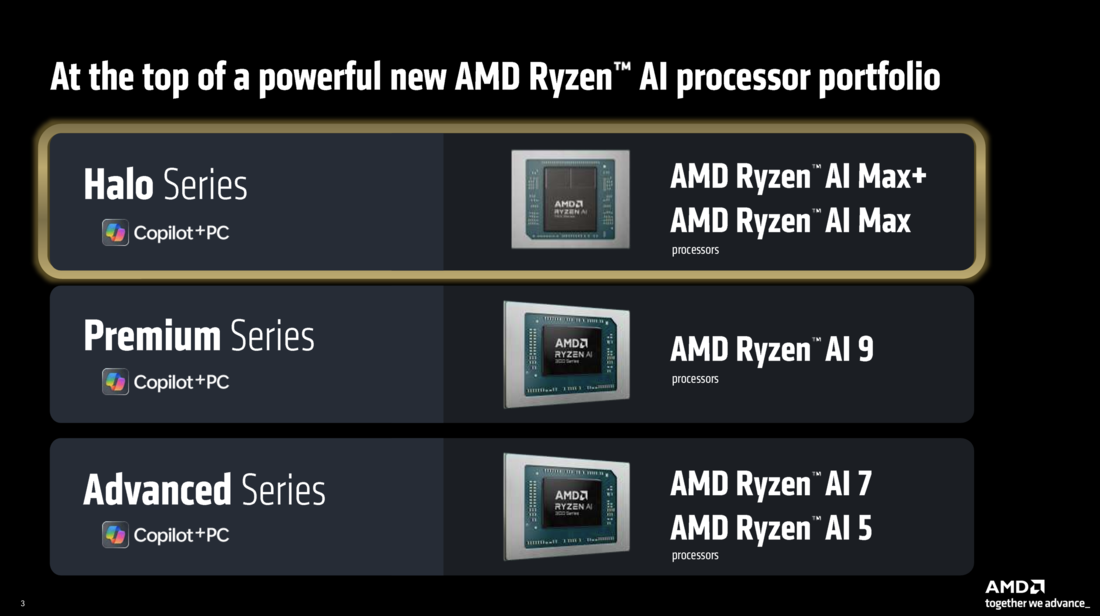
- Ryzen AI Max+ 395 — 16 cores / 32 threads, 5.1GHz boost, 40 RDNA 3.5 CUs, 80MB cache. The flagship for AI inference and creative workloads.
- Ryzen AI Max 390 — 12C/24T, 5.0GHz boost, 32 CUs, 76MB cache. The balanced performer.
- Ryzen AI Max 385 — 8C/16T, 32 CUs. The gaming sweet spot.
- Ryzen AI Max Pro 380 — 6C/12T, 4.9GHz boost, 16 CUs, 22MB cache. Enterprise and entry-level.
All SKUs include the XDNA 2 NPU rated at 50 TOPS, qualifying every configuration as a Windows Copilot+ PC. Maximum memory across all models is 128GB LPDDR5x-8533, delivering a measured bandwidth of 276GB/s — short of Apple M4 Max’s 546GB/s but a generational leap over any previous x86 laptop platform.
Benchmark Deep Dive: Gaming, AI Inference, and Creative Workloads
Gaming: An Integrated GPU That Rivals RTX 4070 Laptop
The gaming benchmarks delivered the most eye-opening results. According to Laptop Mag’s testing, Cyberpunk 2077 at 1600p resolution saw Strix Halo’s integrated GPU hit 39.4fps versus 37.3fps for the NVIDIA RTX 4070 Laptop GPU. Let that sink in: an integrated GPU — sharing its memory with the CPU, drawing from the same power budget — outperforming a dedicated mobile GPU in one of the most demanding AAA titles available. That has never happened before in x86 laptop history.
The HP ZBook Ultra G1a review at HotHardware pushed things further — Cyberpunk 2077 at the native 2880×1800 resolution nearly hit 100fps with Frame Generation enabled. The key enabler here is the 40 RDNA 3.5 compute units in the Max+ 395, combined with the massive unified memory pool that eliminates the VRAM bottleneck that normally constrains integrated graphics. Traditional iGPUs share a tiny slice of system RAM through a narrow bus — Strix Halo’s architecture gives the GPU coherent access to the entire 128GB pool at 276GB/s.
That said, results were mixed across titles. Some games landed closer to RTX 4060 performance levels, and titles heavily optimized for NVIDIA’s CUDA ecosystem showed a wider gap. The honest assessment: Strix Halo’s iGPU sits between RTX 4060 and RTX 4070 Laptop depending on the title, which is remarkable for integrated graphics but not a wholesale replacement for high-end discrete GPUs. For gamers who also need massive VRAM for professional work, though, this is an extraordinary value proposition — you get competitive gaming performance as a bonus on top of the AI and creative capabilities.
AI Inference: 2.2x Faster Than a Desktop RTX 4090
This is where Strix Halo truly separates itself. AMD’s official benchmarks show the Ryzen AI Max+ 395 delivering 2.2x faster performance than a desktop RTX 4090 on Llama 70B Nemotron inference. For Stable Diffusion 3.5, it was 3.9x faster than the Apple M4 Pro (48GB).
The explanation is straightforward: the RTX 4090’s 24GB VRAM ceiling means it cannot hold a full 70B parameter model without aggressive quantization. Strix Halo’s 96GB GPU-addressable memory can load the entire model, eliminating the overhead of model sharding and memory swapping. While the bandwidth deficit (276GB/s vs the RTX 4090’s 1,008GB/s) limits per-token generation speed, the ability to avoid constant data shuffling means higher end-to-end throughput for batch inference on massive models.
CPU Multicore and Creative Workloads
Raw CPU performance holds its own against the competition. The Max+ 395 scored 33,285 in V-Ray 6.0 and 1,596 in Cinebench 2024, roughly double the HP ZBook Firefly G11A. The 16 Zen 5 cores with 5.1GHz boost clocks deliver workstation-class multithreaded performance in a mobile form factor that would have required a desktop just two years ago.
For creative professionals, the 128GB unified memory pool eliminates the memory wall that plagues large multitrack sessions, 4K/8K video proxies, and complex 3D scenes — workloads where system RAM and VRAM are both bottlenecks simultaneously. Consider a typical post-production workflow: you’re running DaVinci Resolve with a 4K timeline, multiple Fusion nodes requiring GPU compute, and an AI-powered noise reduction plugin running inference on every frame. On a traditional laptop, you’d hit the 16GB VRAM wall on the GPU or the 32-64GB system RAM ceiling. Strix Halo lets both the CPU and GPU draw from the same 128GB pool dynamically, scaling allocation based on what the workload actually demands at any given moment.
Available Strix Halo Laptops: What You Can Buy Now
As of May 2025, three major Strix Halo laptops have hit the market.
- HP ZBook Ultra G1a — 14-inch workstation, 128GB configuration, $4,100. The first major Strix Halo workstation targeting creative professionals and AI developers.
- ASUS ROG Flow Z13 — 13-inch gaming tablet form factor, Ryzen AI Max 390, starting at $2,099. Unveiled at CES 2025, it demonstrates the portability potential of unified memory APUs.
- Lenovo ThinkPad — Strix Halo configuration with up to 128GB and an optional on-device drawing tablet input.
Strix Halo vs Apple M4 Max: The Unified Memory Showdown
Apple Silicon pioneered unified memory architecture in consumer devices. The M4 Max comparison is inevitable — and revealing.
- Memory bandwidth: M4 Max at 546GB/s vs Strix Halo at 256GB/s. Apple holds a roughly 2x advantage, directly impacting LLM token generation speed.
- VRAM flexibility: Strix Halo can dynamically allocate up to 96GB to the GPU via Variable Graphics Memory. Apple’s memory allocation is less configurable.
- GPU compute: AMD claims superiority in GPU compute and AI inference workloads per their official benchmarks.
- Single-core CPU: M4 Max leads.
- Battery life: Apple Silicon wins decisively.
- Software ecosystem: Strix Halo supports both Windows and Linux with ROCm GPU compute support. Apple is macOS-only.
- Pricing: Comparable at high-end configurations.
The verdict depends entirely on your workload and ecosystem requirements. If LLM token generation speed is your primary metric, M4 Max wins decisively on raw bandwidth — and that 2x advantage translates directly to faster per-token output when running large language models. If GPU compute, AI model training, or Windows/Linux compatibility matter more, Strix Halo is the only game in town. The ROCm support is particularly significant for ML researchers and developers who need CUDA-alternative compute on portable hardware without rewriting their entire pipeline for Metal or CoreML.
My Take: What 28 Years in Audio and Tech Taught Me About This
After 28 years in music production and technology, I’ve seen my share of products marketed as “game changers.” Most of them weren’t. But Strix Halo’s unified memory architecture is the real deal — a genuine paradigm shift, not marketing hyperbole.
Three things stand out from my perspective. First, the democratization of local AI inference. Running 70B+ parameter LLMs locally used to require a minimum $2,000 discrete GPU investment. Strix Halo puts that capability in a laptop. In music production, AI-powered mastering, vocal separation, and automated mixing tools are getting more sophisticated every quarter. Being able to run these workloads locally — without cloud latency or privacy concerns — is a meaningful advantage for studios handling confidential pre-release material.
Second, the creative workflow implications. 128GB unified memory eliminates the memory ceiling that forces you to split large multitrack sessions, proxy 4K/8K footage, or compromise on Dolby Atmos object-based mixing complexity. I’ve worked on projects where we had to break sessions into pieces just because the system ran out of RAM for plugins. If this chip can hold the entire session — audio, video, AI processing — in one memory pool, it simplifies the production pipeline in ways that compound over hundreds of projects.
Third, from a tech consulting standpoint, this is the first product that earns a conditional “yes” to the question: can a laptop replace a studio server? The bandwidth gap (256GB/s vs M4 Max’s 546GB/s) will bottleneck real-time streaming workloads, and software optimization still has catching up to do. But the direction is right, and I expect the second generation to close much of this gap.
The Bottom Line: Who Should Buy a Strix Halo Laptop?
AMD Strix Halo isn’t perfect. It trails Apple M4 Max in memory bandwidth by a factor of two, its gaming performance fluctuates between RTX 4060 and RTX 4070 levels depending on the title, and battery life simply cannot compete with Apple Silicon’s efficiency-first architecture. The software ecosystem also needs time to mature — ROCm support is improving but still lacks the breadth of CUDA’s optimization across AI frameworks.
But the problem it solves — large-VRAM local AI workloads on Windows and Linux without a discrete GPU — has no other solution at this price point or form factor. For local LLM developers who need to run 70B+ parameter models without cloud dependency, AI researchers who need GPU compute on portable Linux hardware, and creative professionals working with massive datasets that overflow traditional VRAM limits, the Strix Halo is currently the only viable option. It marks the beginning of the x86 unified memory era, and that alone makes it one of the most significant laptop chip launches in years.
Looking into building an AI workstation or optimizing your tech automation pipeline? Let’s talk.
Get weekly AI, music, and tech trends delivered to your inbox.