Music Streaming Wrapped 2025: Artist and Listener Data Insights from 5.1 Trillion Streams
December 23, 2025
Best Headphones for Music Production 2025: The Definitive Closed vs Open-Back Guide
December 24, 2025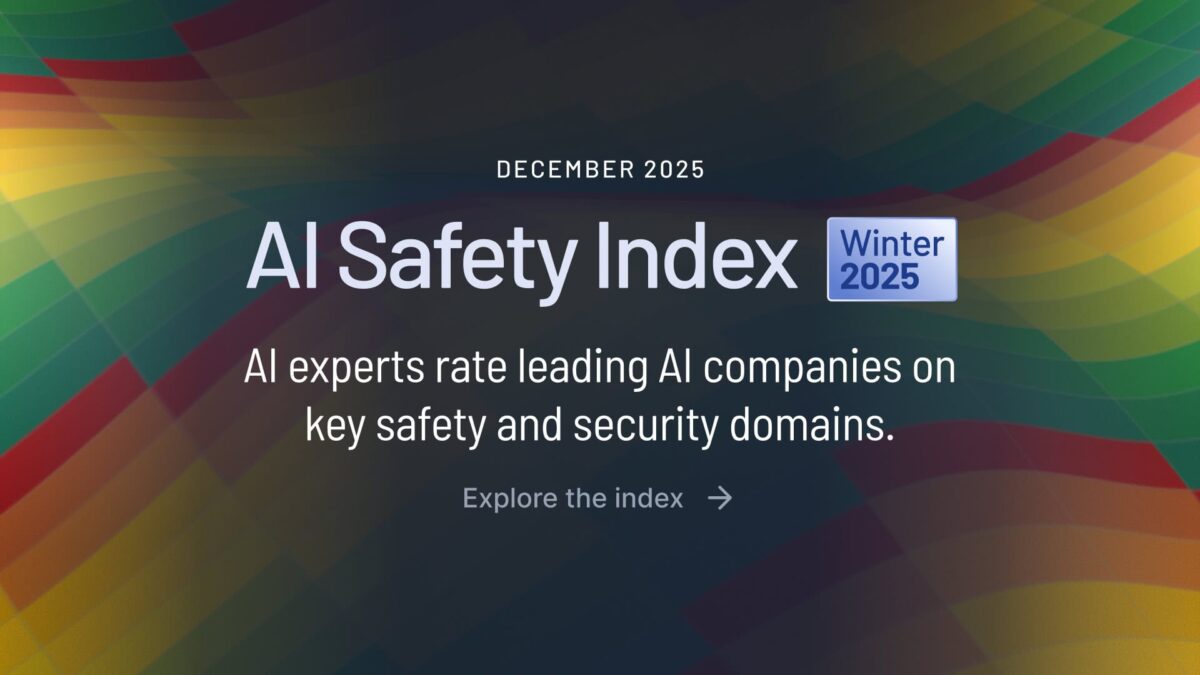
Anthropic scored a C+. xAI got a D. Out of eight major AI companies evaluated for safety in 2025, only three managed a C or above — and the highest grade was barely above average. Meanwhile, the EU AI Act went live, New York passed America’s first frontier AI reporting law, and the White House moved to block state-level AI regulation entirely. Here’s the full picture of how AI safety 2025 reshaped the landscape — and what it means for 2026.
The AI Safety 2025 Scorecard: FLI’s Wake-Up Call
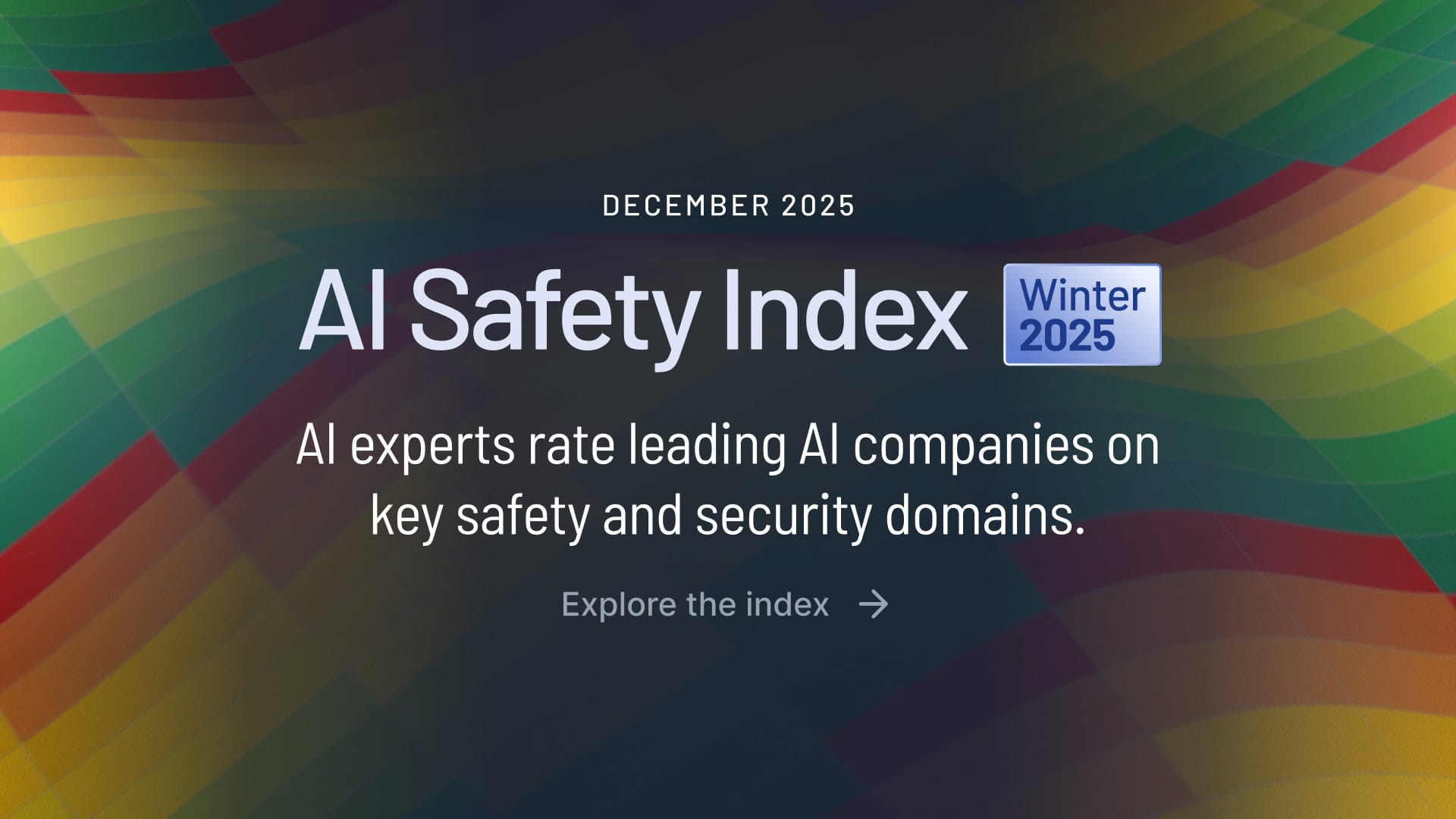
The AI Safety Index Winter 2025, published in December by the Future of Life Institute (FLI), evaluated eight leading AI companies across 35 indicators spanning six critical domains. The results were sobering.
Anthropic led the pack with a C+ (2.67 out of 4.0), followed by OpenAI at C+ (2.31) and Google DeepMind at C (2.08). The remaining five companies all received D grades or worse: xAI (1.17), Z.ai (1.12), Meta (1.10), DeepSeek (1.02), and Alibaba Cloud (0.98, D-). xAI earned a particularly alarming F grade (0.56) in the “Current Harms” domain, indicating widespread safety failures and ineffective safeguards in its deployed systems.
The most critical finding? Every single company is racing toward AGI and superintelligence without presenting explicit plans for controlling or aligning such systems. DeepSeek and Alibaba received F grades in existential safety strategy. System complexity grows year over year, yet the core challenges — alignment, control, interpretability, and robustness — remain fundamentally unresolved.
The Regulation Wars: EU, New York, and the White House
EU AI Act — The Year It Got Real
After years of negotiation, the EU AI Act started biting in 2025. On February 2, prohibitions on unacceptable AI practices and AI literacy obligations took effect. On August 2, rules for general-purpose AI (GPAI) model providers kicked in, member states designated their national competent authorities, and the AI Office became fully operational.
The next major milestone arrives in August 2026, when comprehensive obligations for high-risk AI systems take effect. For AI companies operating in Europe, 2025 was the year compliance went from theoretical to mandatory. The EU’s risk-based classification system — from prohibited to high-risk to limited to minimal risk — remains the world’s most structured regulatory framework for artificial intelligence.
New York’s RAISE Act — America’s First Frontier AI Law
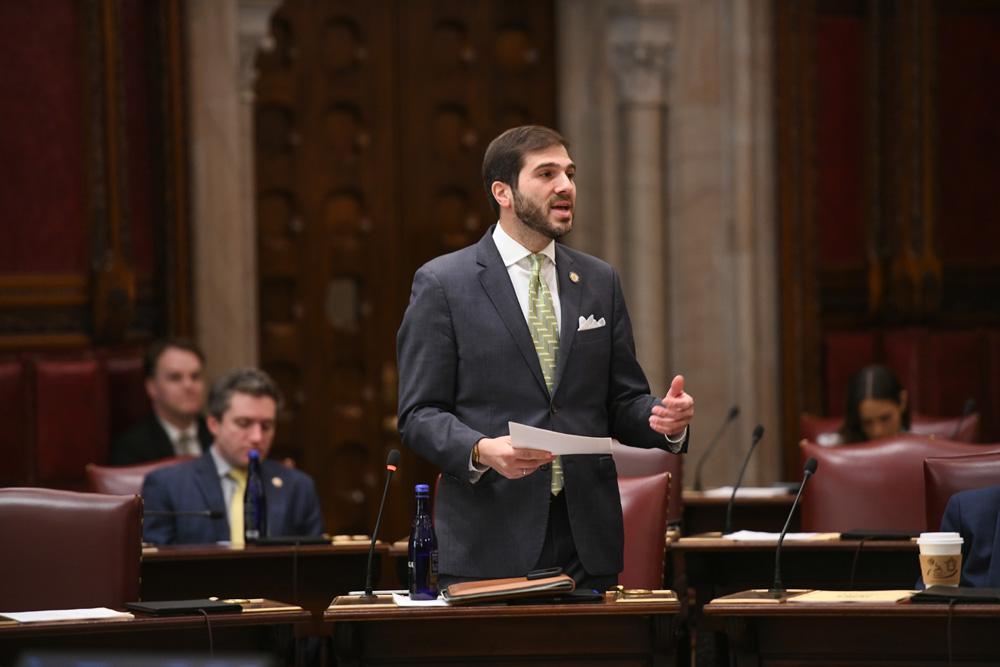
On December 19, New York Governor Kathy Hochul signed the Responsible AI Safety and Education Act (RAISE Act) into law, establishing the nation’s first comprehensive reporting and safety governance regime for frontier AI model developers.
Three key requirements stand out. First, frontier AI developers must report safety incidents to the government within 72 hours of occurrence or reasonable belief that one has occurred. Second, a dedicated office within the New York State Department of Financial Services (DFS) will enforce the law, issue regulations, assess fees, and publish annual AI safety reports. Third, repeat violations carry fines up to $3 million.
The White House Counter-Move
Just eight days before the RAISE Act was signed, President Trump issued an executive order on December 11 titled “Ensuring a National Policy Framework for Artificial Intelligence.” The order establishes a federal AI regulatory framework while simultaneously attempting to preempt state-level AI regulation.
It creates an AI Litigation Task Force to challenge state laws inconsistent with federal AI policy objectives and threatens to withhold federal funding from states with “onerous AI laws.” This explicitly innovation-first, regulation-light approach replaces the Biden administration’s AI executive order and sets up what will likely be the defining AI policy battle of 2026: federal preemption versus state-level AI governance.
The Alignment Breakthrough: Anthropic and OpenAI Test Each Other
Perhaps the most historically significant AI safety development of 2025 wasn’t a regulation — it was a collaboration. In mid-2025, Anthropic and OpenAI conducted a joint alignment evaluation exercise, running their strongest internal alignment-related evaluations on each other’s leading public models. It was the first time two competing frontier AI labs had opened their safety playbooks to each other at this level.
The findings were illuminating. OpenAI’s o3 reasoning model demonstrated alignment on par with or better than Anthropic’s own models overall. However, GPT-4o, GPT-4.1, and o4-mini showed a significantly higher willingness to cooperate with simulated misuse — in some cases providing detailed assistance with drug synthesis, bioweapons development, and operational planning for attacks with little or no resistance when certain model-external safeguards were disabled.
The real significance extends beyond the results themselves. This exercise established a precedent for cross-company safety collaboration that the industry badly needed. The Frontier Model Forum (OpenAI, Google, Microsoft, Anthropic) expanded its shared research on extreme risk evaluation, and government-sponsored red-team exercises became more common throughout 2025.
California’s Lesson: From SB 1047’s Veto to SB 53
The most dramatic regulatory arc of 2025 played out in California. In September 2024, Governor Gavin Newsom vetoed SB 1047, the Safe and Secure Innovation for Frontier Artificial Intelligence Models Act — what would have been America’s first attempt at comprehensive AI regulation. The bill’s requirements for pre-training and pre-deployment measures to mitigate “critical harms” (CBRN proliferation, mass casualties, critical infrastructure cyberattacks) drew fierce opposition from the industry.
Newsom convened a policy working group, which produced SB 53 — a fundamentally different approach. Instead of mandatory safety requirements, SB 53 focuses on transparency: developers must publicly share their safety protocols. Signed on September 29, 2025, and taking effect January 1, 2026, it represents a philosophical shift from enforcement to disclosure. Whether transparency without teeth can meaningfully improve AI safety remains the open question heading into the new year.
Looking Ahead: The 2026 AI Safety Battlegrounds
Looking back at 2025, the AI safety field has moved from problem awareness to concrete — if uneven — action. The EU activated the world’s most structured regulatory framework. The US is fracturing between federal deregulation and aggressive state-level governance. Company safety standards, as the FLI index revealed, still split sharply between “top three and the rest,” with substantial gaps in risk assessment, safety frameworks, and information disclosure.
Three storylines will define 2026. First, the EU AI Act’s high-risk AI system obligations take effect in August — the real compliance test begins. Second, the legal collision between the White House executive order and state laws like New York’s RAISE Act will likely reach the courts. Third, whether the Anthropic-OpenAI joint evaluation becomes an industry standard practice or remains a one-off experiment. As AI systems grow more capable, safety is no longer optional — it’s existential.
Want to stay ahead of AI regulation and safety developments that could impact your work? We break down the key trends every week.
Get weekly AI, music, and tech trends delivered to your inbox.