Claude Sonnet 4.5 Benchmark Deep Dive: 77.2% SWE-bench Crushes GPT-5 and Gemini
September 2, 2025
iPhone 17 Pro vs Samsung Galaxy S25 Ultra: Which Flagship Wins in Fall 2025?
September 2, 2025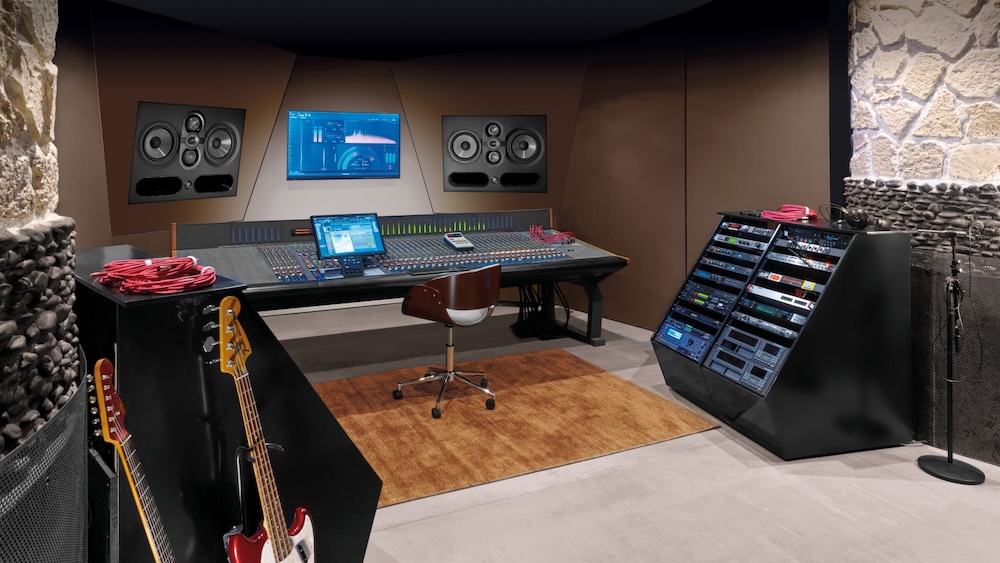
Forget the spec sheets for a moment — this year’s AES Convention is shaping up to be the most exciting pro audio showcase in nearly a decade. From a $30,000 Focal monitor that’s already turning heads at Abbey Road to an Austrian Audio mic that lets you choose your polar pattern after you’ve recorded, the AES 2025 studio gear lineup is genuinely pushing boundaries rather than just iterating on last year’s models.
After 28 years in professional audio production, I can usually spot the gear that will actually change workflows versus the products that look impressive in press releases but collect dust in studios. Here are seven products heading to the AES 2025 show floor that belong firmly in the first category.
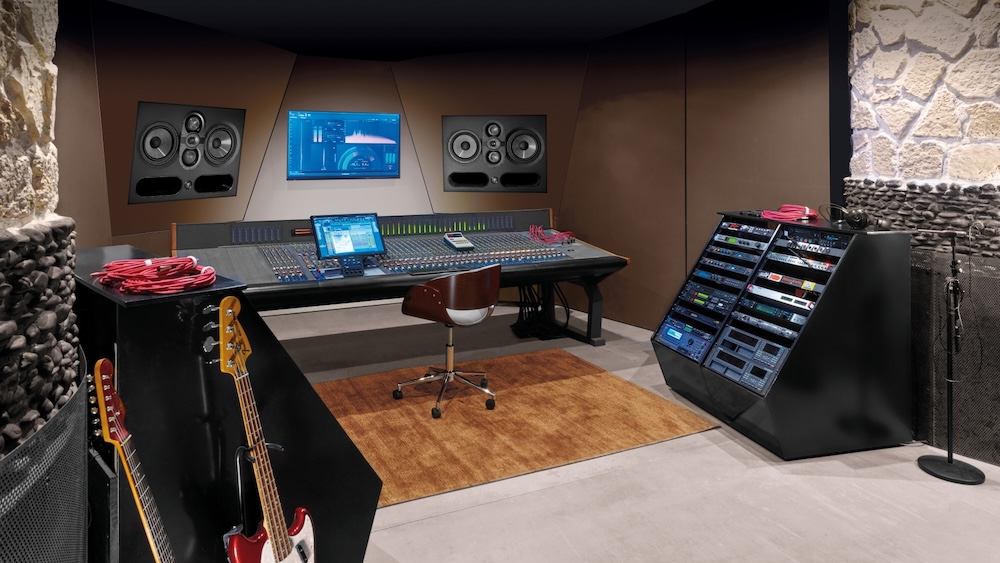
Focal Utopia Main 112: The $29,999 Monitor Rewriting Main Monitoring Standards
When Focal unveiled the Utopia Main 112 at NAMM earlier this year, the pro audio world collectively held its breath. At $29,999 per pair, this isn’t impulse-buy territory — but for studios investing in their monitoring chain, the UM 112 represents a genuine leap in main monitor design.
The three-way design pairs a 13-inch W-cone woofer with a 5-inch M-shaped midrange driver and Focal’s signature 1.5-inch beryllium tweeter. What makes this combination special is Focal’s TMD (Tuned Mass Damper) technology, now integrated into the high-frequency driver for the first time. The result? Total Harmonic Distortion at 3kHz is cut in half compared to previous designs.
The amplification deserves attention too. Focal engineered a Class H design with current-mode amplification — a combination that delivers the transparency of Class A/B with the efficiency needed for sustained high-SPL monitoring at 120dB. The frequency response stretches from 28Hz to 40kHz at -3dB, meaning you’re hearing everything from sub-bass fundamentals to the airiest harmonics your source material contains.
Having worked with Focal monitors across multiple studio builds, I can say their engineering team consistently prioritizes transient accuracy over flattery. The Utopia Main series appears to take that philosophy to its logical extreme — a monitor designed for soffit mounting in world-class facilities that need zero compromises in their monitoring chain.
EVE Audio EXO Series: Berlin Engineering Meets Accessible Pricing
If Focal’s Utopia Main is the aspirational dream, EVE Audio’s EXO Series is the practical reality that most producers and engineers will actually put in their rooms. The Berlin-based manufacturer launched four models — EXO 24, EXO 25, EXO 27, and EXO 28 — each built around a newly developed Precision Air Motion Transformer (AMT) tweeter.
The AMT tweeter is the star here. Made from ultra-light polyamide, it delivers the fast transient response and extended high-frequency detail that ribbon-adjacent designs are known for, but with significantly higher output capability. Paired with EVE’s Guided Directivity Control (GDC) waveguide, the sweet spot is wider and more stable than most nearfield monitors in this class — critical for collaborative sessions where not everyone is sitting dead center.
The EXO 27 (6.5-inch woofer, 116dB SPL) hits the sweet spot for most project and mid-size studios. Its Coated Aluminium (CAL) woofer handles the low end with authority while the rear-panel OLED display and SMART-knob system makes room calibration genuinely intuitive. Add in 192kHz/24-bit S/PDIF I/O and an Ethernet port for firmware updates, and you’ve got a monitor that’s ready for modern production workflows.
At the AES 2025 studio gear showcase, the EXO series is expected to draw significant attention from engineers looking to upgrade their nearfield monitoring without breaking into five-figure territory.
Austrian Audio OC-S10: The Dual-Output Mic That Records the Future
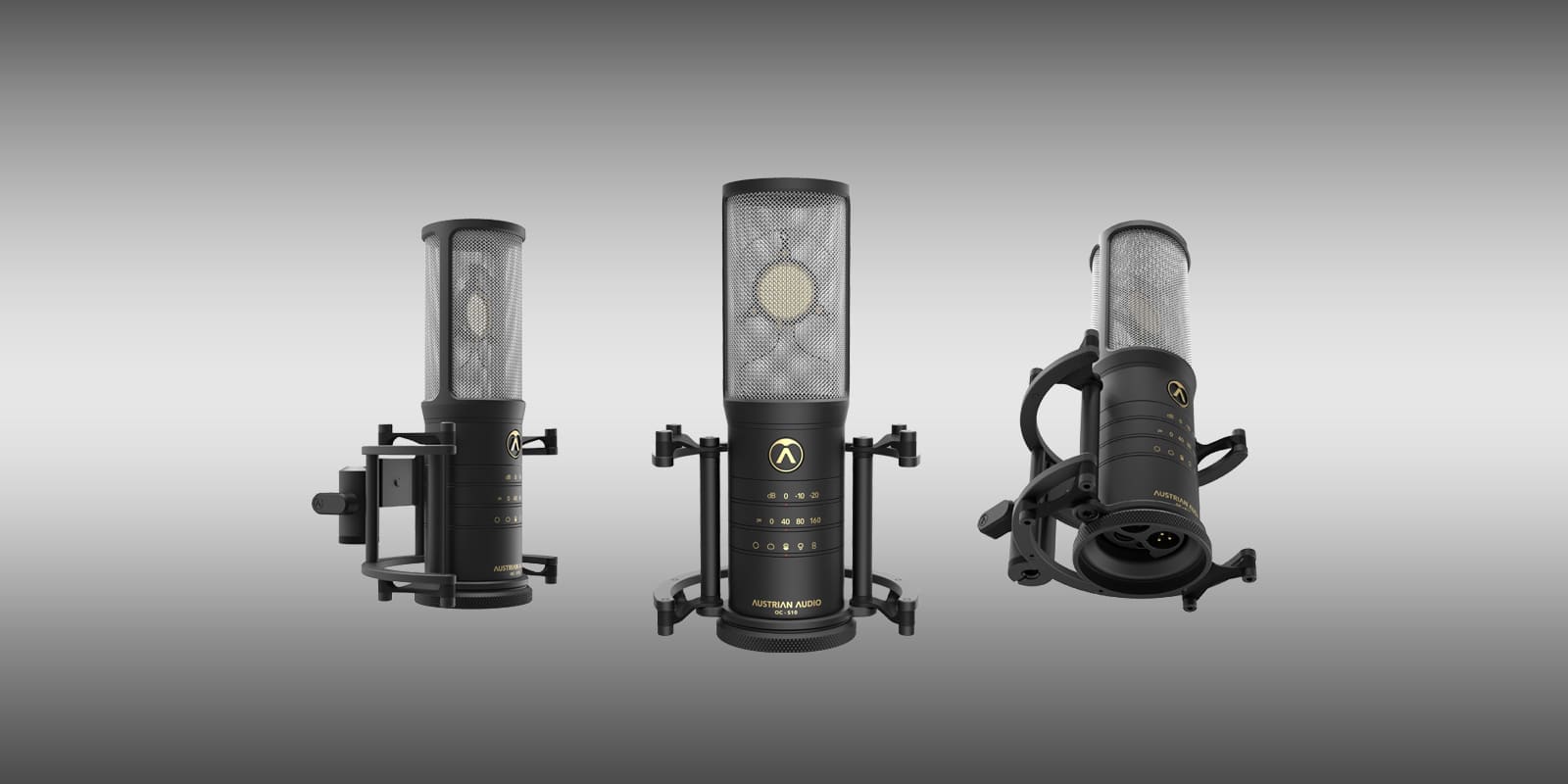
Austrian Audio has been on an absolute tear since their founding by ex-AKG engineers, and the OC-S10 might be their most ambitious product yet. At $2,999, this large-diaphragm condenser doesn’t just capture sound — it captures options.
The headline feature is dual-output recording. The OC-S10 sends two separate signals simultaneously, allowing you to mix between omnidirectional and figure-8 patterns in post-production. Think about that for a moment: you can record a vocalist, a room, or an instrument once, and then dial in exactly the right polar pattern balance after the session. For engineers who’ve ever wished they’d used a different pattern mid-session, this is transformative.
The CKR12 capsule uses Austrian Audio’s Open Acoustics Technology — a free-floating design that minimizes mechanical interference with the diaphragm. Five selectable polar patterns (omni, wide cardioid, cardioid, hypercardioid, figure-8) are accessible through the mic’s rotating housing sections, alongside a three-position pad (0/-10/-20dB) and variable high-pass filter (off/40/80/160Hz).
With a native 147dB maximum SPL before engaging the pad, this mic handles everything from whispered vocals to cranked guitar cabinets without breaking a sweat. Austrian Audio also includes a ball-joint shockmount and a magnetic pop filter — details that show they understand how microphones actually get used in sessions.
Sony ECM-100N and ECM-1000N: Pencil Condensers for the Broadcast-Meets-Music World
Sony’s new pencil condenser pair — the ECM-100N (omnidirectional) and ECM-1000N (cardioid) — targets a fascinating niche at the intersection of broadcast and music production. These small-diaphragm condensers feature exceptionally extended high-frequency response, originally designed for broadcast applications where slow-motion video playback requires audio that can be time-stretched without losing upper harmonic detail.
But here’s where it gets interesting for music production: that same extended HF response makes these pencil mics exceptional for capturing acoustic instruments, drum overheads, and room ambience where upper harmonics and air are essential to the character of the recording. At the AES 2025 convention, Sony is positioning these as crossover tools that bridge the broadcast and music production worlds — a smart move as more studios handle both music and content creation workflows.
Neumann KH Subwoofer Expansion: Five New Models Down to 16Hz
Neumann’s KH subwoofer expansion is arguably the most significant low-frequency monitoring announcement of 2025. Five new DSP-powered models — the KH 805 II, KH 810 II, KH 870 II, plus AES67-enabled variants of the 810 and 870 — deliver monitoring capabilities that were previously reserved for custom installations.
All five models reach down to 16Hz with an 80Hz crossover point, running 32-bit DSP processing internally. The KH 805 II builds on the KH 750 DSP’s success with approximately double the output for stereo configurations. The KH 810 II adds multichannel bass management supporting systems up to 7.1.4 — essential for Dolby Atmos and immersive audio production. The KH 870 II doubles the 810’s output for large rooms and pairs with Neumann’s flagship KH 420 monitors.
The AES67 variants support 12 input channels with full ST 2110/ST 2022-7 compliance, RAVENNA, NMOS, and Dante-generated streams. For studios building or upgrading immersive audio rooms, these subwoofers represent the kind of future-proof infrastructure investment that pays dividends across format changes.
AudioScape AS-2A: Handcrafted LA-2A Heritage Meets Modern Studio Needs
In an era of plugin emulations and digital recreations, the AudioScape AS-2A stands as a testament to the enduring demand for the real thing. Built by hand in Daytona, Florida by Chris Yetter, this optical compressor recreates the legendary Teletronix LA-2A Leveling Amplifier with a level of detail that borders on obsessive.
The AS-2A uses a custom-built T4B opto-attenuator designed exactly to the original Jim Lawrence specification, NOS (New Old Stock) tubes, and iron-core transformers that contribute to the warm, musical compression character that made the original LA-2A a studio standard. The unit features the original hinged front-panel design — the only modern 2A recreation to include this detail — plus a modern addition: a front-panel high-frequency control for the limiter response.
The limited edition Shadow Black variant adds a dual-cell configuration, switchable between a classic “slow” T4B and a separate faster opto-attenuator, plus true bypass. For vocal tracking, bass guitar, and any source that benefits from that silky optical compression character, the AS-2A delivers the real analog experience that no plugin can fully replicate.
Sanken CUP-X1: Disappearing Act for Live and Studio Applications
Sanken’s CUP-X1 takes a different approach to microphone design entirely. This compact cardioid features a rectangular capsule design that makes it practically invisible in stage applications while maintaining the sonic integrity Sanken is known for. The CUP-X1 is purpose-built for discrete placement — think theater, broadcast sets, and live performance situations where visual clutter needs to be eliminated without compromising audio quality.
While it may not be the flashiest AES 2025 studio gear announcement, the CUP-X1 represents the kind of specialized engineering that solves real production problems. For audio engineers working in theater, film, and live broadcast, this mic addresses a gap that’s existed in the market for years.
What the AES 2025 Studio Gear Lineup Tells Us About Pro Audio’s Direction
Looking across these seven products, three clear trends emerge in the AES 2025 studio gear landscape. First, the monitoring world is splitting into ultra-premium reference systems (Focal Utopia Main) and accessible high-performance nearfields (EVE Audio EXO) — the middle ground is disappearing. Second, microphone design is increasingly about post-production flexibility rather than fixed characteristics, with Austrian Audio’s dual-output OC-S10 leading this shift. Third, AES67 and audio-over-IP connectivity is becoming standard infrastructure rather than a premium add-on, as Neumann’s subwoofer lineup demonstrates.
For engineers and producers planning studio upgrades this fall, these products represent the current state of the art across their respective categories. The AES Convention in October will offer hands-on demos of most of these products — and based on the engineering behind them, several are likely to become the new reference points in their categories for years to come.
Planning a studio monitoring upgrade or looking for expert guidance on gear selection for your production workflow? Sean Kim brings 28+ years of professional audio experience to every consultation.
Get weekly AI, music, and tech trends delivered to your inbox.