NVIDIA RTX 5060 Launch Preview: $299 Blackwell GPU Specs, Benchmarks, and the 8GB VRAM Debate
May 6, 2025
7 Ableton Live 12 Performance Mode Tips That Will Transform Your Live Shows
May 7, 2025
Microsoft is about to drop the biggest upgrade to Copilot Studio since its launch — and if the leaks are accurate, it will fundamentally change how enterprises build and deploy AI agents. Microsoft Build 2025 Copilot Studio announcements, scheduled for May 19-22 in Seattle, are shaping up to be the most consequential developer conference of the year. Here is everything we know so far.

Satya Nadella’s keynote is expected to center on what insiders are calling the “open agentic web” — a vision where AI agents don’t just respond to prompts but actively interact, make decisions, and perform tasks autonomously across organizational boundaries. Based on early documentation, developer previews, and sources close to the Build program, here are the five features that will matter most.
1. Multi-Agent Orchestration: Microsoft Build 2025 Copilot Studio’s Headline Feature
The most anticipated announcement is multi-agent orchestration — a framework that will reportedly allow agents from Copilot Studio, Microsoft 365, Azure AI Agents Service, and Fabric to delegate tasks to each other and share results in real time. Think of it as a team of specialized AI workers that can collaborate without human intervention at every step.
What makes this particularly significant is the expected support for Google’s Agent2Agent (A2A) protocol. This means Microsoft isn’t building a walled garden — Copilot Studio agents will reportedly be able to communicate with third-party agents from other platforms. The A2A protocol provides a standardized way for agents to discover each other’s capabilities, negotiate task delegation, and exchange results securely.
For enterprise teams, this changes the calculus entirely. Instead of building one monolithic agent that tries to do everything, you’ll be able to compose specialized agents — a finance agent, a compliance agent, a customer service agent — and have them collaborate on complex workflows that span departments.
2. Computer Use for Agents: Bridging the Legacy Software Gap
Perhaps the most eye-catching rumored feature is “computer use” — the ability for agents to interact with desktop applications and websites by clicking buttons, navigating menus, and typing into fields. Early reports suggest this will be available through the M365 Copilot Frontier program for organizations processing 500,000 or more messages.
This is Microsoft’s answer to a real-world problem that has plagued enterprise AI adoption: legacy software. Most large organizations run critical processes on applications that have no API, no webhook support, and no integration pathway. Computer use essentially gives agents the ability to operate these applications the same way a human would — through the GUI.
Imagine an agent that can log into your ERP system, navigate to the correct screen, pull a report, and feed that data into an analysis pipeline — all without anyone writing a custom integration. That’s the promise, and if Microsoft delivers, it eliminates one of the biggest blockers in enterprise automation.
3. Code Interpreter: Python-Powered Logic Inside Copilot Studio
Sources indicate that Microsoft Build 2025 will unveil a code interpreter preview for Copilot Studio — bringing Python execution directly into agent workflows. This is expected to come in two modes: a dynamic mode that runs code at runtime, and a static mode that integrates with Prompt Builder at design time.
The practical applications are immediately compelling. Agents will reportedly be able to analyze CSV and Excel files, generate charts and visualizations, perform complex mathematical calculations, and execute data transformations — all within the low-code Copilot Studio environment. For organizations that have business analysts who aren’t developers but need sophisticated data processing, this bridges a critical gap.
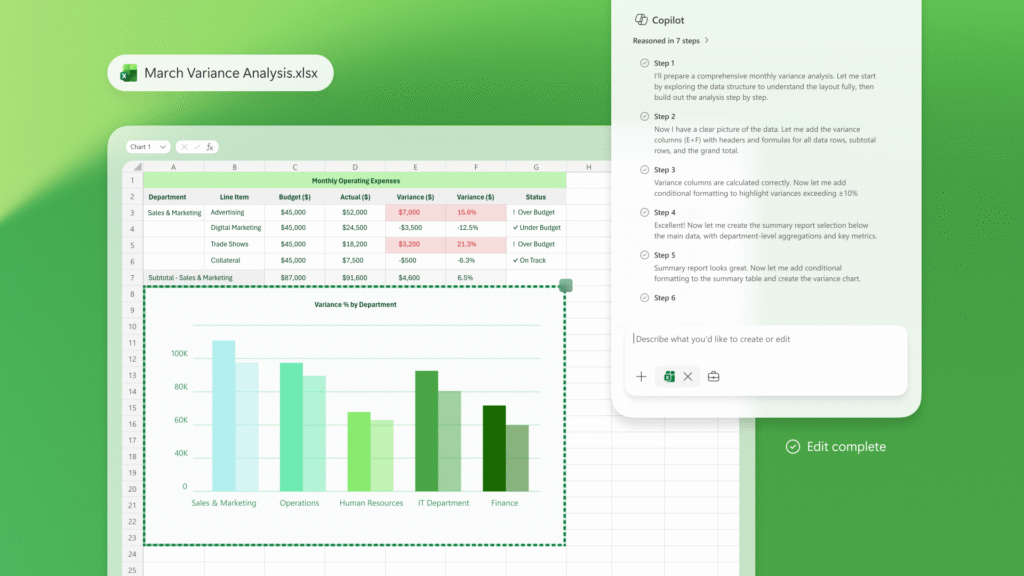
What’s particularly interesting is how this positions Copilot Studio against dedicated data analysis tools. With code interpreter, an agent could receive a spreadsheet from a customer, clean the data, run statistical analysis, generate a visualization, and email the results — all as a single automated workflow.
4. MCP General Availability with 65+ Enterprise Connectors
The Model Context Protocol (MCP) is expected to move from preview to general availability at Build 2025, accompanied by a massive expansion of enterprise connectors. Early documentation references over 65 connectors for platforms like Gong, PagerDuty, and Unily, plus access to more than 11,000 models through Azure AI Foundry with fine-tuning capabilities.
MCP is the glue that makes everything else work. It provides a standardized protocol for giving AI agents access to external data and tools — essentially letting agents “see” and “interact with” enterprise systems in a consistent way. With 65+ connectors at GA, Microsoft is signaling that Copilot Studio isn’t a toy for simple chatbots anymore. It’s infrastructure for enterprise-grade autonomous workflows.
The Azure AI Foundry integration is equally significant. Access to 11,000+ models means organizations can match the right model to the right task — using smaller, cheaper models for simple classification and routing, and reserving larger models for complex reasoning. Fine-tuning support means these models can be adapted to domain-specific language and processes.
5. Agent Store and Discovery: The App Store Moment for Enterprise AI
The final major expected announcement is the Agent Store — a centralized marketplace within M365 Copilot Chat where organizations can discover, deploy, and manage agents. Reports suggest it will include in-conversation agent recommendations, shareable links, and new deployment channels including SharePoint and WhatsApp.
This is Microsoft’s play to create network effects around Copilot Studio. When it’s easy to discover and deploy agents, adoption accelerates. When agents can be shared via link or embedded in SharePoint sites, the friction drops to near zero. And the WhatsApp channel opens up customer-facing use cases in regions where WhatsApp dominates business communication.
The Agent Store also points to a future where third-party developers and ISVs build and sell specialized agents through Microsoft’s ecosystem — similar to how the Salesforce AppExchange created a multi-billion dollar market for CRM extensions.
Early Enterprise Results Signal Real Impact
What makes these announcements credible isn’t just the feature list — it’s the early enterprise results that have been leaking ahead of Build. According to Microsoft’s own documentation, Pets at Home — a major UK pet retailer — has reportedly achieved seven-figure annual savings through profit protection automation using Copilot Studio’s autonomous agent capabilities.
McKinsey & Company, not exactly a company that adopts technology casually, is said to have reduced client onboarding lead time by 90% and cut administrative work by 30% using these tools. Thomson Reuters reportedly slashed legal due diligence workflow steps by more than 50%. These aren’t pilot programs or proof-of-concepts — these are production deployments at some of the world’s most demanding organizations.
Security and Governance: The Enterprise Trust Layer
Microsoft is also expected to address the elephant in the room: security. Autonomous agents that can make decisions and take actions independently need robust governance. Build 2025 previews are expected to include Data Security Posture Management (DSPM) for AI, network isolation capabilities, federated identity credentials for agents, DLP policies that extend to agent actions, and automated Entra agent identities.
This security-first approach is essential. Without it, no CISO at a Fortune 500 company would approve autonomous agent deployment. By building governance directly into the platform rather than offering it as an afterthought, Microsoft is removing the final objection that has kept many enterprises on the sidelines.
Sean’s Take: Why This Is Microsoft’s Most Important Build in Years
I’ve been tracking the AI agent space closely for the past two years, and I can tell you that what Microsoft is expected to announce at Build 2025 represents a genuine inflection point. The combination of multi-agent orchestration, A2A protocol support, and MCP general availability isn’t just a product update — it’s the foundation for a new computing paradigm.
Here’s what I find most strategically interesting: Microsoft is betting on openness. The A2A protocol support means they’re not trying to lock customers into a Microsoft-only agent ecosystem. MCP general availability means they’re embracing a standard that originated outside of Microsoft. This is a calculated move — by being the most interoperable platform, they become the default platform. It’s the same playbook that made Azure the enterprise cloud leader: don’t fight open source, embrace it.
From a practical standpoint, I’m most excited about the computer use capability. In my work building automation pipelines, the single biggest time sink is dealing with legacy systems that have no API. If agents can reliably interact with GUI applications, it unlocks automation for the vast majority of enterprise processes that are currently stuck in manual-only territory. The key word is “reliably” — the demos will look impressive at Build, but the real test is whether it works consistently at scale with messy, real-world enterprise applications.
One concern: the Frontier program requirement for computer use (500K+ messages) means this feature will initially be limited to Microsoft’s largest customers. For mid-market organizations, the full autonomous agent vision may still be a year or more away. Still, the direction is clear, and organizations should be planning their agent strategies now — not waiting until these features are generally available.
What This Means for the Enterprise AI Landscape
Microsoft Build 2025 is shaping up to be the conference where enterprise AI stops being about chatbots and starts being about autonomous systems. The five features we’ve outlined — multi-agent orchestration, computer use, code interpreter, MCP GA, and the Agent Store — collectively form a platform that can handle complex, multi-step business processes with minimal human oversight.
For developers and IT leaders, the action item is clear: start evaluating your workflows for agent automation now. Identify the processes that are high-volume, rule-based, and currently require humans to bridge between systems. Those are the workflows that will see the biggest ROI from what Microsoft is about to unveil at Build 2025.
Building AI agent workflows or planning enterprise automation? Let’s talk strategy.
Get weekly AI, music, and tech trends delivered to your inbox.