Razer Blade 16 RTX 5080 Review: $1,000 Cheaper Than the 5090 — But How Much Performance Do You Actually Lose?
May 19, 2025
Music Production CPU Benchmark 2025: M4 Max vs i9-14900K vs Ryzen 9 7950X — Which Chip Handles 200+ Plugins?
May 20, 2025
A $500-per-month AI developer just became $20. I waited six weeks before writing this Devin AI review for a reason — first impressions of AI tools are almost always wrong. But after watching Cognition slash prices by 96%, ship a completely revamped feature set, and grow ARR from $1M to $73M in nine months, the question isn’t whether Devin works. It’s whether it works well enough.

What Is Devin 2.0? The Ambitious Relaunch of AI’s First Software Engineer
When Cognition AI unveiled Devin in March 2024, the pitch was audacious: the world’s first fully autonomous AI software engineer. Not a code completion tool. Not an inline suggestion engine. A digital teammate that could plan, write, test, and debug entire tasks independently.
Founded in August 2023 by Scott Wu, Steven Hao, and Walden Yan, Cognition went from early access to general availability in December 2024 at $500 per month. No seat limits, Slack integration, IDE extensions, and full API access — but the price tag kept it firmly in enterprise territory.
Then on April 3, 2025, everything changed. Devin 2.0 launched with three seismic shifts: a Core plan at $20/month with pay-as-you-go Agent Compute Units (ACUs) at $2.25 each, 83% more tasks completed per ACU compared to version 1.x, and a suite of new features that fundamentally rethink how developers interact with an AI agent.
Devin AI Review: Pricing Breakdown — Is $20/Month the Real Cost?
Let’s be clear about what you’re actually paying. As VentureBeat reported, the 96% price reduction is real but comes with nuance.
- Core Plan: $20/month base + $2.25 per ACU (pay-as-you-go). Target audience: individual developers and small teams.
- Team Plan: $500/month including 250 ACUs, with API access. For established development teams.
- Enterprise Plan: Custom pricing with VPC deployment, custom-trained Devins, and dedicated support.
TechCrunch highlighted the pay-as-you-go model as the key democratization play. But here’s the reality check: ACUs add up fast. A complex debugging session might burn through multiple ACUs, and even straightforward code modifications consume compute. Your actual monthly bill could easily exceed $100-200 with moderate usage. The $20 headline is your entry ticket, not your final bill.
Real-World Performance — Marketing Claims vs. Independent Testing
This is where any honest Devin AI review must separate signal from noise. Cognition’s own 2025 performance review paints a rosy picture, while independent testers tell a more complicated story.
Cognition’s official numbers:
- 4x faster problem-solving compared to the initial launch
- 2x more efficient resource consumption
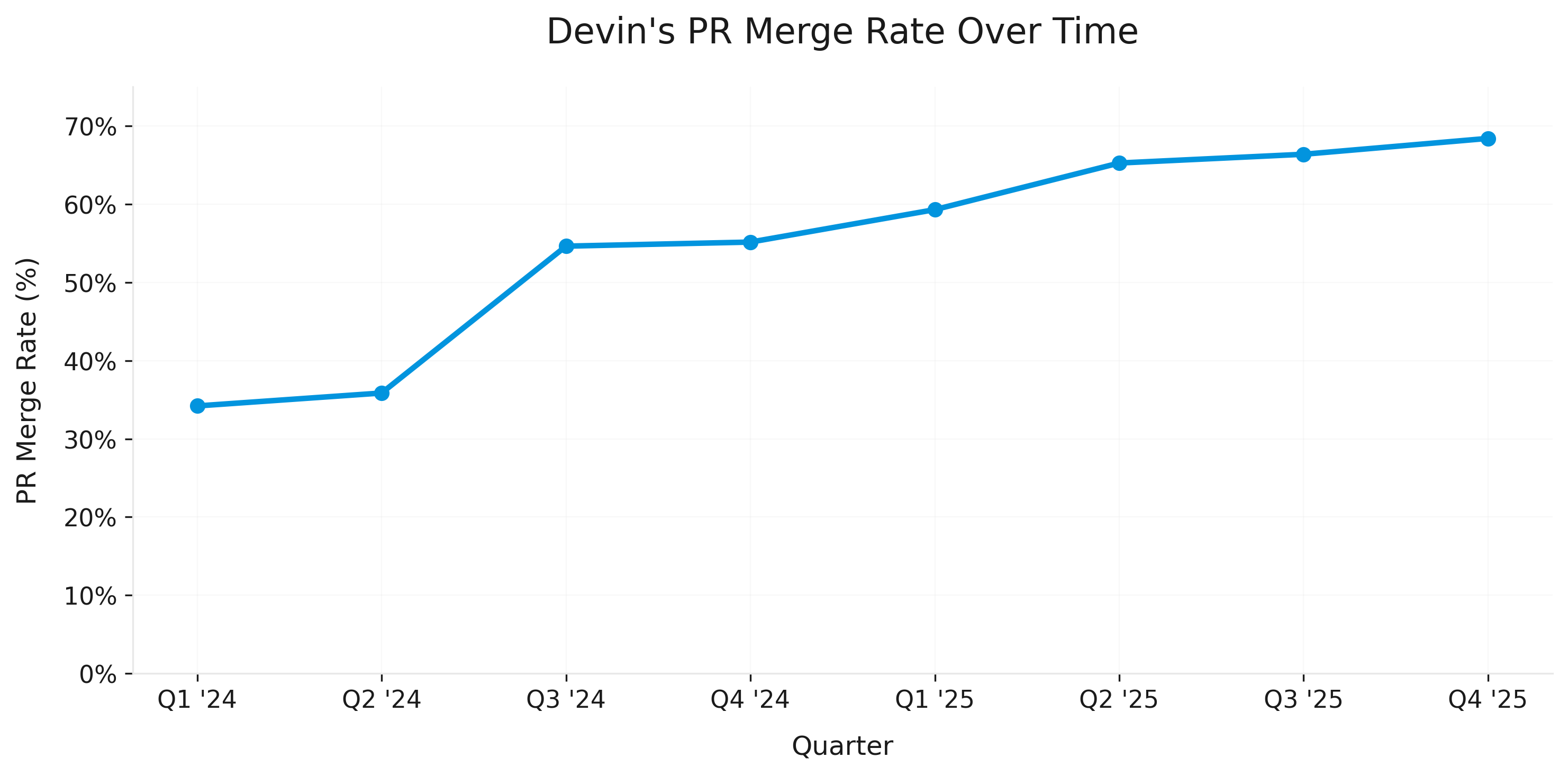
- PR merge rate jumped to 67% (up from 34% at launch)
- Sweet spot: tasks that would take a junior engineer 4-8 hours
- Saved 5-10% of developer time on security fixes at one large organization
Independent test results (the reality check):
- SWE-bench resolution rate: 13.86% (79 out of 570 issues resolved end-to-end)
- Complex task solo completion rate: approximately 15%
- In one independent study, only 3 out of 20 assigned tasks were completed successfully
- Strong at web scraping and API integrations — struggles with complex recursive functions and ambiguous requirements
As The Register reported, early reviews of Devin were mixed-to-negative, with significant gaps between marketing claims and actual performance. The 2.0 update has improved things, but the fundamental limitation remains: Devin excels at well-defined, bounded tasks and falters when requirements are vague or context-dependent.
Devin 2.0’s New Features: From Autonomous to Collaborative
The most significant strategic shift in 2.0 isn’t a feature — it’s a philosophy change. According to SiliconANGLE, Cognition pivoted from “AI does everything alone” to “AI works alongside developers.” This is arguably the smartest move they’ve made.
Interactive Planning is the headline feature. Before executing anything, Devin now researches your codebase, creates a detailed step-by-step plan, and presents it for your review. You can modify, approve, or reject the plan before a single line of code gets written. This directly addresses the biggest complaint from version 1.x: Devin would go off on tangents and produce unreviewed code that missed the mark entirely.
Devin Search transforms codebase exploration. Instead of simple text search, it functions as an agentic Q&A system with cited code references. Ask “where is the authentication middleware defined and what does it depend on?” and you get answers grounded in actual code, not hallucinated responses.
Devin Wiki auto-generates documentation for your codebase. For teams drowning in undocumented legacy code, this could be genuinely useful — though auto-generated docs are only as good as the code they describe.
Agent-Native IDE provides a cloud-hosted development environment where you can run multiple Devin instances in parallel. No local setup required, everything runs in the browser, and you can juggle multiple tasks simultaneously.
Competitive Landscape: Devin vs. Copilot vs. Cursor
The AI coding tool market now operates on three distinct levels, and understanding where Devin fits requires understanding what it’s not.
- GitHub Copilot ($10/month, 20M+ users): The market leader in inline code suggestions. Mature, reliable, deeply integrated into existing workflows. It’s a co-pilot — it helps you write code faster.
- Cursor (VS Code fork with native AI): A developer-first IDE with deeply integrated AI capabilities. Composer handles multi-file refactoring naturally. It enhances your coding environment rather than replacing it.
- Devin ($20+/month): A fully autonomous agent. It doesn’t suggest code — it plans, writes, tests, and submits entire implementations. The fundamental paradigm is task delegation, not inline assistance.
Copilot and Cursor are “coding with AI” tools. Devin aims to be a “coding by AI” tool. This distinction matters enormously for use case selection. For boilerplate generation, clear-spec API integrations, and repetitive migrations, Devin’s autonomous approach can save real time. For anything requiring architectural judgment, nuanced business logic, or team convention awareness, the human-in-the-loop tools still win.
My Take: What 28 Years in Tech Taught Me About AI Coding Agents
I use AI coding tools every single day. My blog pipeline, Telegram bot integration, WordPress automation — all built with Claude Code as a constant collaborator. So I’m not skeptical about AI-assisted development. I’m skeptical about AI-autonomous development, and there’s a critical difference.
Devin’s biggest challenge is the “autonomy” promise itself. To hand off a 4-8 hour task to an AI agent, your requirements need to be mathematically precise. How often does that happen in real-world development? Most coding work is tangled up in ambiguous specs, implicit legacy code rules, and team conventions that live in people’s heads, not in documentation. A 67% PR merge rate sounds impressive until you account for the time spent reviewing and fixing the other 33%.
That said, the 2.0 direction change is fundamentally right. Adding Interactive Planning is Cognition admitting that full autonomy isn’t realistic yet — and that honesty is refreshing. The pivot from “AI replaces you” to “AI plans, you approve, AI executes” is humble but wise. And the numbers speak: ARR growth from $1M in September 2024 to $73M by June 2025 tells you the market wants this, even in its imperfect state.
If I were deploying Devin on my team, I’d assign it the boring-but-clear work: API integrations with well-documented endpoints, boilerplate CRUD operations, simple data migrations, automated test scaffolding. The kind of work that eats up junior developer hours but doesn’t require senior judgment. Architecture decisions, business logic design, and anything involving trade-offs? Still human territory. The real value of AI coding agents isn’t replacing developers — it’s freeing developers to focus on problems that actually require human intelligence.
Bottom line: Devin 2.0 represents a meaningful evolution from hype to utility. The $20 entry point makes experimentation accessible, Interactive Planning builds trust, and the performance improvements are real. But the 13.86% SWE-bench resolution rate, the ACU cost accumulation, and the still-limited autonomous completion rate demand honest assessment. Think of Devin not as a junior developer replacement, but as a senior developer’s productivity multiplier — and you’ll set expectations correctly.
Need help building AI-powered automation systems or integrating coding agents into your workflow?
Get weekly AI, music, and tech trends delivered to your inbox.