Best Budget Laptops July 2025: Under $600 Picks for Students and Work
July 9, 2025
Plugin Alliance Mega Bundle Summer Sale: 200+ Plugins at $14.99/Month — Is the Subscription Actually Worth It?
July 10, 2025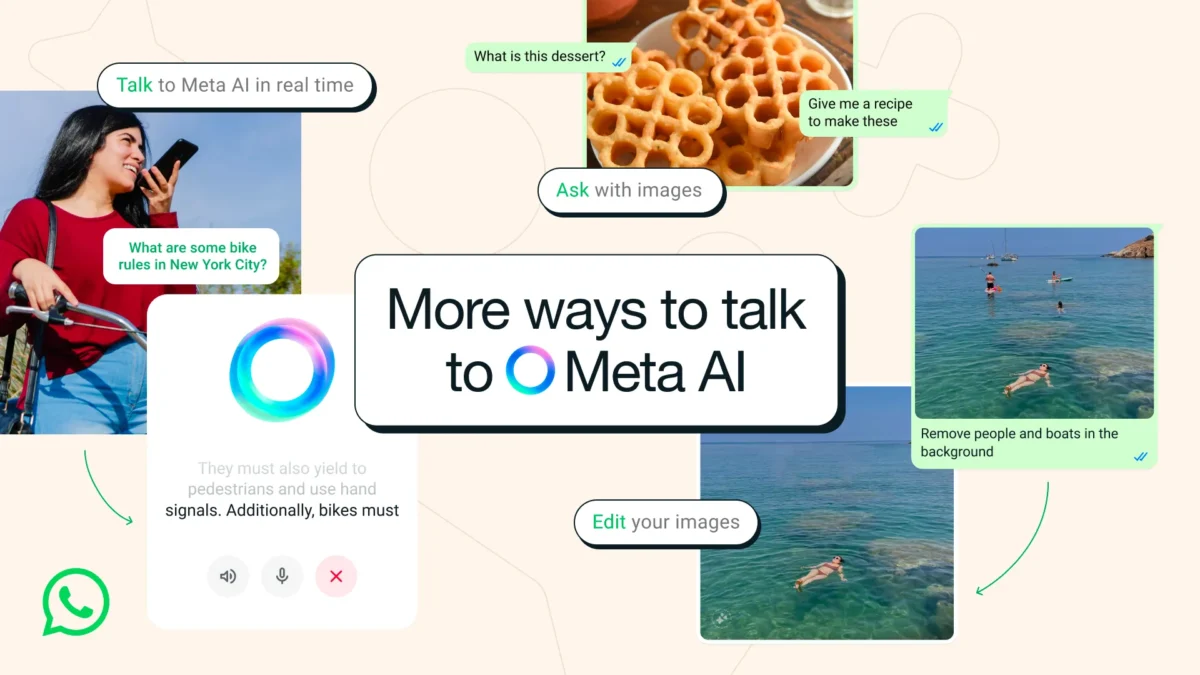
630 million people used Meta AI WhatsApp integration to ask an AI assistant a question last month. Not on a dedicated chatbot app, not through a browser — inside the same green-icon messenger they use to text their family. Meta AI crossed 1 billion monthly active users in early 2025, and WhatsApp accounts for 63% of that engagement. By July 2025, this isn’t a beta experiment anymore — it’s the largest AI deployment most people have never consciously thought about.
Meta AI WhatsApp Growth: From Zero to a Billion in Under Two Years
Let’s put the numbers in perspective. Meta AI launched as a WhatsApp integration in late 2023. By September 2024, it had roughly 500 million monthly active users across all Meta platforms. By early 2025, that number doubled to 1 billion — the fastest growth trajectory for any AI assistant platform in history. For context, ChatGPT took over a year to reach 200 million monthly users. Meta AI did five times that in a comparable window.
The secret isn’t technological superiority. It’s distribution. WhatsApp has over 3 billion monthly active users globally. Meta didn’t need to convince people to download a new app or create a new account. The AI simply appeared inside a messenger people already open 23 times a day on average. That frictionless entry point is something no standalone AI company can replicate.
Currently, 40 million users interact with Meta AI daily on WhatsApp alone. The platform has rolled out to over 40 countries, with English-language markets seeing the deepest adoption. India, Brazil, and Indonesia — WhatsApp’s three largest markets — are driving massive volume, though feature availability still varies by region.
AI-Powered Message Summaries: The Feature Nobody Expected to Need
On June 25, 2025, Meta announced AI-powered message summaries for WhatsApp, and it’s already rolling out in English across the United States with global expansion underway this July. The concept is straightforward: when you open a group chat with 50+ unread messages, Meta AI generates a concise summary of what you missed.
Anyone who’s been in an active WhatsApp group knows the pain. You mute a family group for eight hours, come back to 200 messages, and spend ten minutes scrolling to figure out whether anything important happened (it usually didn’t). Meta AI’s summary feature condenses that into two or three bullet points: who said what matters, what decisions were made, what needs your attention.
What makes this feature technically interesting is how it handles privacy. Unlike most cloud-based AI features, WhatsApp message summaries use what Meta calls “Private Processing” — a framework designed to analyze encrypted messages without exposing their content to Meta’s servers in a readable form. The summaries are generated within an encrypted environment, and Meta claims it cannot access the underlying message content. Whether this satisfies privacy advocates remains to be seen, but the architectural approach is significantly more cautious than what most competitors offer.
Llama 4 Under the Hood: Why Meta AI WhatsApp Feels Different Now
If you used Meta AI on WhatsApp six months ago and tried it again recently, you probably noticed it got noticeably smarter. That’s because Meta quietly upgraded the underlying model. Llama 4, announced in April 2025, represents a fundamental architecture shift from Meta’s previous language models.
The Llama 4 family includes three models: Scout, Maverick, and the still-in-preview Behemoth. Scout features a staggering 10 million token context window — roughly 15,000 pages of text — while Maverick handles up to 1 million tokens. Both use a Mixture of Experts (MoE) architecture, which means the model activates only the relevant portions of its neural network for each query, making responses faster and more efficient.
For WhatsApp users, this translates to three practical improvements. First, Meta AI can now maintain longer conversation context, remembering what you discussed earlier in a chat thread. Second, it handles multimodal inputs natively — send a photo of a restaurant menu, and it can translate, summarize, and suggest dishes in a single response. Third, response quality in non-English languages has improved substantially, which matters enormously for a platform where the majority of users don’t speak English as their first language.
Voice Features and Photo Analysis: Meta AI WhatsApp Beyond Text
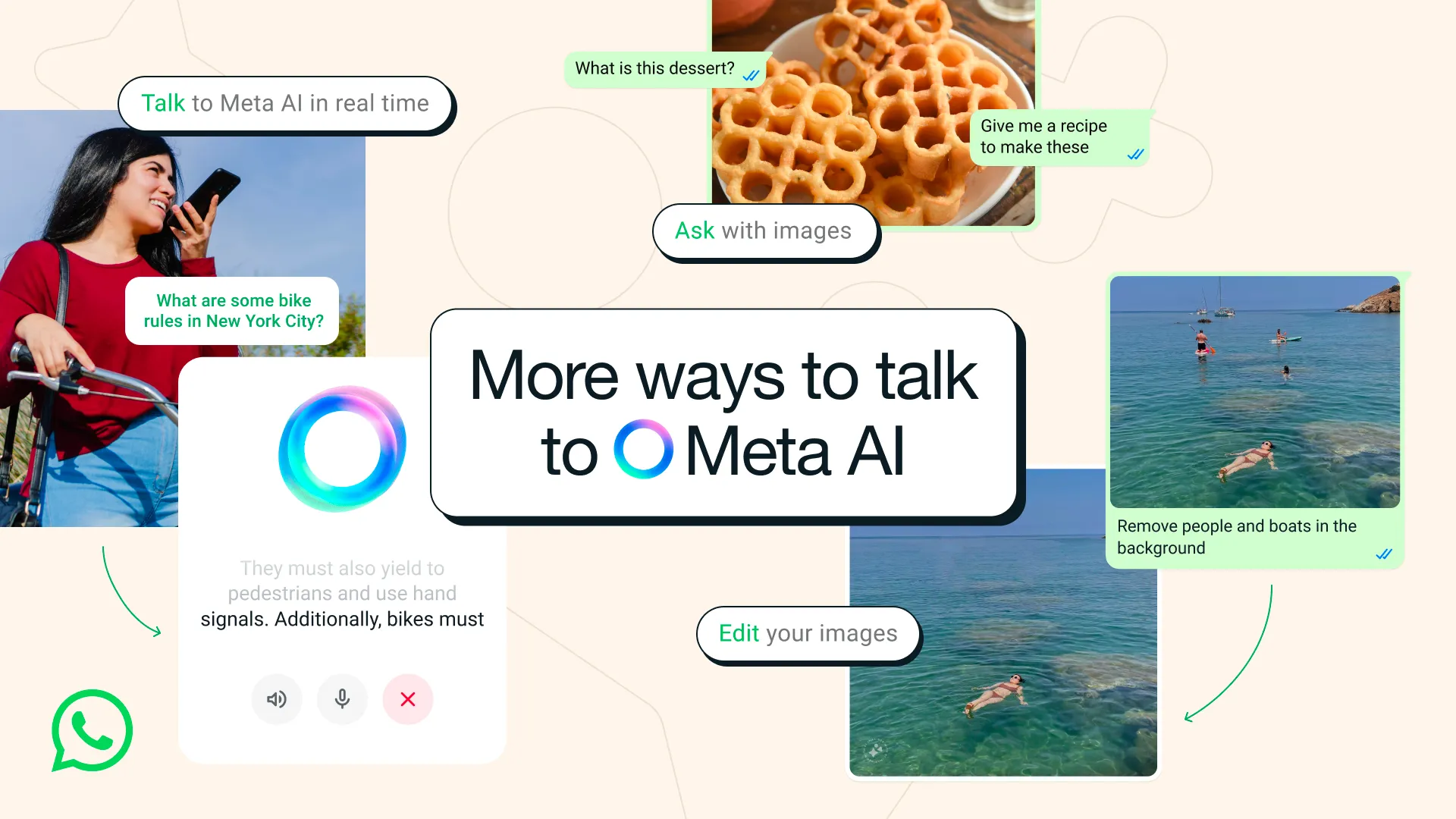
Text-based chat is just the starting point. According to WhatsApp’s official blog, Meta AI now supports real-time voice conversations directly within the app. You can talk to the AI assistant just like you’d send a voice note to a friend — except it responds intelligently, in real time, with the option to choose from multiple voice profiles including celebrity voice options.
Photo analysis has matured significantly too. Point your camera at a plant, a piece of furniture, a math problem, or a product barcode, and Meta AI identifies it, provides context, and can follow up with related questions. This isn’t just image recognition — it’s conversational visual understanding. You can send a photo of your refrigerator contents and ask “what can I cook with this?” and get actual recipes based on what it sees.
These features work across Meta’s Family of Apps — Instagram, Facebook, and Messenger all share the same Meta AI backbone. But WhatsApp remains the dominant engagement platform, likely because its chat-first interface maps more naturally to AI conversation than a social media feed does.
Private Processing: How WhatsApp Handles AI Without Breaking Encryption
The elephant in every room where WhatsApp and AI are discussed together is end-to-end encryption. WhatsApp built its reputation on the promise that nobody — not even Meta — can read your messages. So how do you add AI features that need to understand message content without breaking that promise?
Meta’s answer is Private Processing, a framework that creates what they describe as a secure, encrypted environment where AI processing happens in isolation. Messages are decrypted within this environment, processed by the AI model, and the results are returned — but the decrypted content is never stored, never logged, and according to Meta, never accessible to Meta employees or systems outside the secure enclave.
Privacy researchers have raised valid questions about this approach. The “trust us” element is significant — users must take Meta’s word that the Private Processing environment is truly isolated. Independent audits and technical documentation have been published, but the cryptographic community remains cautiously optimistic rather than fully convinced. What’s clear is that Meta is taking a more privacy-conscious approach than simply processing everything in plaintext on their servers, which is what a lazier implementation would have done.
Business API Integration: Meta AI for Commerce
Beyond consumer features, Meta AI WhatsApp is increasingly becoming a business tool. The WhatsApp Business API now supports AI-assisted customer interactions in over 40 countries, allowing businesses to deploy Meta AI as a first-line customer service agent that can answer questions, process simple requests, and escalate to human agents when needed.
This is where Meta’s monetization strategy becomes clearer. While Meta AI is free for consumers, business API access comes with per-conversation pricing. Companies like airlines, banks, and e-commerce platforms are integrating Meta AI into their WhatsApp Business accounts to handle the kind of repetitive queries — “where’s my order,” “what’s your return policy,” “I need to change my reservation” — that currently consume enormous customer service resources.
The compliance framework is also maturing. Businesses operating in regulated industries can now configure data retention policies, set boundaries on what Meta AI can and cannot discuss, and maintain audit logs of AI-assisted conversations. This enterprise readiness is what separates Meta AI’s WhatsApp deployment from more experimental AI chatbot integrations.
What This Means for the AI Landscape in Summer 2025
The broader implication of Meta AI reaching 1 billion users through WhatsApp is a fundamental challenge to the standalone AI app model. OpenAI, Google, and Anthropic have all invested heavily in dedicated chat interfaces — websites and apps purpose-built for AI interaction. Meta’s approach proves that distribution through existing platforms can achieve scale orders of magnitude faster.
This doesn’t mean ChatGPT or Google’s Gemini are in trouble. Power users who need advanced reasoning, code generation, or specialized workflows will continue to use dedicated AI tools. But for the vast majority of people who just want to ask a quick question, get a summary, or analyze a photo, the AI that’s already in their messenger is the one they’ll use. Convenience beats capability for mainstream adoption, every single time.
The competitive pressure is also pushing improvements across the board. Google has accelerated Gemini’s integration into Android Messages. Apple is deepening Siri’s AI capabilities in iMessage. The era of AI as a standalone destination is giving way to AI as an embedded layer in communication tools people already use daily.
For businesses, developers, and anyone building in the AI space, the Meta AI WhatsApp story in July 2025 carries a clear lesson: the next billion AI users won’t come from building a better chatbot. They’ll come from meeting people where they already are — and right now, 3 billion of them are on WhatsApp.
Interested in building AI-powered automation systems or integrating AI into your workflows? Sean Kim helps businesses and creators navigate the rapidly evolving AI landscape.
Get weekly AI, music, and tech trends delivered to your inbox.