ElevenLabs Eleven Music Review: The AI Music Generator That Actually Cleared Its Licensing (2025)
August 1, 2025
GPT-5 Deep Dive: OpenAI’s First Unified Model Merges Speed, Reasoning, and Multimodal Into One
August 4, 2025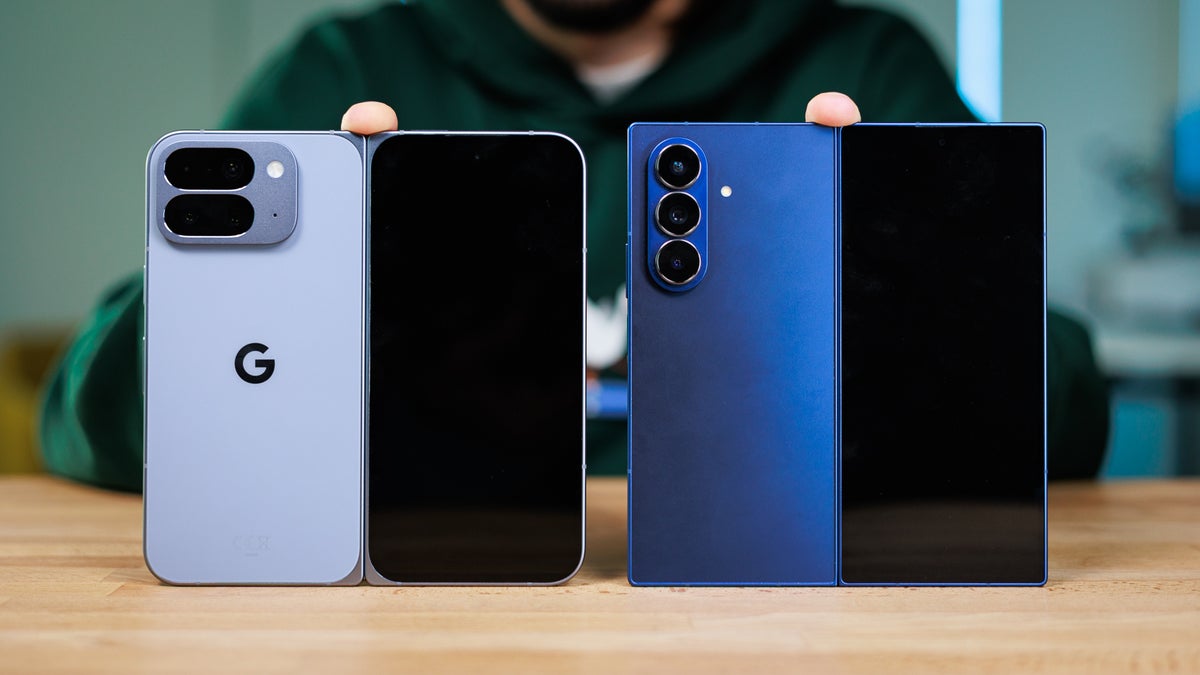
Here’s the foldable dilemma nobody warned you about: you’re standing at the crossroads of a $1,999 Samsung and a $1,799 Google, and the cheaper one might actually be the smarter buy. The Samsung Galaxy Z Fold7 vs Google Pixel Fold 2 (officially the Pixel 10 Pro Fold) is the most competitive foldable matchup Android has ever seen — and the winner depends entirely on who you are. Let’s break it down category by category.
Quick Specs Side-by-Side
| Spec | Galaxy Z Fold7 | Pixel 10 Pro Fold |
|---|---|---|
| Launch | July 25, 2025 | October 9, 2025 |
| Starting Price | $1,999 (256GB) | $1,799 (256GB) |
| Chipset | Snapdragon 8 Elite for Galaxy | Google Tensor G5 (TSMC 3nm) |
| RAM | 12GB (base) / 16GB | 16GB (all configs) |
| Cover Display | 6.5″ Dynamic AMOLED 2X, 2600 nits | 6.4″ Actua OLED, 3000 nits |
| Main Display | 8.0″ Dynamic AMOLED 2X, 2600 nits | 8.0″ Super Actua Flex OLED, 3000 nits |
| Rear Cameras | 200MP + 12MP + 10MP (3x optical) | 48MP + 10.5MP + 10.8MP (5x optical) |
| Battery | 4,400 mAh / 25W wired | 5,015 mAh / 30W wired (PPS) |
| Durability | IP48 | IP68 |
| Weight | 215g | 258g |
| Folded Thickness | 8.9mm | ~10.9mm |
| Software | Android 16 / One UI 7 | Android 16, 7-year updates |
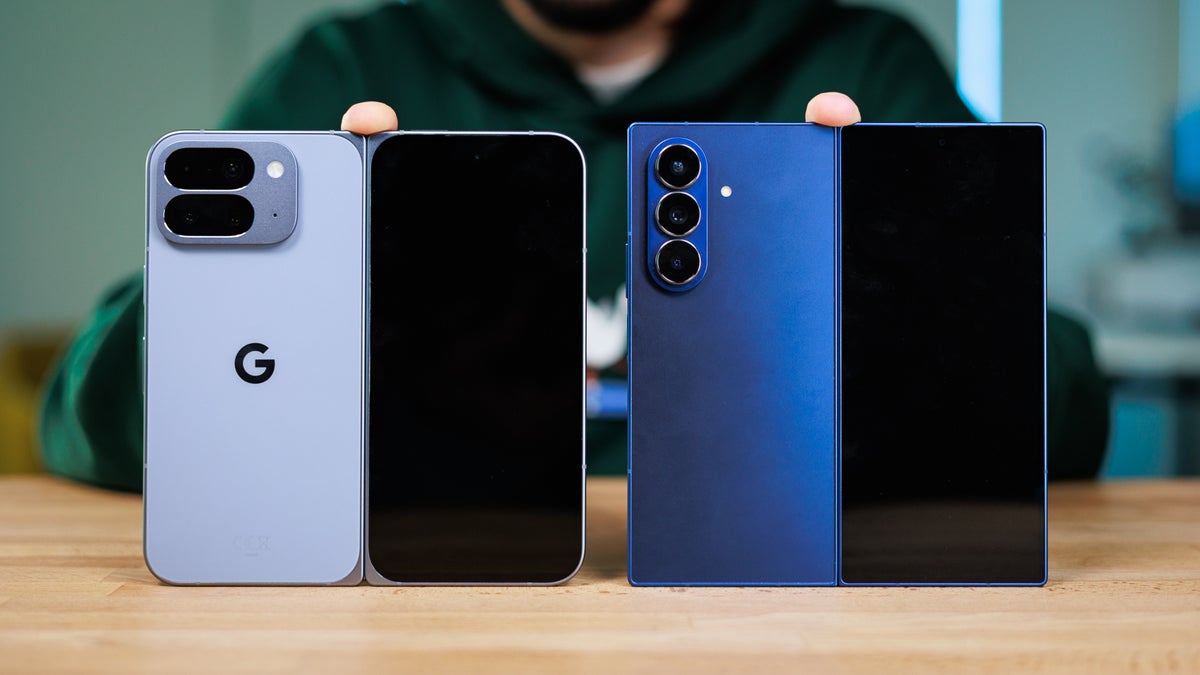
Design & Build: 43 Grams Is More Than You Think
The Galaxy Z Fold7 is the lightest book-style foldable ever made at 215g. The Pixel 10 Pro Fold weighs 258g. That 43-gram gap sounds trivial until you’re carrying it through an airport or holding it one-handed during a long video call — then it becomes very real. The Z Fold7 also folds down to just 8.9mm, making it roughly as thin as a standard flagship. The Pixel at ~10.9mm folded is noticeably chunkier in a pocket.
But here’s where Google flips the script: IP68. The Pixel 10 Pro Fold is the first fully dustproof and waterproof foldable ever made. Samsung’s IP48 on the Z Fold7 means it’s water-resistant but not fully protected against fine dust particles entering the hinge mechanism. If you work outdoors, near construction, or just hate worrying about dust, IP68 is a genuinely significant advantage.
Both hinge systems are impressive. Samsung’s 3rd-gen Armor FlexHinge is rated for 500,000 folds (roughly 10 years of daily use), and the zero-gap design when folded gives the Z Fold7 a premium, seamless look. Google’s gearless hinge is twice as durable as the Pixel 9 Pro Fold’s mechanism. Both phones use Gorilla Glass Victus 2 on the back and cover glass.
Display: Pixel Wins on Brightness, Samsung on Ecosystem
Both phones land on an identical 8.0-inch main display. That’s where the obvious similarities end. The Pixel 10 Pro Fold’s Super Actua Flex OLED pushes up to 3,000 nits peak brightness versus the Z Fold7’s 2,600 nits. In bright sunlight, that 400-nit difference is genuinely visible — the Pixel’s outdoor legibility is superior.
The Z Fold7’s cover display has a slight size edge at 6.5 inches versus the Pixel’s 6.4 inches — not a meaningful real-world difference. Samsung did expand the inner display by 11% compared to the Z Fold6, which improves the aspect ratio for side-by-side multitasking apps. Both panels support 1–120Hz adaptive refresh rates for smooth scrolling without punishing battery life.
Where the Z Fold7’s display ecosystem pulls ahead is software. One UI 7’s Taskbar, Flex Mode panel, and App Pair feature are the most mature foldable UI on the market. Samsung DeX turns the Fold7 into a full desktop experience when connected to an external monitor — something no other phone can match.
Performance: Snapdragon 8 Elite Dominates Raw Benchmarks
Raw performance goes to Samsung. The Snapdragon 8 Elite for Galaxy is the fastest Android chip in 2025, and benchmark scores confirm it by a significant margin over the Tensor G5. For gaming, heavy video editing, and running multiple apps simultaneously, the Z Fold7 feels noticeably snappier.
The Tensor G5 — now built on TSMC’s 3nm process rather than Samsung’s previous Exynos-based fabs — is a huge leap in efficiency and thermal management compared to prior Tensor chips. Real-world performance is smooth and responsive; it just can’t match Snapdragon in a drag race. What the Tensor excels at is AI inference: Gemini integration, on-device Call Assist, Live Translate, and real-time image processing are deeply embedded and run faster and more accurately than on any non-Pixel device.
RAM is worth noting: the Pixel 10 Pro Fold ships with 16GB across all models. The base Z Fold7 (256GB storage) only comes with 12GB — you need the 512GB or 1TB model to get 16GB. For demanding multitasking on a large display, those extra 4GB matter.
Camera: 200MP vs 5x Zoom — A Genuine Split Decision
This is the most nuanced battle in the entire comparison. The Z Fold7’s 200MP main camera — the same sensor as the Galaxy S25 Ultra — is the highest-resolution camera ever put in a foldable. Detail, sharpness, and the ability to crop aggressively are unmatched in the category.
But Google counters with a 5x optical telephoto versus Samsung’s 3x. For concerts, sports, wildlife, and anything where you need reach, the Pixel 10 Pro Fold’s telephoto is a decisive advantage. With 20x Super Res Zoom, the Pixel extends its range to territory the Z Fold7 simply can’t follow. Once you push past 3x on the Fold7, you’re in digital crop territory.
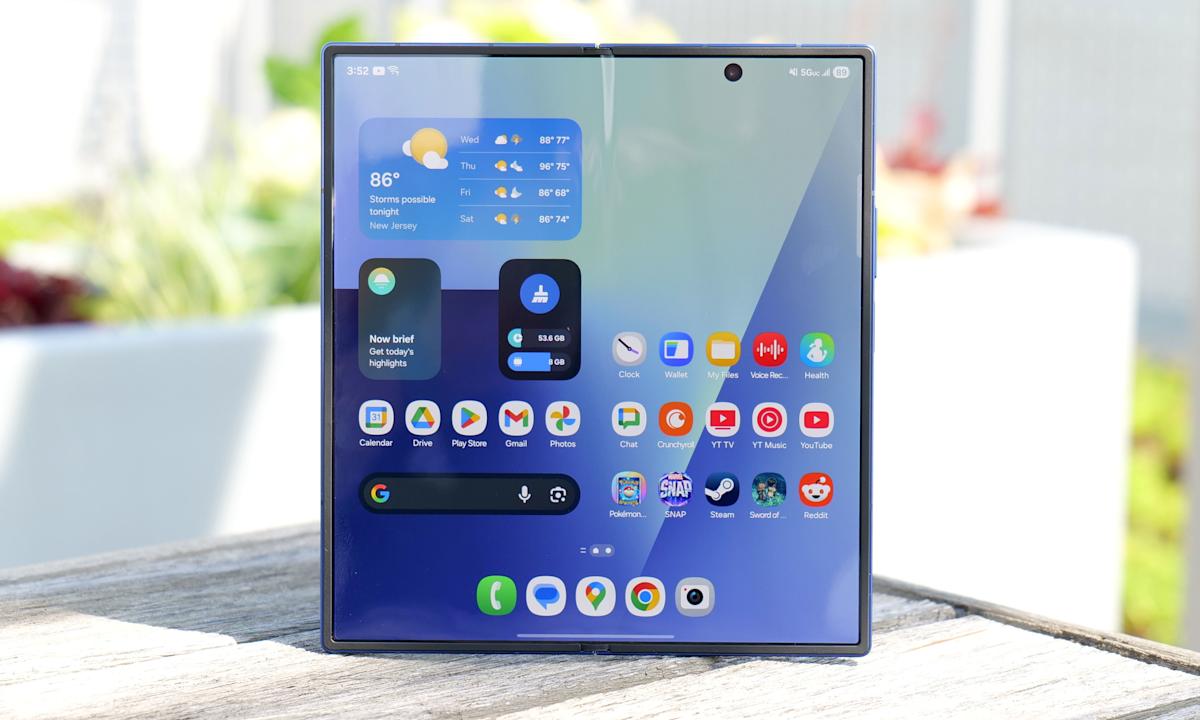
The Pixel’s ultrawide camera also supports autofocus and macro shooting — a detail the Z Fold7’s ultrawide lacks. Google’s computational photography pipeline (Night Sight, Best Take, AI-powered scene understanding) remains best-in-class for low-light and complex scenes. Samsung’s 200MP excels in good light; Pixel’s AI excels in bad light.
The front cameras are equivalent: both phones offer a 10MP cover selfie camera and a 10MP under-display camera on the main panel. The under-display cameras on both devices are still a compromise versus a proper punch-hole — but they’re the best the foldable form factor allows right now.
Battery & Charging: Pixel Wins Convincingly
The Pixel 10 Pro Fold’s 5,015 mAh battery versus the Z Fold7’s 4,400 mAh is not a close contest. That 615 mAh gap, combined with the more efficient Tensor G5 architecture, translates to meaningfully longer screen-on time — especially with the power-hungry 8-inch inner display in heavy use.
Charging speeds follow the same story: 30W wired PPS (0–50% in about 30 minutes) on the Pixel versus 25W wired on the Z Fold7. Both support 15W wireless charging. The Z Fold7 adds 4.5W reverse wireless charging. For a $1,999 flagship, 25W wired charging is a frustrating limitation — it’s the single most frequent complaint in every Z Fold7 review published this year.
Software: DeX Productivity vs Pure Android + 7-Year Guarantee
Both phones run Android 16, but the experiences diverge significantly. Samsung’s One UI 7 is the most feature-complete foldable interface available. The Taskbar gives you persistent app access, App Pair lets you save multitasking layouts, and Flex Mode optimizes any app for the half-folded position. Samsung DeX — a full desktop environment when connected to a monitor — is a killer feature for road warriors and power users. If you treat your phone like a portable workstation, the Fold7’s software ecosystem is unmatched.
Google’s approach is purer and longer-lasting. The Pixel 10 Pro Fold guarantees 7 years of OS and security updates — meaning this phone will receive software support until 2032. Samsung hasn’t matched that commitment. Google’s Gemini AI integration is tighter and more capable on Pixel hardware than anywhere else: on-device processing, Call Assist, and real-time translation work seamlessly without routing to the cloud for basic tasks.
One more thing worth mentioning: Samsung removed S Pen support from the Z Fold7. If you were using the Fold6 with an S Pen for note-taking or creative work, this is a meaningful loss. Samsung’s reasoning was the thinner form factor — the S Pen slot added bulk. Your feelings on that trade-off depend on whether you used it.
Price & Value: The $200 Gap Tells the Real Story
Let’s be direct about what you get for $200 less with the Pixel: IP68 dust and water resistance, a 615 mAh larger battery, 16GB RAM standard on every configuration, and faster charging. The Z Fold7 asks $200 more and delivers better raw performance, a lighter body, a 200MP camera system, and 1TB storage availability.
For the majority of buyers — people who want a reliable, durable, capable foldable that handles everyday life without compromise — the Pixel 10 Pro Fold is the more rational choice. For power users who want the absolute fastest Android device with the best foldable productivity ecosystem, the extra $200 for the Z Fold7 is justifiable.
Samsung Galaxy Z Fold7 vs Google Pixel Fold 2: Who Should Buy Which?
Buy the Galaxy Z Fold7 if you:
- Use your phone as a portable workstation (Samsung DeX, advanced multitasking)
- Prioritize the highest-resolution camera and detail in your shots
- Want the lightest, thinnest foldable available (215g, 8.9mm)
- Need maximum storage (up to 1TB)
- Are already invested in the Samsung ecosystem (Galaxy Watch, Buds, etc.)
Buy the Pixel 10 Pro Fold (Pixel Fold 2) if you:
- Work in dusty or wet environments and need real dust/water protection (IP68)
- Want all-day and into-the-night battery life (5,015 mAh)
- Shoot a lot of zoom photography (5x optical vs 3x)
- Prefer stock Android and deep Google AI integration
- Want 7 years of guaranteed OS updates
- Want 16GB RAM without paying a premium storage tier
- Are spending $200 smarter
Final Verdict
The Samsung Galaxy Z Fold7 vs Google Pixel Fold 2 is genuinely the most competitive foldable battle we’ve seen. There’s no universally “better” phone here — just two different philosophies about what a premium foldable should prioritize. Samsung built the most refined, lightest, highest-performance device in the segment. Google built the most durable, longest-lasting, best-value foldable with the strongest software future.
For most mainstream buyers, the Pixel 10 Pro Fold edges ahead on sheer value. For foldable power users and Samsung ecosystem loyalists, the Z Fold7 remains the apex foldable. Check the latest pricing and availability at the Samsung official store and Google Store.
Get weekly AI, music, and tech trends delivered to your inbox.