Claude Opus 4.1 vs GPT-5: Which AI Model Should You Use in August 2025?
August 11, 2025
Best Gaming Mice August 2025: 7 Wireless Lightweight Picks Under $100
August 11, 2025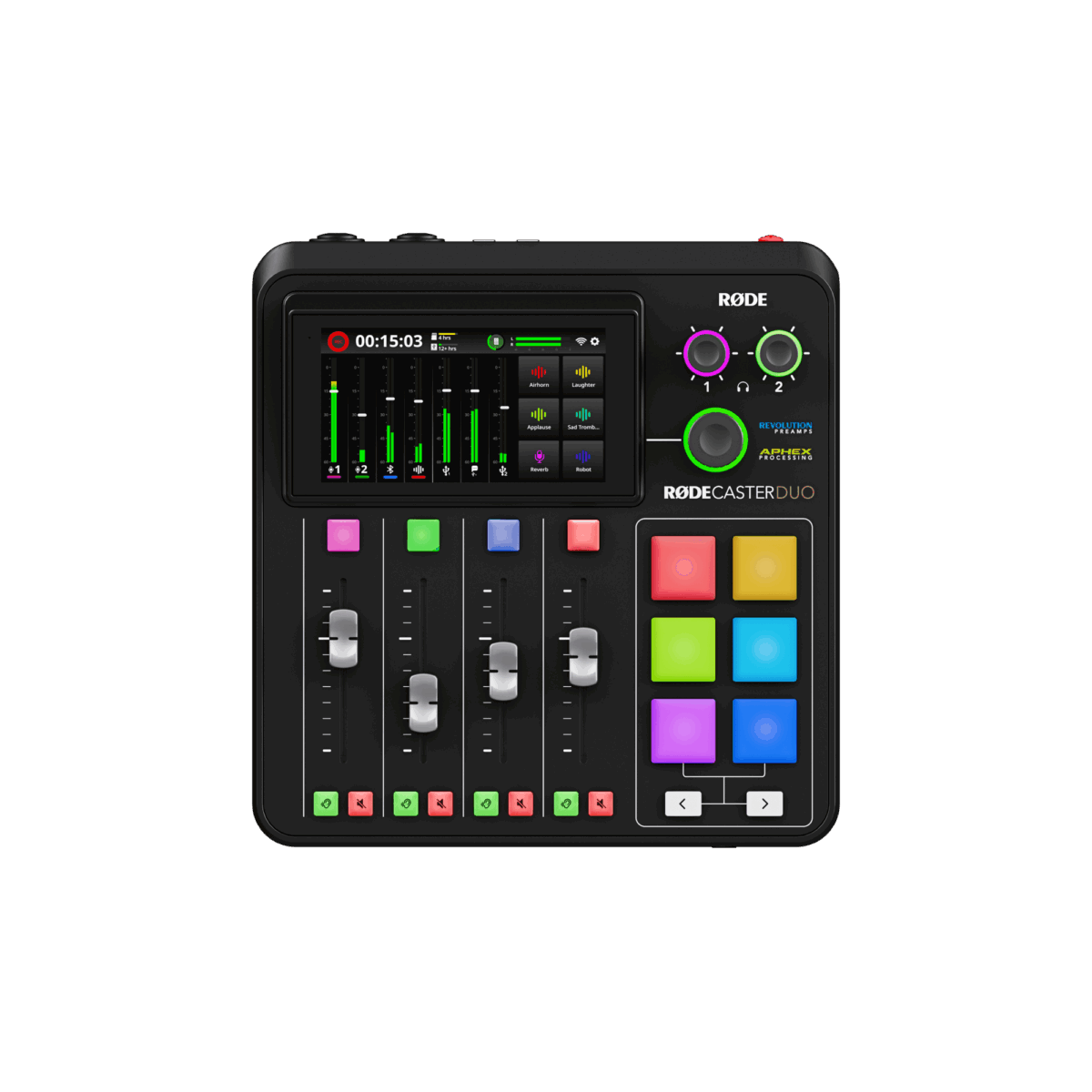
Your podcast audience can hear the difference — and they’re judging you for it. After testing dozens of USB-C audio interfaces across voice types, room conditions, and price points, here are the five that actually earn their spot on a podcaster’s desk in August 2025.
Why USB-C Matters for Podcasters in 2025
The USB-C transition isn’t just about a different plug shape. Modern USB-C audio interfaces deliver lower latency, higher power delivery (no more wall adapters cluttering your desk), and universal compatibility across MacBooks, Windows laptops, iPads, and even smartphones. Every interface on this list runs bus-powered through a single USB-C cable — plug in, open your DAW or recording app, and you’re live. That simplicity matters when you’re recording weekly episodes and can’t afford technical hiccups eating into your production time.
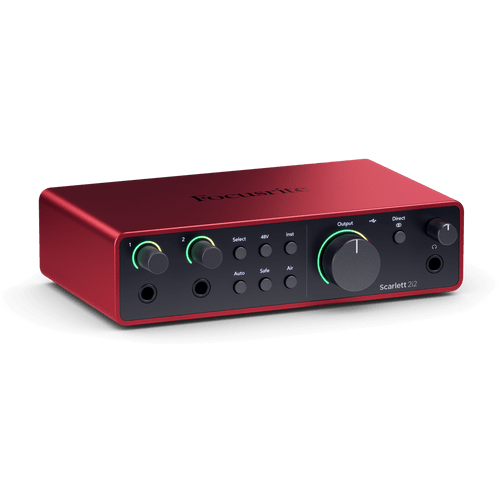
1. Focusrite Scarlett 2i2 4th Gen — Best Overall ($179)
The Scarlett 2i2 has been the best-selling audio interface in the world for years, and the 4th generation proves why that dominance continues. With 69dB of gain across three switchable preamp modes — Clean, Air, and Drive — it handles everything from the Shure SM7B (a notoriously gain-hungry dynamic mic) to sensitive condensers without breaking a sweat.
The Auto Gain feature is a genuine game-changer for podcasters who aren’t audio engineers. Speak into your mic for 10 seconds, and the Scarlett sets your level automatically. Clip Safe engages a second A/D converter that kicks in when your signal peaks, preventing clipping before it happens — a lifesaver for animated podcast conversations that suddenly get loud.
Focusrite’s 4th Gen shares converter technology from their flagship RedNet range, delivering 120dB dynamic range. The included software bundle (Ableton Live Lite, Hitmaker Expansion, and a suite of plugins) means you can start producing polished episodes immediately after unboxing.
Best for: Solo podcasters and two-person shows who want reliable, set-and-forget recording. The Air mode adds a subtle high-frequency lift that makes voices cut through clearly without sounding harsh — something Focusrite specifically tuned for spoken word and vocal recordings.
2. MOTU M2 — Best Audio Quality ($200)
If raw audio quality is your top priority, the MOTU M2 punches absurdly above its $200 price point. It uses the same ESS Sabre32 Ultra DAC found in MOTU’s professional-tier interfaces, delivering a 120dB dynamic range and -129.5dBu EIN (Equivalent Input Noise) on the mic inputs. In practical terms, your recordings will have a noise floor so low that even aggressive noise reduction in post won’t introduce artifacts.
The standout feature for podcasters is the built-in loopback functionality combined with ultra-low latency — just 2.3ms at a 32-sample buffer. This means you can record Zoom calls, Discord chats, or system audio directly alongside your microphone input without any virtual audio cable hacks. The full-color LCD metering on the front panel provides precise visual feedback that’s far more useful than the basic LED ladders on most competitors.
The M2 also supports 32-bit float recording at up to 192kHz, which is technical overkill for podcasting but means your recordings have virtually unlimited headroom. Even if you accidentally record too hot, you can pull the levels back in post without quality loss.
Best for: Podcasters who also record music or voiceover work and need reference-grade monitoring. The Sound On Sound review called it “the best audio interface under $200” — a title it continues to earn.
3. Audient iD4 MKII — Best Premium Compact ($199)
Audient built their reputation designing large-format studio consoles like the ASP8024 that sit in professional recording studios worldwide. The iD4 MKII takes that exact same Class-A preamp circuit and fits it into a palm-sized USB-C interface. The result is a mic preamp that sounds noticeably more open, detailed, and three-dimensional than typical budget interface preamps — a difference you’ll hear immediately on voice recordings.
One killer podcasting feature: dual headphone outputs. If you’re co-hosting or conducting in-person interviews, both you and your guest get independent headphone monitoring without a separate headphone amplifier. The all-metal build quality is tank-like, and the ScrollControl encoder doubles as a DAW controller for hands-free volume adjustments, transport control, and plug-in parameter tweaking.
The trade-off? Only one XLR mic input and a maximum 96kHz sample rate. For podcasting, 96kHz is more than sufficient (most podcasts publish at 44.1kHz/48kHz anyway), and the single-mic limitation is a non-issue for solo shows. If you need two mics, Audient’s iD14 MKII ($299) offers the same preamp quality with dual XLR inputs.
Best for: Podcasters who want the absolute best preamp quality under $200 and value build quality that will survive years of daily use. The dual headphone outputs make it surprisingly versatile for its compact size.
4. Universal Audio Volt 2 — Best Vintage Character ($219)
Universal Audio’s Volt 2 brings something none of the other interfaces on this list offer: a genuine analog character circuit modeled after UA’s legendary 610 tube preamp. Flip the Vintage switch, and your voice gains a warmth and richness that typically requires running through thousands of dollars worth of outboard gear. For podcasters with thin or harsh-sounding voices, this single feature can be transformative.
The Volt 2 packs two XLR/TRS combo inputs, 24-bit/192kHz conversion, and — rare at this price — full MIDI I/O. It’s also fully iOS compatible, meaning you can record professional-quality episodes directly to an iPad or iPhone when you’re on the road. The included LUNA recording software from UA is a legitimate DAW with built-in Neve, API, and SSL channel strip emulations.
The one caveat: 55dB of gain is the lowest on this list. If you’re using a Shure SM7B or other gain-hungry dynamic mic, you’ll likely need a Cloudlifter or similar inline preamp booster. For most condenser mics and the popular Rode PodMic, 55dB is plenty.
Best for: Podcasters who want their voice to sound warm, polished, and “radio-ready” straight out of the box. The UA Volt 2 is also the best pick if you need iOS compatibility for mobile recording setups.
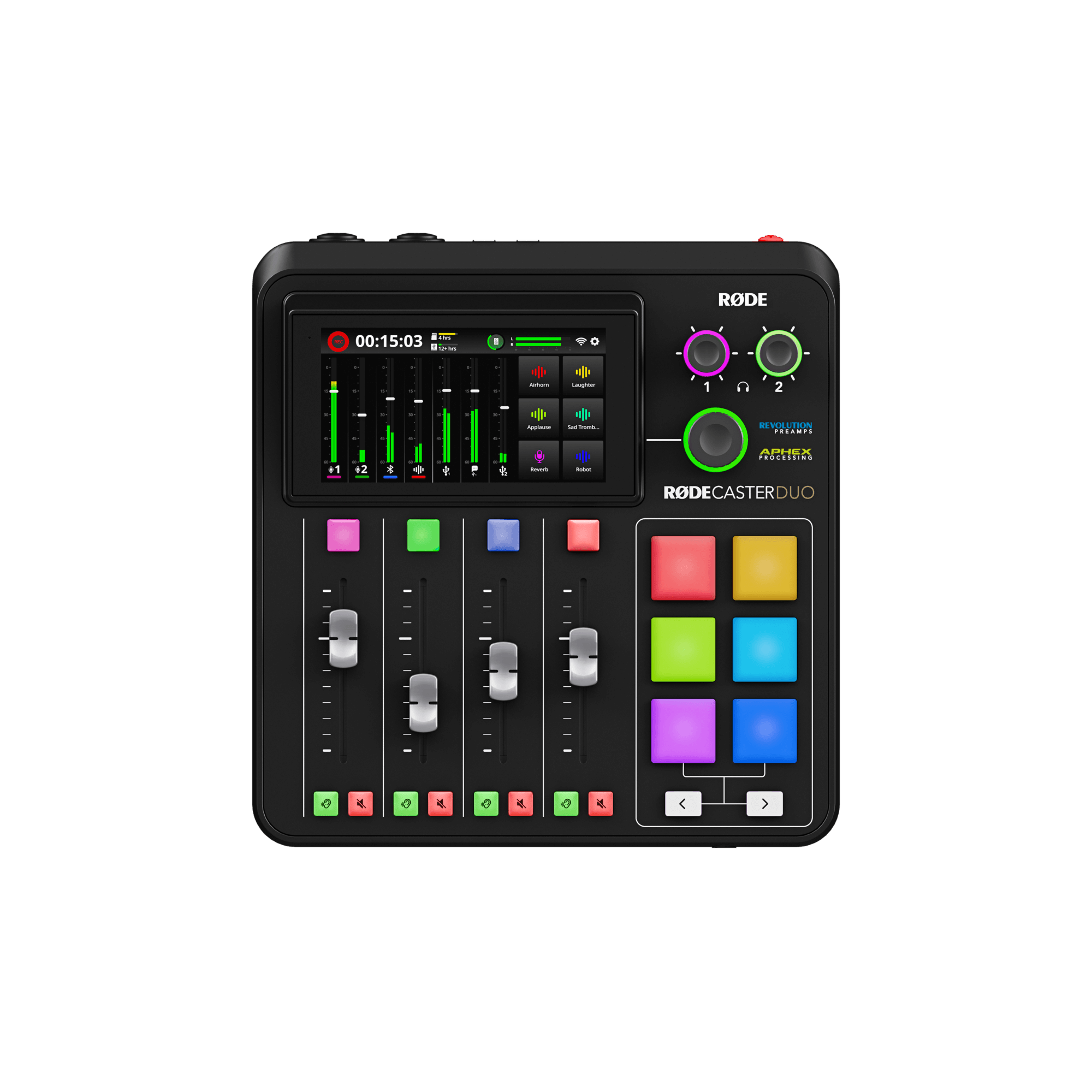
5. RODE RODECaster Duo — Best All-in-One ($399)
The RODECaster Duo isn’t just an audio interface — it’s a complete podcast production studio crammed into a device slightly larger than a paperback book. With 76dB of gain from RODE’s Revolution preamps and an EIN of -131.5dBV, it will drive absolutely any microphone without needing a Cloudlifter, FetHead, or any other inline boost. That alone eliminates one of the most common frustrations for new podcasters.
What sets the Duo apart is the built-in APHEX audio processing — Aural Exciter adds harmonic richness, Big Bottom tightens low-end presence, and Compellor provides broadcast-style automatic level control. These are the same processors used in professional radio stations, available here with one-knob simplicity. Add six programmable SMART pads for sound effects, jingles, or ad roll markers, Bluetooth connectivity for phone-in guests, and standalone recording to microSD — and you have a device that eliminates the need for a laptop entirely.
The dual USB-C ports let you connect two computers simultaneously (ideal for streaming from one while recording on another), and the four-fader mixer with three virtual channels gives you broadcast-style control without software routing headaches.
Best for: Podcasters who want maximum capability with minimum complexity. If you’re tired of juggling separate interfaces, mixers, and software plugins, the RODECaster Duo consolidates everything into one device.
Best Audio Interfaces for Podcasters: Quick Comparison
Here’s how these five USB-C audio interfaces stack up side by side:
- Focusrite Scarlett 2i2 4th Gen ($179) — 69dB gain, 3 preamp modes, Auto Gain, Clip Safe. Best all-rounder.
- MOTU M2 ($200) — ESS Sabre32 DAC, 32-bit float, 2.3ms latency, loopback. Best pure audio quality.
- Audient iD4 MKII ($199) — Console-class Class-A preamp, dual headphones, ScrollControl. Best premium compact.
- Universal Audio Volt 2 ($219) — 610 Vintage mode, MIDI I/O, iOS compatible. Best for warm vocal character.
- RODE RODECaster Duo ($399) — 76dB gain, APHEX processing, Bluetooth, standalone recording. Best all-in-one.
Which USB-C Audio Interface Should You Buy?
For most podcasters starting out or upgrading from a USB microphone, the Focusrite Scarlett 2i2 4th Gen is the safest bet — it’s the industry standard for good reason. If audio quality is your obsession, the MOTU M2 delivers reference-grade performance that belies its price. The Audient iD4 MKII wins if you value preamp character and build quality above all else. The Universal Audio Volt 2 is the pick for voices that need analog warmth without software processing. And if you want to simplify your entire setup into a single device, the RODE RODECaster Duo does things no traditional interface can match.
All five of these interfaces connect via USB-C, run bus-powered, and deliver professional-quality audio that your audience will notice. The USB-C ecosystem has matured to the point where there’s genuinely no reason to buy an older USB-A interface — these five prove that modern connectivity and professional audio quality go hand in hand.
Need help choosing the right interface for your podcast setup, or looking for professional mixing and mastering for your show?
Get weekly AI, music, and tech trends delivered to your inbox.