Meta Connect 2025: How Llama 4 Scout’s 17B Parameters Are Redefining On-Device AI Processing
October 3, 2025
Apple Mac Mini M5 Launch: $599 Desktop Packs Pro-Level AI Performance
October 3, 2025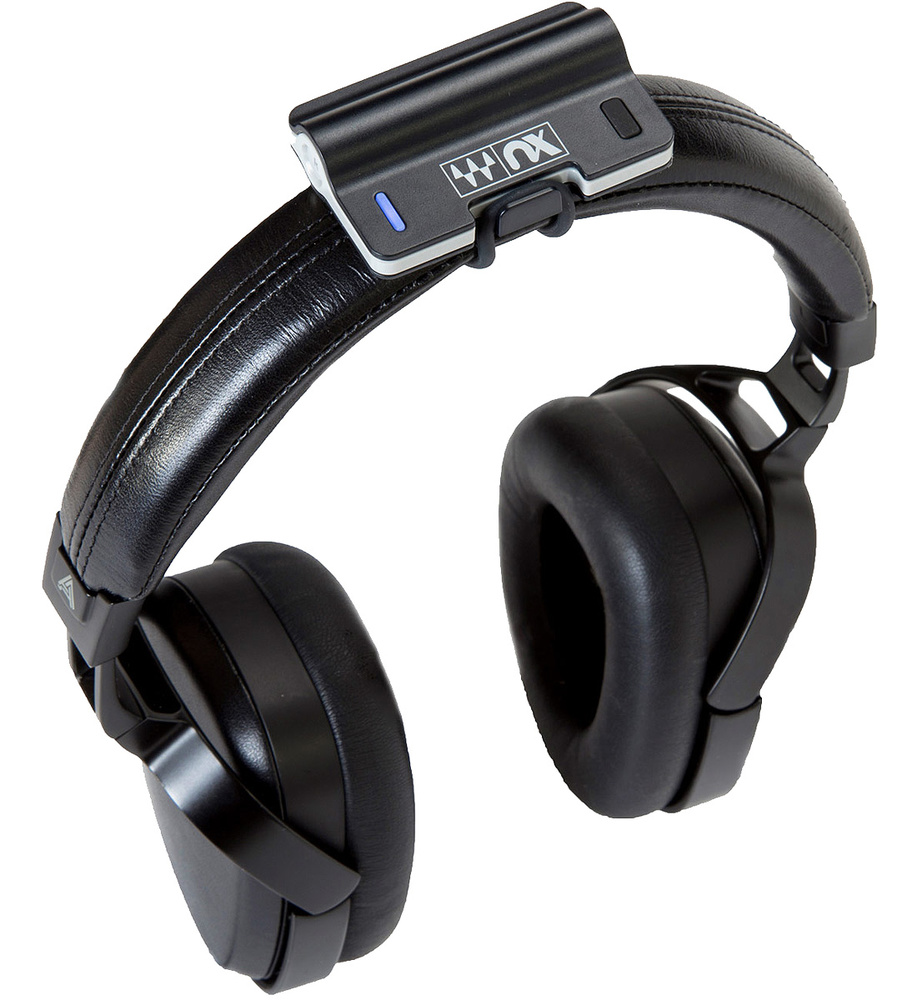
Finally — a way to mix on headphones without second-guessing every pan decision. Waves Nx Head Tracking has quietly become one of the most transformative tools in modern production, turning a $99 Bluetooth tracker and any pair of headphones into five legendary studio control rooms. After months of mixing with the full Nx ecosystem, here’s what actually works and what falls short.
What Is Waves Nx Head Tracking and Why Does It Matter?
Waves Nx Head Tracking is a spatial audio monitoring system that recreates the acoustic experience of mixing in a real studio — on any pair of headphones. The system consists of two components: the Nx Head Tracker, a compact Bluetooth device that clips onto your headphone band, and a family of Nx virtual studio plugins that model the precise acoustic response of legendary control rooms.
The fundamental problem with headphone mixing is well-documented: sound sources appear locked inside your head rather than emanating from speakers in front of you. Stereo imaging collapses, reverb tails sound unnaturally close, and low-end decisions made on headphones rarely translate to monitors. Waves Nx addresses this through a combination of channel crosstalk, inter-aural time delays (ITD), inter-aural level differences (ILD), early reflections modeling, and real-time head motion tracking.
When you turn your head while wearing the tracker, the virtual sound field stays fixed in space — exactly like real speakers would. This single feature transforms the psychological experience of headphone monitoring from “sound in my head” to “sound in a room.”
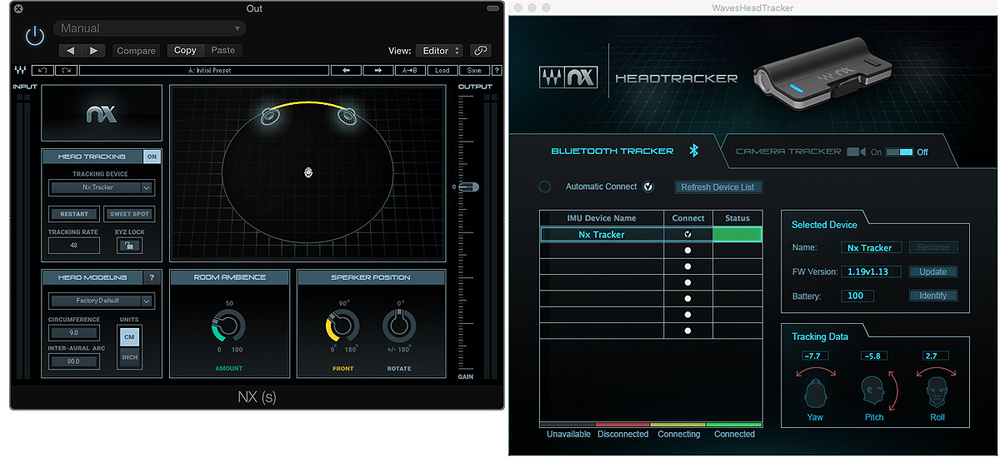
Waves Nx Head Tracker: Hardware Deep Dive
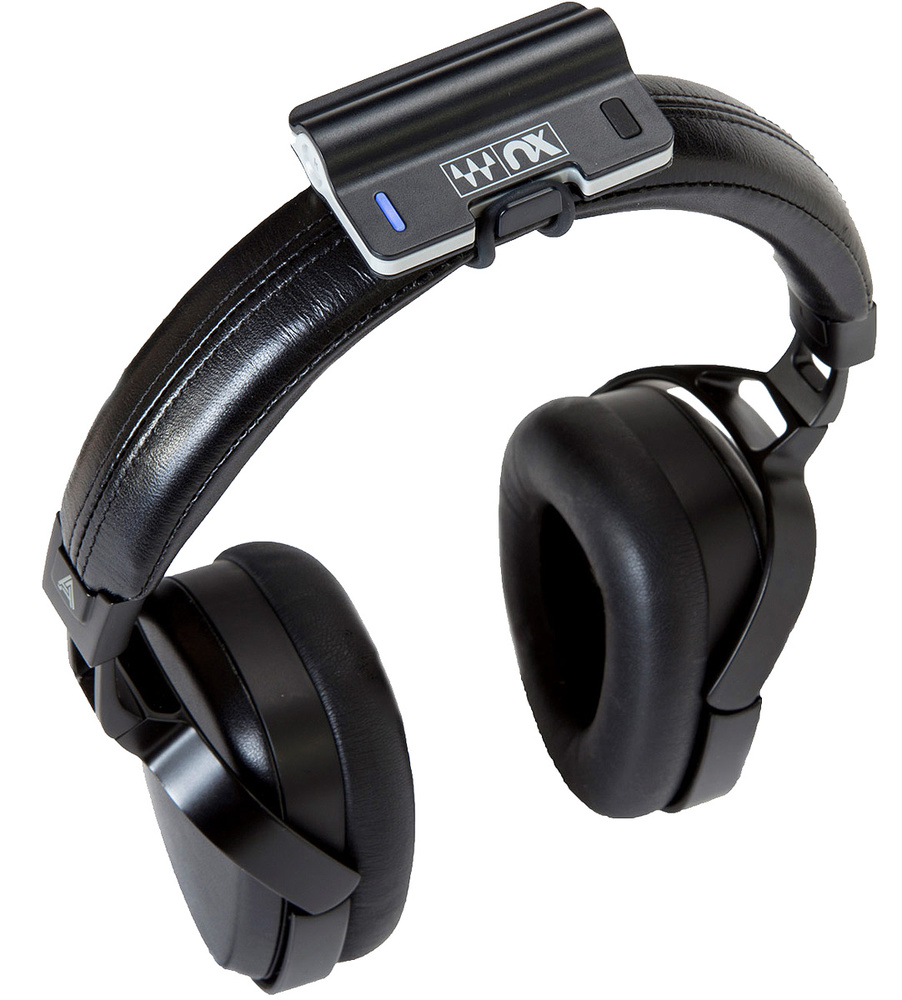
The Nx Head Tracker itself is deceptively simple. It’s a small Bluetooth 4.0 BLE device weighing just a few grams, with a rubber locking strap that secures to any headphone headband. A single AAA battery provides approximately 40 hours of continuous tracking, and the Bluetooth range extends up to 20 feet from your computer.
What makes the hardware impressive is the 360-degree full-sphere tracking with near-zero latency. Head movements are tracked across all three axes — yaw (left/right), pitch (up/down), and roll (tilt). The tracker communicates with any Nx plugin in real-time, adjusting the virtual sound field to match your head position.
- Connectivity: Bluetooth 4.0 BLE — minimal power draw, up to 20ft range
- Battery: Single AAA, ~40 hours of use
- Tracking: Full 360° sphere, 3-axis (yaw/pitch/roll)
- Weight: Under 10 grams — no impact on headphone comfort
- Multi-user: Up to 6 devices simultaneously for collaborative mixing
- Compatibility: All Nx family plugins — works with any headphones
One underappreciated feature: up to six Nx Head Trackers can operate simultaneously. This means a producer, mixing engineer, and artist can all monitor the same session through their own headphones with individual head tracking — perfect for collaborative sessions in untreated spaces.
The 5 Nx Virtual Studio Plugins Compared
Waves has built five distinct Nx plugins, each modeling a different legendary control room. They share the same core spatial technology but differ significantly in acoustic character. Here’s how they stack up:
1. Nx Virtual Mix Room — The Foundation
The original Nx plugin provides a neutral, idealized control room with adjustable speaker angles, room reflections, and center trim. It supports stereo, 5.0, 5.1, and 7.1 monitoring — making it the most versatile option in the lineup. Think of it as a perfectly calibrated reference room that doesn’t impose any particular sonic character. Best for: general-purpose mixing when you want a clean, neutral reference.
2. Abbey Road Studio 3 — The Classic
Models the iconic Studio 3 control room at Abbey Road Studios in London. This plugin captures the room where countless legendary records were mixed, complete with its characteristic warm mid-range and controlled low end. The acoustic measurements include the studio’s specific monitor positions and room geometry. Best for: rock, pop, and orchestral mixing where a classic British console-room sound is desired.
3. CLA Nx — Chris Lord-Alge’s Mix LA
This is where the Nx system gets personal. CLA Nx models Grammy-winner Chris Lord-Alge’s Mix LA studio — the room where he’s delivered mixes for Bruce Springsteen, Green Day, and Muse since 2008. The plugin includes emulations of his CLA-10 nearfield monitors, custom Ocean Way farfield speakers, subwoofer system, and even his boombox for small-speaker checking. With EQ correction curves for over 270 headphone models, it’s also the most comprehensive in terms of headphone calibration. Best for: aggressive rock and pop mixes where you want to hear what CLA hears.
4. Ocean Way Nashville — The Nashville Sound
Developed in collaboration with Ocean Way Nashville Studios at Belmont University, this plugin captures the warm, musical character of Nashville’s premier recording facility. The custom Ocean Way Audio monitoring system is faithfully reproduced, delivering that signature Nashville punch and warmth. Best for: country, Americana, singer-songwriter, and any genre benefiting from a warm, musical room.
5. Germano Studios New York — The Hit Factory Legacy
The newest addition to the Nx family models the legendary Germano Studios (originally The Hit Factory) in New York City. For nearly five decades, artists from David Bowie and Stevie Wonder to Travis Scott and Kendrick Lamar chose this room for its signature power, punch, and club-worthy low end. The plugin emulates Studio 1’s control room with three monitoring options: NS10 near-fields, the massive Exigy S412G four-way system with dual 18-inch subwoofers, and Germano Acoustics A2 speakers. It also offers a full 5.1 surround monitoring setup. Best for: hip-hop, R&B, electronic, and pop — anything that demands serious low-end authority.
Waves Nx Head Tracking vs. the Competition
The Nx ecosystem doesn’t exist in a vacuum. Here’s how it compares to the main alternatives in the headphone monitoring space:
dearVR MONITOR by Dear Reality offers multi-channel monitoring up to 9.1.6 and 13.1 formats — surpassing Nx’s 7.1 maximum. However, dearVR MONITOR doesn’t model specific real rooms (it creates idealized spaces) and doesn’t support head tracking. For Dolby Atmos work, dearVR MONITOR’s higher channel count is a clear advantage, but for stereo and 5.1 mixing, the Nx head tracking delivers a more convincing spatial experience.
Sonarworks SoundID Reference takes a completely different approach — it’s a headphone calibration tool that corrects frequency response rather than simulating room acoustics. SoundID and Nx are actually complementary: use SoundID to flatten your headphones, then Nx to add the room. Sonarworks supports over 500 headphone models with individual calibration profiles.
APL Virtuoso is gaining reputation as having the most convincing binaural rendering of any plugin tested, where listeners report truly feeling sound moving around them. At approximately $199, it’s positioned as a premium alternative with exceptional spatial accuracy.
The Waves Nx advantage remains in its combination of real room modeling + physical head tracking + broad headphone EQ correction. No single competitor matches all three.
Practical Setup: Getting the Best Results from Waves Nx Head Tracking
After extensive testing, here’s the workflow that produces the most reliable mixes:
- Step 1: Calibrate your head measurements. Waves recommends measuring the circumference and inter-aural arc of your own head. This 2-minute step dramatically improves the spatial accuracy of all Nx plugins.
- Step 2: Select headphone EQ profile. If your headphones are in the 270+ supported list, apply the correction curve. This flattens your headphones’ frequency response before the room simulation is applied.
- Step 3: Choose your room. Match the plugin to your genre: CLA Nx for rock, Germano for hip-hop, Ocean Way for Nashville-style warmth, Abbey Road for classic British monitoring.
- Step 4: Attach the Head Tracker. Clip the tracker to your headband, pair via Bluetooth, and hit the Sweet Spot button in the plugin to set your preferred center position.
- Step 5: Insert on master bus LAST. Nx plugins go on the stereo out as the final insert — after all processing. Never bounce with Nx active.
One critical workflow tip: always A/B between Nx on and off. The goal isn’t to mix entirely in the virtual room — it’s to use it as a reality check. Some engineers work primarily with Nx off and toggle it on periodically to verify spatial decisions. Others keep it on throughout, as reported by Sound On Sound’s review, where the reviewer found panned mono signals sounded natural without the stuffy closeness of traditional headphone monitoring.
Who Should Invest in Waves Nx Head Tracking?
The Nx system is most valuable for producers and engineers who regularly mix on headphones — whether by necessity (apartment studios, travel, late-night sessions) or by choice. If you already have a well-treated control room with calibrated monitors, Nx serves as a secondary check rather than a primary monitoring tool.
For bedroom producers and traveling musicians, the value proposition is straightforward: the Nx Head Tracker plus one plugin costs less than a single session of acoustic treatment. And unlike room treatment, the Nx system travels with you — delivering consistent monitoring anywhere you have headphones and a laptop.
The bottom line: Waves Nx Head Tracking won’t fully replace a calibrated studio, but it bridges roughly 80% of the gap between headphone mixing and speaker monitoring. For the price of a few plugin sales, that’s a remarkable return on investment.
Whether you’re setting up an immersive headphone monitoring workflow or optimizing your studio for spatial audio mixing, professional guidance makes the difference.
Get weekly AI, music, and tech trends delivered to your inbox.