NVIDIA Llama Nemotron: 3 Open Reasoning Models That Just Crushed DeepSeek R1 in Every Benchmark
October 13, 2025
AMD Radeon RX 9080 XT Specs Leak: 32GB GDDR7, 4GHz Clocks, and a Serious Threat to NVIDIA’s Dominance
October 13, 2025
After 28 years behind the console, there is one question that has dominated my inbox over the past two years more than any other — “How do I get that synthwave sound?” From Vangelis’s Blade Runner score to The Midnight’s latest release, synthwave production techniques have transcended nostalgia to become a fully realized, independent genre. And here is the exciting part: your DAW and a handful of free plugins are genuinely all you need to nail it.
Setting the Foundation: Tempo and Arrangement for Synthwave Production Techniques
Every synthwave track starts with the right tempo. While the genre spans 80 to 140 BPM, the sweet spot sits between 100 and 120 BPM — that magical range where the neon-lit, late-night driving groove truly comes alive. Set your project to 110 BPM as a starting point, and you will immediately feel the vibe lock in.
Arrangement-wise, synthwave keeps things deliberately simple. Think in 8 to 16-bar sections that repeat with gradual layering. A typical structure runs: Intro (8 bars) → Verse (16 bars) → Chorus (8 bars) → Bridge (8 bars) → Chorus (8 bars) → Outro (8 bars). The trick is building tension by adding or removing a single element per section rather than dramatic structural changes.
Melodies should be simple, repeating phrases with portamento (glide) enabled. Set your synth’s glide time to 30-80ms for that signature sliding feel between notes. Chord progressions lean heavily on minor keys — the classic D-D-A-G progression highlighted in EDMProd’s comprehensive guide is a perfect starting point. Add 7th and 9th extensions to your chords for that dreamy, nostalgic quality.
Choosing Your Synth Plugins: Free and Premium Options
Original 80s hardware synths are increasingly rare and expensive, but software emulations have reached a point where even seasoned engineers struggle to tell the difference in a blind test. Here are the synthwave production techniques essentials when it comes to plugin selection.
Free Plugins That Punch Above Their Weight
TAL-U-NO-LX is the gold standard Roland Juno-60 emulation. It nails the original’s chorus circuit — that thick, swirling modulation that defined countless 80s records. Set the oscillator to Saw, engage Chorus I or II (or both for extreme width), and you have instant synthwave pads. The sub-oscillator adds weight to bass patches without muddying the low end.
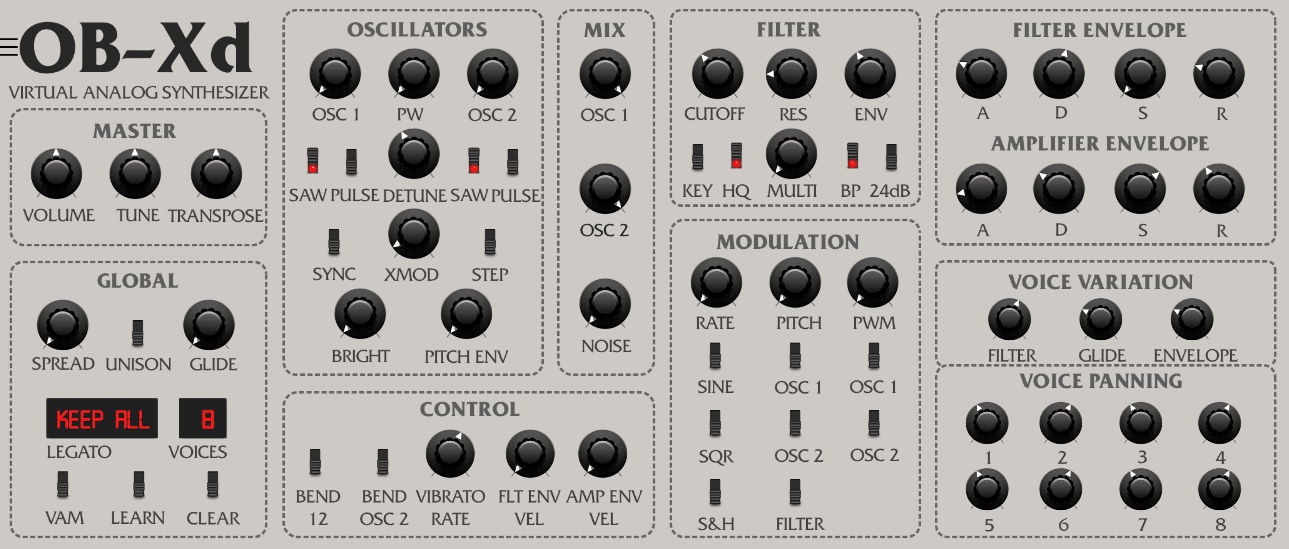
OB-Xd faithfully recreates the Oberheim OB-X family. Its strength is thick, detuned saw waves — perfect for leads and stacked pads. Set Voice Detune between 15-25% to recreate that analog instability where no two notes sound exactly the same. The 2-pole and 4-pole filter modes give you different flavors of warmth.
Vital is a wavetable synth at its core, but it excels at analog-style sounds too. Its modulation matrix is extraordinarily powerful — route an LFO to filter cutoff, another to oscillator pitch for vibrato, and use the macro knobs for real-time performance control. The built-in effects chain handles chorus, reverb, and distortion without leaving the plugin.
Voxengo OldSkoolVerb is the free reverb plugin best suited for synthwave. Start with a Large Hall preset, set Decay to 2.5 seconds, Pre-delay to 25ms, and dial the Wet mix to 30-40%. This gives you that spacious 80s studio reverb without washing everything out.
TAL Vocoder handles the robotic vocal processing that is a synthwave signature. Set the carrier to a Saw wave, adjust band count to 12-16, and you get that Daft Punk-meets-Kraftwerk vocoder character. Feed it sustained pad chords as the carrier for a more musical result.
Premium Plugins Worth the Investment
Arturia V Collection is the definitive suite for 80s synth recreation. It includes the Prophet-5, Jupiter-8, CS-80, and Minimoog — the instruments that literally defined the era. Their TAE (True Analog Emulation) technology models circuits at the component level. The Prophet V’s Polymod section deserves special mention for creating unique FM-like textures that sit perfectly in a synthwave mix.
The Baby Audio Synthwave Essentials bundle is purpose-built for this genre. BA-1 is an analog-modeled synth designed from the ground up for retro sounds. Crystalline provides reverb with a built-in gate function — essential for those explosive 80s snare tails. Super VHS adds lo-fi VHS tape degradation. Tekno handles drum machine duties, and Humanoid delivers vocoder processing. It is the only bundle where every single plugin serves the synthwave workflow.
Serum might seem like an odd choice for retro sounds, but load resampled vintage waveforms into its wavetable engine and you get analog character with modern precision. Assign VHS noise to the Noise oscillator, add the built-in Hyper/Dimension effect, and you have a surprisingly authentic retro machine with surgical control.
Programming Drums: Vintage Machine Grooves
Synthwave drums draw their DNA from the Roland TR-808, TR-909, TR-505, and the LinnDrum. Understanding what makes each machine tick is essential to authentic synthwave production techniques.
The kick drum should be deep and round — classic TR-808 territory. Set the 808 kick’s Decay to medium length (200-400ms), but apply a high-pass filter at 30Hz to keep sub frequencies from overwhelming your monitors and competing with the bassline. The four-on-the-floor pattern (kick on every quarter note) is the most common foundation, though half-time variations work well for slower, moodier tracks.
The snare absolutely must have gated reverb — this single effect defines the 80s sound more than anything else. Here is the signal chain that gets you there:
- Route the snare to a reverb on a send/return bus
- Set the reverb to Large Hall or Plate with a long Decay of 2-4 seconds
- Insert a noise gate on the reverb return channel
- Adjust the gate Threshold so the reverb tail cuts off at approximately 300-500ms
- Start with Hold at 200ms and Release at 50-100ms, then fine-tune to taste
This creates that explosive, truncated reverb burst immortalized by Phil Collins’ “In the Air Tonight” and heard across countless 80s records. Baby Audio’s Crystalline reverb includes a built-in gate that handles this entire chain in one plugin — genuinely one of the fastest ways to nail the sound.
For hi-hats, aim for the sampled, slightly lo-fi character of the TR-505 or LinnDrum. Program 8th-note or 16th-note patterns and add subtle velocity variation (plus or minus 10-15 from your default) to avoid a machine-gun effect. Place open hi-hats on the and-of-2 and and-of-4 for classic groove movement.
Bass and Pads: The Emotional Foundation of Synthwave
The bassline drives a synthwave track forward. Start with these fundamental settings:
- Oscillator: Saw wave, Square wave, or a mix of both
- Filter: Low-pass filter, Cutoff at 400-800Hz, Resonance 20-35%
- Filter Envelope: Attack 0ms, Decay 200-400ms, Sustain 30%, Release 150ms — this envelope creates the “wah” movement on each note attack
- LFO → Filter Cutoff: Rate at 1/4 or 1/8 note, Depth 20-40% — this adds rhythmic filter movement that keeps the bass alive
The arpeggiated octave bass is a synthwave signature move. Sequence root notes alternating between octaves (C2-C3-C2-C3) in 8th notes, and you get that driving bass pattern heard in Kavinsky’s “Nightcall” and Perturbator’s work. In OB-Xd, set up two oscillators an octave apart and use the built-in arpeggiator for an even quicker workflow.
Pads provide the depth and spatial dimension that make synthwave so immersive. Here is the complete pad recipe:
- Oscillators: Two Saw waves, one detuned 5-12 cents — this creates that thick, warm analog character
- Filter: Low-pass at 2-5kHz, Resonance 10-20%
- Vibrato: LFO → Pitch at 4-6Hz rate, 5-15 cents depth — simulates real analog oscillator instability
- Reverb: Large Hall, Decay 2-4 seconds, Pre-delay 20-40ms, Wet mix 30-50%
- Amp Envelope: Attack 200-600ms for a slow fade-in that lets pads breathe into the mix organically
Mixing and Effects: Completing the Retro Texture
The philosophy behind mixing synthwave comes down to one principle: create a perfectly clean sound, then intentionally degrade it. Here is the effects chain that gets you there.
Sidechain Compression — The Pumping Effect
Using the kick drum (and optionally the snare) as a sidechain source on your pads, bass, and leads creates that signature “breathing” pump that defines the genre. Dial in these settings as your starting point:
- Ratio: 4:1 to 8:1
- Attack: 0.1-1ms (fast enough to catch the transient)
- Release: 100-200ms (adjust to match your tempo)
- Threshold: -20 to -15dB (controls the intensity of the pump)
The key is matching the release time to your tempo. At 110 BPM, a quarter note is about 545ms — set your release so the gain reduction fully recovers just before the next kick hit. Too fast and the pump feels choppy; too slow and the mix never opens up.
Lo-Fi VHS Processing
Apply lo-fi processing to individual channels or the master bus to recreate the warm imperfections of 80s VHS tape. Baby Audio’s Super VHS is purpose-built for this, though several free alternatives exist. The critical parameters:
- Wow and Flutter: Tape speed instability — keep it subtle at 5-15%
- Noise: VHS hiss — set it below -30dB so it is felt more than heard
- High Cut: Gentle low-pass at 12-14kHz to remove digital brightness
Dotted-Eighth Delay and Spatial Design
The dotted-eighth delay is essential for sequenced pluck sounds and lead melodies. At 120 BPM, a dotted-eighth note equals approximately 375ms. Set Feedback to 30-45% and Wet mix to 25-35% — this fills the stereo field with rhythmic echoes without masking the dry signal. It is the same delay technique that defined The Edge’s guitar tone, repurposed here for synth leads.
Across the entire mix, apply gentle low-pass filtering. A subtle low-pass on the master bus at 16-18kHz with a 6dB/octave slope removes the hyper-detailed high end of digital production and nudges everything toward that analog warmth. It is a small move that makes a massive difference.
For cinematic synthwave, study the masters: Vangelis’s Blade Runner OST, John Carpenter’s Escape from New York score, and Tangerine Dream’s Thief soundtrack. The common thread is minimal melodies, wide stereo pads, and deep reverb spaces — restraint as a creative tool rather than a limitation.
Everything covered in these synthwave production techniques ultimately comes back to one idea: creativity within constraints. The producers of the 80s built extraordinary sounds with limited gear, and we are layering that same philosophy onto modern tools with far greater convenience. With OB-Xd, Vital, and a solid reverb plugin, you have everything you need to complete your first synthwave track. Skip the presets — designing your own sounds from scratch is where your signature style will emerge, and that process is half the joy of the genre.
Want to take your synthwave production further or need professional mixing for your retro tracks? With 28 years of studio experience, I can help you nail the sound.
Get weekly AI, music, and tech trends delivered to your inbox.