Samsung Bespoke AI Home Companion CES 2026: Your Refrigerator Now Sees, Thinks, and Cooks
January 6, 2026
Arturia NAMM 2026 Preview: AstroLab 37, KeyLab mk3 Colors, Pigments 7, and V Collection 11
January 7, 2026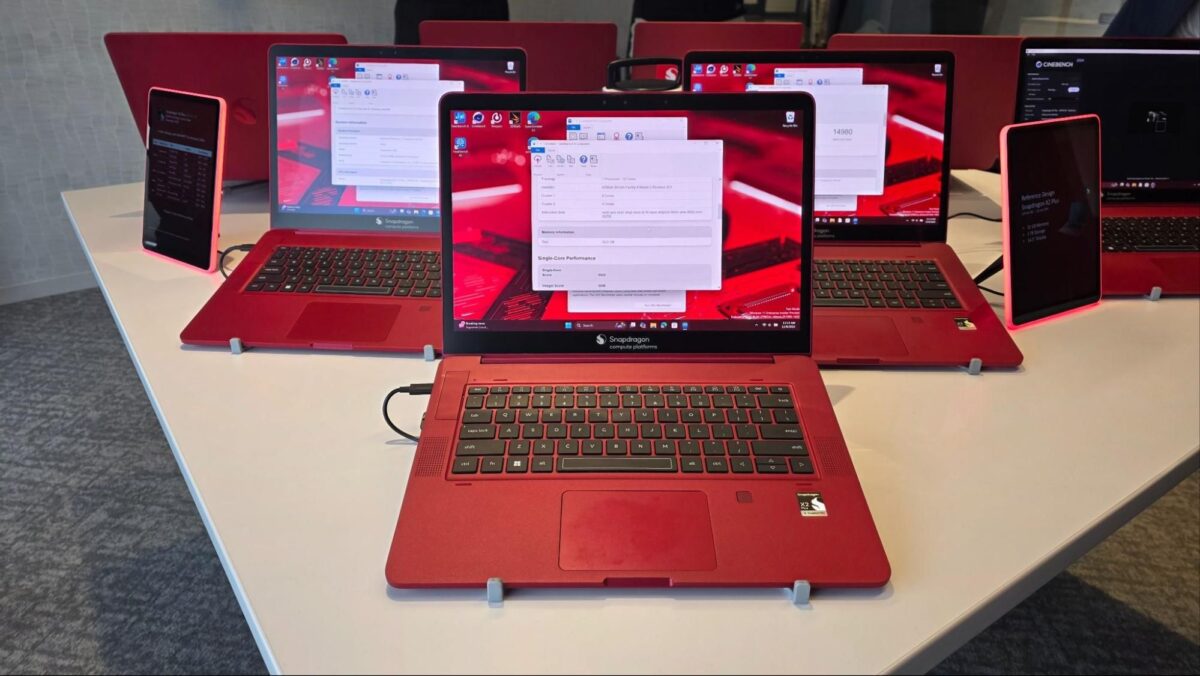
Qualcomm just dropped the mic at CES 2026. The new Snapdragon X2 Plus packs 80 TOPS of AI processing power, a 35% single-core CPU leap, and enough efficiency to push battery life past 29 hours — all targeting the $800 laptop sweet spot. If you’ve been waiting for ARM-based Windows laptops to truly compete with x86, this is the moment everything changes.
Snapdragon X2 Plus: What’s Under the Hood
Qualcomm has announced two Snapdragon X2 Plus SKUs at CES 2026, both built on a cutting-edge 3nm process node. The flagship X2P-64-100 features 10 custom cores clocked at up to 4.0 GHz with a massive 34MB cache. The more accessible X2P-42-100 trims down to 6 cores with 22MB of cache while maintaining the same 4.0 GHz peak frequency.
Both chips support LPDDR5x memory up to a staggering 128GB with 152 GB/s bandwidth — numbers that would have been reserved for workstation-class machines just two years ago. The 3nm fabrication process delivers a remarkable 43% reduction in power consumption compared to the first generation, which directly translates to the jaw-dropping battery numbers we’ll get into shortly.
The 128GB LPDDR5x ceiling deserves special attention because it fundamentally changes what a thin-and-light laptop can do. Creative professionals working with multiple 4K video timelines, developers running local Kubernetes clusters, and data scientists fine-tuning machine learning models all benefit from having workstation-class memory in a fanless ultrabook form factor. The 152 GB/s bandwidth is equally critical — when running local AI inference, the speed at which model weights can be loaded into the NPU directly impacts response latency. A 13B parameter language model, for instance, requires roughly 26GB of memory at FP16 precision. With 128GB available and 152 GB/s of bandwidth feeding the Hexagon NPU, the Snapdragon X2 Plus can load and run these models with room to spare for the operating system and other applications. Qualcomm has clearly designed the Snapdragon X2 Plus memory subsystem with AI-heavy workflows as a first-class use case, not an afterthought.
Benchmark Numbers That Speak for Themselves
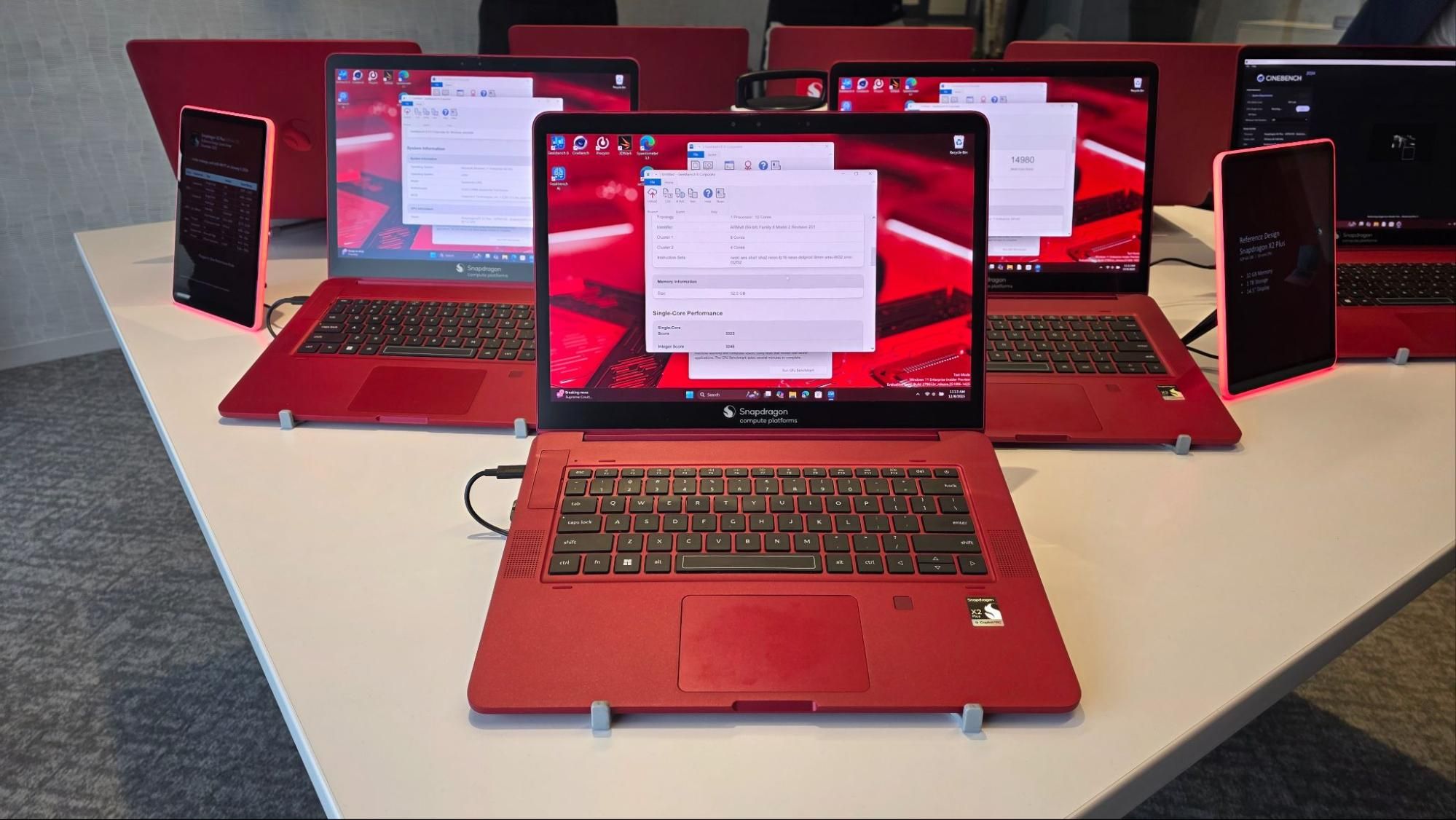
Qualcomm isn’t just talking big — the Snapdragon X2 Plus has the receipts. According to WCCFTech’s coverage, the X2P-64-100 scored 3,323 in single-core and 15,084 in multi-core on Geekbench 6.5. Those aren’t incremental improvements — they represent a generational leap.
To put those numbers in perspective, here’s how the competition stacks up:
- Intel Core Ultra 7 256V: 2,700 SC / 10,500 MC
- AMD Ryzen AI 7 350: 2,900 SC / 12,500 MC
- Snapdragon X2 Plus (X2P-64-100): 3,323 SC / 15,084 MC
That’s a 23% single-core advantage over Intel and a 15% lead over AMD. In multi-core workloads, the gap widens even further — 44% ahead of Intel’s latest and 21% ahead of AMD. For a chip targeting $800 laptops, these numbers are nothing short of extraordinary.
It’s also worth noting that these benchmarks put the Snapdragon X2 Plus in striking distance of Apple’s M3 Pro in multi-core performance, while consuming significantly less power. Apple has long been the gold standard for ARM-based laptop silicon, but Qualcomm is closing that gap faster than most analysts expected. The single-core score of 3,323 trails Apple’s M4 by a narrow margin, but the multi-core advantage of the 10-core Snapdragon X2 Plus configuration closes that gap — particularly in sustained workloads where the 3nm process and 43% power efficiency gains allow the chip to maintain peak clocks longer without thermal throttling.
The competitive picture becomes even more dramatic when you factor in NPU performance: Intel’s Core Ultra 7 256V tops out at roughly 13 TOPS, AMD’s Ryzen AI 7 350 reaches about 50 TOPS, and the Snapdragon X2 Plus doubles that at 80 TOPS. Intel’s NPU deficit is particularly stark — at just 13 TOPS, it barely meets the baseline for basic AI acceleration, let alone the sustained neural processing needed for features like real-time language translation or on-device image generation. AMD is closer with 50 TOPS, but Qualcomm’s 60% advantage still translates to noticeably faster AI task completion and the ability to run multiple AI workloads simultaneously. In an era where AI capability is increasingly the differentiator, that NPU gap matters more than a few percentage points on Geekbench.
80 TOPS NPU: Redefining What an AI PC Can Do
The headline upgrade in the Snapdragon X2 Plus is the Hexagon NPU, now pushing 80 TOPS (trillion operations per second). That’s a massive 78% jump from the first-generation Snapdragon X’s 45 TOPS — and it’s double Microsoft’s 40 TOPS threshold for Copilot+ PC certification.
What does 80 TOPS actually mean in practice? It means running large language models locally without cloud dependency. It means real-time AI-powered video editing, background noise cancellation that actually works, and intelligent OS-level features that respond instantly rather than waiting for a server round-trip. As Tom’s Hardware notes, this positions the Snapdragon X2 Plus as the most capable on-device AI processor in the mainstream laptop category.
Let’s get specific about what 80 TOPS unlocks. Microsoft’s Copilot+ PC features — including Live Captions with real-time translation across 40+ languages, Studio Effects for video calls (eye contact correction, automatic framing, background blur), and Recall — all run on the NPU. With 80 TOPS, there’s enough headroom to run all of these features simultaneously without any perceptible impact on system performance. But the implications go further. Users can run 7B to 13B parameter local LLMs entirely on-device for private, zero-latency AI assistance. AI image generation tools like Stable Diffusion can produce results in seconds rather than minutes. Real-time video filters and AI-powered photo editing become instantaneous. And because all of this processing happens locally, sensitive data never leaves the device — a significant advantage for enterprise security and personal privacy alike.
The GPU story is equally compelling. The new X2-45 Adreno GPU runs at 1.7 GHz on the 10-core model, delivering a 29% boost in graphics performance. Whether you’re doing light 3D work, video rendering, or gaming, there’s meaningfully more headroom this generation.
29-Hour Battery Life and $800 Pricing: The Mass Market Play
Performance numbers are impressive, but battery life is where the Snapdragon X2 Plus truly separates itself from the x86 competition. HP’s EliteBook X G2i, one of the first announced devices, achieves 29 hours of battery life. ASUS takes it even further with the Zenbook A16, claiming 32 hours on a single charge. These aren’t theoretical numbers from optimized lab conditions — they come from the 43% power efficiency improvement baked into the 3nm architecture.
To put 29-32 hours in real-world context, consider what this actually means for daily use. In a mixed workload of video calls, browser tabs, document editing, and occasional AI tasks, real-world battery life should comfortably exceed 15 hours. That’s enough to cover a full transatlantic flight without reaching for a charger. For college students, it means charging in the morning and making it through a full day of lectures, study sessions, and late-night assignments with battery to spare. For business travelers, the charger becomes optional for domestic trips. Compare this to Intel-based ultrabooks that typically deliver 10-14 hours, or the latest AMD offerings hovering around 16 hours, and the Snapdragon X2 Plus isn’t just an improvement — it’s a paradigm shift in how we think about laptop battery life.
But perhaps the most strategically important detail is the price target. Qualcomm is positioning the Snapdragon X2 Plus squarely at the $800 mainstream laptop segment. The first-generation Snapdragon X Elite largely appeared in $1,000+ premium machines. By pushing flagship-tier AI and CPU performance down to the $800 price point, Qualcomm is making a direct play for volume — and that’s what changes ecosystems.
OEM partners including HP, Lenovo, and ASUS have already committed to launching Snapdragon X2 Plus-powered devices in H1 2026. The pipeline is real, and the machines are coming fast.
Why CES 2026 Could Be the ARM Laptop Tipping Point
Let’s be honest — Windows on ARM has had a rocky history. App compatibility issues, underwhelming first-gen performance, and premium pricing kept it as a niche curiosity for early adopters. The Snapdragon X2 Plus addresses every single one of those pain points simultaneously.
The software ecosystem story has changed dramatically. Microsoft’s Prism emulation layer — the successor to the original x86 emulation that frustrated early Windows on ARM users — now handles the vast majority of legacy x86 applications with minimal performance overhead. More importantly, the list of native ARM64 applications has grown substantially. Adobe’s Creative Suite runs natively, Chrome has been ARM64-native for over a year, and major productivity tools like Slack, Zoom, and Microsoft 365 all ship ARM64 builds. For developers, the toolchain is equally mature: Visual Studio ships an ARM64-native build, and essential tools like Node.js, Python, Git, Docker, and WSL2 all run natively. The “app compatibility” objection that plagued the first generation has effectively been retired.
Performance? It now beats both Intel and AMD in single-core and multi-core benchmarks. Battery life? 29 to 32 hours obliterates anything the x86 world can offer. AI capability? 80 TOPS doubles the Copilot+ requirement. Price? $800 puts it in the mainstream. And with Windows on ARM app compatibility improving dramatically through Microsoft’s Prism emulation layer, the software gap has narrowed to the point of near-irrelevance for most users.
Looking at the broader CES 2026 landscape, AI PCs are the dominant theme across every major manufacturer. But while Intel and AMD are still iterating on power-hungry x86 architectures and bolting on NPUs as secondary features, Qualcomm has built the Snapdragon X2 Plus from the ground up as an AI-first processor. The Hexagon NPU isn’t an add-on — it’s a co-equal compute engine alongside the CPU and GPU, with dedicated memory pathways and power management optimized for sustained AI workloads. That architectural advantage is difficult for competitors to replicate without a fundamental redesign of their chip architectures.
For developers specifically, the Snapdragon X2 Plus represents a turning point. ARM64-native toolchains are now mature enough that building, testing, and deploying applications on a Windows on ARM machine is no longer a compromise — it’s a viable primary development environment. With Visual Studio running natively on ARM64, along with VS Code, the entire .NET stack, and containerized workflows through Docker, developers can take advantage of the superior battery life and AI capabilities without sacrificing their workflow. The 80 TOPS NPU also opens doors for on-device AI model testing and prototyping that previously required cloud GPU instances or dedicated hardware.
The Snapdragon X2 Plus isn’t just another chip announcement at CES — it’s the strongest argument yet that ARM-based Windows laptops are ready for the mainstream. When devices hit shelves in the first half of 2026, independent benchmarks and real-world reviews will tell the final story. But based on what Qualcomm has shown here in Las Vegas, the x86 duopoly should be very, very concerned.
Get weekly AI, music, and tech trends delivered to your inbox.